
SECTION 10: PRIVACY — FROM CYPHERPUNK IDEAL TO INSTITUTIONAL REQUIREMENT
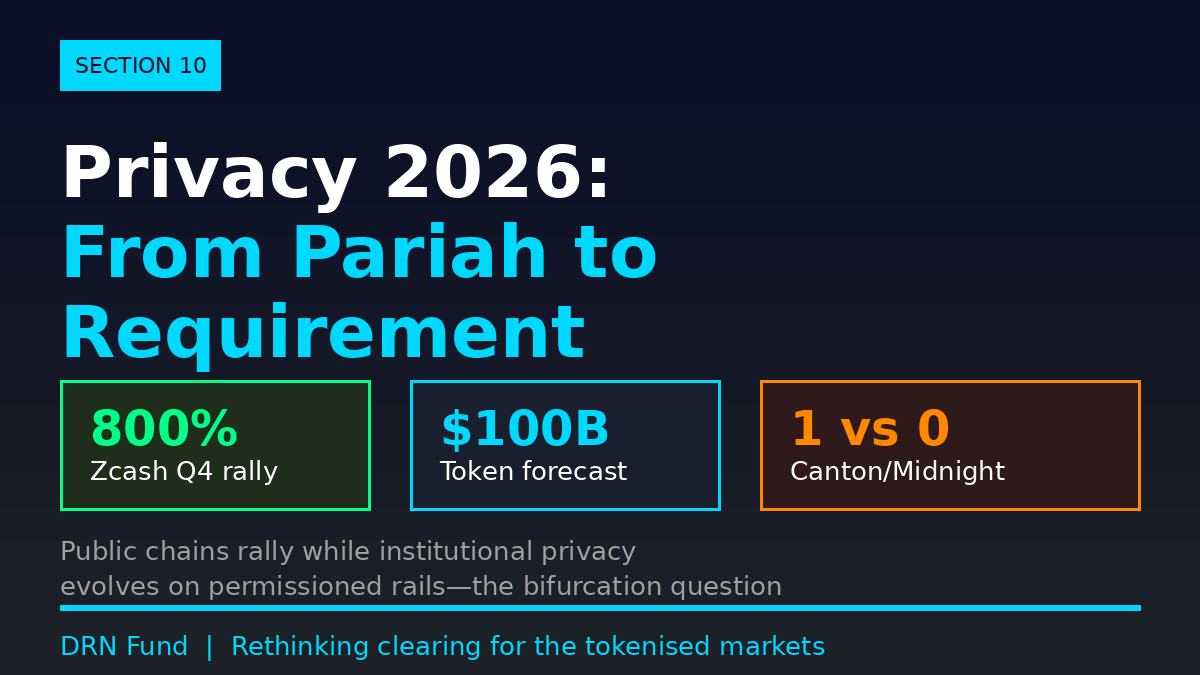
Privacy technology stands at a pivotal inflection point in 2026, transitioning from crypto's cypherpunk origins as ideological principle to institutional infrastructure as competitive necessity. Derided across regulated payments providers as a mechanic for fraudsters, its essential when you are asking regulated financial institutions to move internal private data on public blockchains.
While Bitcoin's radical transparency once seemed revolutionary—every transaction permanently recorded on a public ledger visible to all—the maturation of institutional participation has exposed a fundamental contradiction. The same transparency that builds trust in decentralized systems creates intolerable risks for institutions that cannot reveal trading strategies, portfolio positions, or treasury holdings to competitors. As Grayscale Ventures' 2026 outlook argues, "If public blockchains are going to be more deeply integrated into the financial system, they will need much more robust privacy infrastructure—and this is becoming obvious now that regulation is facilitating that integration."
Yet beneath the surface of this emerging consensus lies a profound strategic silence. The Canton Network, DTCC's choice for permissioned privacy blockchain, specifically designed for institutional securities settlement, appears exactly once across all major crypto predictions, mentioned only in Coinbase's infrastructure analysis. The Midnight Network, IOG's enterprise-focused privacy chain built on Cardano, receives zero mentions. This near-total absence from crypto venture capital forecasts suggests that institutional privacy may be evolving on permissioned rails invisible to public crypto markets, fundamentally challenging the bullish thesis that privacy token adoption will follow institutional capital inflows. This suggest that these and any other privacy L1 are fundamentally under valued.
A further question facing 2026 is whether public privacy solutions like Zcash, Railgun, and Aztec can capture institutional adoption, as they have not been institutional so far, or whether institutions will consistently choose Canton-style permissioned privacy that delivers confidentiality without exposing them to public chain risks.
A don't understand how all the professional investors can comment on privacy, but not then on the emerging privacy solution. Canton clearly has an important role to play, and deserved more attention. Midnight is based on some of the best tech design and backed by a lot of capital. Study required.
Privacy's Market Maturation: From Regulatory Pariah to Competitive Necessity
Privacy tokens endured years as regulatory targets between 2020 and 2024. Exchanges delisted Monero amid compliance concerns. Governments labeled privacy coins as money laundering tools. Tornado Cash developers faced criminal charges. Yet by late 2025, the narrative had fundamentally shifted. Galaxy Research (December 2025) reports that during Q4 2025, Zcash rallied approximately 800%, Railgun gained 204%, and even Monero—the pure privacy chain facing the most regulatory pressure—appreciated 53%. Galaxy boldly predicts that "the combined market cap of privacy tokens will exceed $100 billion" in 2026, representing a validation of privacy not as criminal infrastructure but as essential financial technology.
This revaluation reflects a deeper understanding among institutional participants that privacy is not about hiding from regulators but about maintaining competitive advantages in transparent markets. Coinbase's 2026 outlook explains that "the necessity for privacy stems from both professionals and individuals: institutional and professional retail traders require confidentiality to prevent competitors from exploiting their strategies, while everyday users are generally unwilling to expose their complete financial history on the blockchain." When a hedge fund executes a multi-million dollar position on a transparent blockchain, every transaction is visible to sophisticated competitors who can front-run trades or reverse-engineer strategies. When a corporate treasury holds digital assets, competitors can monitor balance sheet positions in real-time. This competitive intelligence problem makes privacy a requirement, not a preference.
Grayscale identifies privacy as Theme #5 in its 2026 outlook, stating that "privacy is a normal part of the financial system: almost everyone has an expectation that their paychecks, taxes, net worth, and spending habits will not be visible on a public ledger." The firm specifically highlights relevant crypto assets as ZEC (Zcash), AZTEC (Aztec Protocol), and RAIL (Railgun), signaling institutional confidence in both privacy-native chains and privacy-as-a-service middleware. [Which also makes the lack of mention of Canton incomprehensible]. Coinbase reports that "the number of shielded transactions has recently reached new cycle highs," indicating that privacy adoption has moved beyond speculative token price appreciation to actual on-chain usage.
Why Institutions Need Transaction Privacy: Trade Confidentiality vs Regulatory Transparency
The institutional privacy requirement stems from a fundamental distinction that crypto builders sometimes miss: regulatory transparency to authorities differs entirely from market privacy from competitors. Institutions need to prove compliance to regulators through selective disclosure mechanisms while simultaneously keeping trade data confidential from market participants who could exploit that information. Tiger Research Inc.'s 2026 predictions articulate this clearly: "Chain transparency reveals trade plans. This is a weakness for large firms. High-net-worth players must hide their moves to stay safe."
Consider the specific use cases driving institutional privacy demand.
First, front-running protection for large trades requires obscuring transaction details until settlement completes. When an institution places a significant order on a transparent blockchain, MEV (maximal extractable value) bots and sophisticated traders can detect the pending transaction and execute competing orders that extract value at the institution's expense. Privacy-preserving transaction pools prevent this exploitation.
Second, competitive intelligence concerns make balance sheet privacy essential. If a rival firm can monitor a competitor's real-time holdings, token accumulation patterns, and trading activity, they gain strategic advantages in negotiations, market positioning, and investment decisions.
Third, RWA (real-world asset) trading privacy becomes critical as institutional securities move on-chain. Which pension fund holds which tokenized Treasury bonds? Which endowment accumulated which real estate tokens? This information has profound competitive and strategic implications.
Fourth, DeFi participation without full portfolio exposure enables institutions to access decentralized lending, yield protocols, and liquidity pools without revealing complete position sizing to competitors. Fifth, corporate treasury management requires privacy—publicly traded companies do not want shareholders, competitors, or activists monitoring every digital asset transaction the treasury executes.
Our observation: The institutional privacy requirement extends beyond spot trading to derivatives markets, where privacy needs are structurally different and more complex. Spot transactions can use privacy pools with delayed settlement, shielding the trade for hours or days before final on-chain settlement. Derivatives clearing requires real-time privacy with continuous risk calculation: counterparties' positions change every second as markets move, margin requirements update dynamically, and default fund exposures shift.
This creates architectural challenges public privacy chains haven't solved. Derivatives clearing infrastructure needs to calculate portfolio-level risk across counterparties in real-time while maintaining transaction privacy.
Traditional derivatives clearinghouses solve this through known counterparties and permissioned access, risk managers have visibility into positions for margining purposes while market participants don't see competitors' positions. Replicating this on public privacy chains requires selective disclosure at operational speed (sub-second risk calculations) with legal enforceability across jurisdictions. Zero-knowledge proofs can prove compliance, but can they prove solvency for real-time margin calls? Can they enable liquidation auctions without revealing position details? These are clearing infrastructure questions that privacy token discussions typically ignore. Lot's of questions that are just ignored as future issues that turn out to be unsolvable for most crypto exchanges. All the realistic solutions are hybrid on and off-chain.
Coinbase emphasizes that institutional privacy needs extend beyond professional traders to the fundamental architecture of institutional finance. The report notes that "growing global awareness of digital surveillance and data exploitation has raised the profile of privacy-first payment solutions," describing how "technologies like zero-knowledge proofs (ZKPs)—specifically zkSNARKs and STARKs—and fully homomorphic encryption (FHE) are becoming the cornerstones of this evolution. ZKPs allow users to prove the validity of a transaction without revealing any underlying data, such as the sender, recipient, or amount."
The critical distinction that makes privacy compatible with regulation is that privacy technologies enable selective disclosure. An institution can prove to a regulator that it complied with KYC requirements, paid appropriate taxes, and followed travel rules without revealing trade details to the market. Zero-knowledge proofs mathematically verify compliance conditions without exposing underlying transaction data. This represents privacy at the edges (exchanges, onramps, offramps requiring KYC) with confidentiality in the middle (on-chain transactions invisible to competitors), a model that satisfies both institutional needs and regulatory requirements.
Privacy Technology Landscape: Grayscale's Infrastructure Analysis
Grayscale's comprehensive privacy assessment identifies multiple technology pathways for achieving transaction confidentiality, ranging from privacy-native Layer 1 blockchains to privacy middleware for existing DeFi ecosystems to upcoming privacy features on major smart contract platforms. The diversity of approaches reflects both the technical complexity of cryptographic privacy and the varied requirements of different institutional use cases.
Zcash (ZEC) represents the foundational privacy-native cryptocurrency, offering optional shielded transactions through zkSNARK cryptography. Users can choose between transparent addresses (similar to Bitcoin's public ledger model) and shielded addresses where transaction amounts, senders, and receivers remain confidential. Grayscale notes that Zcash appreciated sharply in Q4 2025, reflecting growing recognition that privacy-preserving digital currency serves institutional needs that transparent alternatives cannot satisfy. Zcash's optional privacy model allows regulatory compliance at onramps while enabling confidential value transfer within shielded pools.
Aztec Protocol emerges in Grayscale's analysis as a privacy-focused Ethereum Layer 2, bringing confidential smart contract execution to the Ethereum ecosystem. Unlike Zcash's focus on currency transactions, Aztec enables private DeFi applications where users can interact with lending protocols, DEXs, and yield products without revealing position sizes, trading strategies, or portfolio composition. This represents a significant architectural advancement, privacy not just for transfers but for complex financial operations.
Railgun receives particular attention as privacy middleware for DeFi, providing a privacy layer that works across multiple blockchains and DeFi protocols. Railgun's approach allows users to shield existing DeFi positions and execute transactions within a private pool before revealing final settlement on-chain. This middleware model addresses a critical adoption barrier: institutions don't need entirely new privacy-native chains or applications; they can add privacy to existing DeFi infrastructure they already use. Galaxy's data showing Railgun gaining 204% in Q4 2025 suggests market validation of this privacy-as-a-service approach.
Beyond dedicated privacy projects, Grayscale highlights native privacy features coming to leading smart contract platforms. ERC-7984 proposes bringing confidential transactions directly to Ethereum mainnet, potentially eliminating the need for separate privacy layers or L2s for certain use cases. Solana is implementing Confidential Transfers as token extensions, enabling native privacy for SPL tokens without requiring separate privacy coins or protocols. These developments suggest that privacy may transition from specialized protocols to standard features across general-purpose blockchains.
Grayscale cautions that "improved privacy tools may also require better identity and compliance infrastructure for DeFi," acknowledging that privacy technology alone does not solve regulatory requirements. The successful privacy solutions of 2026 will integrate cryptographic confidentiality with compliance mechanisms that satisfy Know Your Customer (KYC), Anti-Money Laundering (AML), and Travel Rule obligations.
TigerResearch: Privacy as Standard Infrastructure
While Grayscale provides the technical privacy landscape, TigerResearch's December 2025 predictions deliver the institutional adoption thesis. The firm makes privacy its 10th and final key prediction for 2026 under the heading "Privacy Tech as Core Institutional Infrastructure," stating explicitly: "Privacy tools will become essential for institutional participation." This represents a categorical shift from privacy as optional feature to privacy as mandatory infrastructure.
TigerResearch's reasoning centers on competitive dynamics: "Chain transparency reveals trade plans. This is a weakness for large firms. High-net-worth players must hide their moves to stay safe. Privacy tech is a vital tool for these firms to join the market. Big capital will only flow in if trade data is secure." The firm predicts that institutions will demand privacy-preserving solutions as a precondition for deploying capital at scale, making privacy technology a gating factor for the institutional adoption wave that dominates other 2026 predictions.
The culmination of TigerResearch's privacy thesis appears in their final assessment: "Expect privacy-focused solutions to become standard infrastructure rather than optional features." This framing aligns privacy with other essential blockchain infrastructure layers, oracles, bridges, custody solutions, that enable institutional participation. Just as institutions require secure custody solutions before holding digital assets, they require privacy solutions before trading those assets at scale on transparent blockchains.
TigerResearch's prediction gains credibility from their broader 2026 framework emphasizing the transition "from speculation to sustainability," where "real revenue, sustainable business models, and institutional-grade infrastructure will dominate." Privacy fits naturally into this narrative as the infrastructure component that makes blockchain transparent enough for regulatory oversight yet confidential enough for competitive markets.
a16z: Privacy as Competitive Moat and Chain Lock-In
While Grayscale focuses on privacy technology and TigerResearch emphasizes institutional adoption, a16z crypto's 2026 outlook examines privacy's strategic implications for blockchain competitive dynamics. In a section titled "Privacy Will Be the Most Important Moat in Crypto," general partner Ali Yahya argues that "privacy is the one feature that's critical for the world's finance to move onchain. It's also the one feature that's hardest to bridge between chains."
Yahya's insight centers on network effects and switching costs. He explains that "privacy by itself is sufficiently compelling to differentiate a chain from all the rest. Privacy creates chain lock-in." The technical reasoning is straightforward: "Thanks to bridging protocols, it's trivial to move from one chain to another as long as everything is transparent. But bridging secrets is hard." When users establish privacy on one blockchain, shielding assets, creating confidential positions, building privacy-preserving applications, migrating to another chain requires either revealing the private state (defeating the purpose of privacy) or developing complex cross-chain privacy protocols that maintain confidentiality during migration.
This technical difficulty creates powerful competitive moats. Yahya argues that "compared to undifferentiated new chains where fees will likely be driven to zero by competition, privacy chains can maintain pricing power and user stickiness." Blockchains that successfully implement privacy infrastructure can charge higher fees and retain users because the cost and risk of migrating to competing chains exceeds the benefit of lower transaction costs. Privacy becomes a "most important moat" because it creates sustainable competitive advantages in an industry where most technical features can be rapidly copied or bridged.
The strategic implication extends beyond individual chains to entire ecosystems. If Ethereum achieves superior privacy through ERC-7984 and privacy L2s like Aztec, DeFi applications and institutional users might concentrate on Ethereum despite higher base layer costs. If Solana's Confidential Transfers prove faster and cheaper, privacy-sensitive applications might migrate there despite Ethereum's network effects. Privacy could become the determining factor in long-term blockchain market share, particularly for institutional use cases where confidentiality is non-negotiable.
Secrets-as-a-Service and Privacy Middleware
Beyond transaction privacy, a16z identifies an emerging category called "secrets-as-a-service" that extends privacy concepts to data, AI agents, and automated systems. Adeniyi Abiodun, chief product officer and co-founder of Mysten Labs, frames the challenge: "Behind every model, agent, and automation lies a simple dependency: data. But most data pipelines today are built for centralized extraction, sending data to the cloud, processing it, and shipping results back." This centralized model contradicts crypto's decentralization principles while creating privacy vulnerabilities.
Abiodun asks: "So how do we preserve privacy while enabling innovation that is safe, compliant, autonomous, and global? Without data access controls, anyone who wants to keep data confidential currently has to use a centralized solution or avoid the benefits of automation and AI." His answer: "That's why we need secrets-as-a-service: New technologies that can provide programmable, non-interactive zero-knowledge proofs and secure enclaves."
This concept directly connects to Section 1's analysis of AI agents entering crypto markets. Autonomous agents require confidential state, trading strategies, portfolio positions, private keys, algorithm parameters, that cannot be exposed on transparent blockchains. Secrets-as-a-service infrastructure would enable agents to maintain privacy while operating autonomously on-chain, proving computational integrity through zero-knowledge proofs without revealing underlying logic. The social media predictions explicitly note that "increased demand for AI agents will give rise to increased demand in security, privacy, verification, and transparency," connecting agent proliferation to privacy infrastructure needs.
Privacy middleware extends beyond individual transactions to entire application stacks. Secret Network pioneered confidential smart contracts where contract state and execution remain private. Oasis Protocol developed privacy-preserving computation using trusted execution environments (TEEs). These approaches enable private order books for DEXs (where trade orders remain confidential until execution), sealed-bid auctions for NFTs or RWA tokens, and confidential voting mechanisms for governance. Bankless notes that "privacy and security becoming baseline requirements" for 2026, suggesting that privacy features will be expected rather than exceptional across crypto applications.
Social media predictions indicate that market participants expect "ready-made 'Privacy-as-a-Service' solutions will emerge, especially for the corporate sector, along with a unified Dev-Ex for privacy (a developer interface)." This forecast suggests that privacy technology in 2026 will move beyond specialized implementations requiring deep cryptographic expertise toward standardized toolkits and APIs that any developer can integrate, similar to how cloud infrastructure abstracted complex distributed systems into simple service calls.
Our take: This all feels super optomistic, super complex behaviours are not going to happen fully on chain, trust and reliability for transactions or billions can be communicated across chain but not with all the assets fully on chain. Defi will not be the centre of complex behaviours, it will be around this and serving related purpose, but the attack surface and trust for complex transactions on-chain is years away. This will be hybrid, on-chain for comms, trade forming and for collateral, but not for complex processing. L1 privacy like Canton seems more aligned than the suggestions here.
Privacy vs Regulatory Compliance: Selective Disclosure and Zero-Knowledge Proofs
The tension between privacy and regulatory compliance represents perhaps the most critical challenge for institutional privacy adoption. Regulators worldwide require transaction reporting, KYC verification, AML monitoring, and Travel Rule compliance for cross-border transfers. Privacy technologies that completely obscure transaction details would seem incompatible with these obligations, creating an apparent contradiction: institutions need privacy from competitors but transparency to regulators.
Zero-knowledge proofs offer a mathematical solution to this apparent contradiction through selective disclosure. A zero-knowledge proof allows one party to prove to another that a statement is true without revealing any information beyond the validity of the statement itself. Applied to financial compliance, an institution could prove to a regulator that a transaction satisfied KYC requirements, originated from a non-sanctioned address, and complied with local tax obligations without revealing the transaction amount, counterparty identity, or trading strategy to anyone else.
Coinbase Institutional's analysis explains how privacy technologies achieve regulatory compatibility: "ZKPs allow users to prove the validity of a transaction without revealing any underlying data, such as the sender, recipient, or amount." This capability enables a compliance model where KYC occurs at the edges, when users onramp through exchanges or offramps to bank accounts, while privacy persists in the middle during on-chain activity. Regulators receive cryptographic proofs of compliance without accessing the underlying financial data that competitors could exploit.
The regulatory landscape for privacy technology remains fragmented. Coinbase notes that while "some investors see this theme growing ahead of the European Union's implementation of stricter KYC and transaction-monitoring rules, though the EU will prohibit privacy coins and anonymous or self-custodied crypto wallets starting from July 2027." This creates a jurisdictional split where privacy solutions must navigate different regulatory frameworks, potentially succeeding in crypto-friendly jurisdictions while facing prohibition in others.
Our observation: Regulatory compliance requirements for derivatives clearing exceed spot transaction requirements. Derivatives clearinghouses must demonstrate regulatory capital adequacy, maintain default fund contributions, satisfy cross-border bankruptcy enforceability, and provide real-time risk reporting to regulators. Zero-knowledge proofs that work for spot transaction compliance (prove KYC, prove non-sanctioned address) don't automatically satisfy derivatives clearing obligations (prove real-time solvency, prove portfolio risk calculations, prove default fund adequacy). This compliance gap may drive institutional derivatives toward permissioned privacy infrastructure where regulatory reporting is built into architecture rather than bolted on through cryptographic proofs.
The Ethereum Foundation's establishment of the Privacy Cluster, mentioned in Coinbase's report, signals that major blockchain ecosystems recognize privacy as essential infrastructure requiring dedicated development resources. Yet regulatory acceptance remains uncertain. The challenge for 2026 is whether privacy technologies can mature fast enough to satisfy both institutional confidentiality needs and regulatory transparency requirements, or whether regulatory hostility in key jurisdictions will force institutions toward permissioned privacy solutions outside public blockchains.
Canton Network and Institutional Privacy Silence: The Critical Bifurcation
The near-total absence of Canton Network from crypto predictions reveals a potentially fundamental bifurcation in institutional privacy strategies. Canton appears exactly once across all major 2026 forecasts from crypto VCs, institutional analysts, and industry observers: in Coinbase's infrastructure analysis, which notes that "Projects such as Canton are engineering private, permissioned environments specifically designed to unlock the trillions of dollars in institutional capital tied up in asset tokenization and securities trading." The Midnight Network, IOG's enterprise privacy blockchain built on Cardano and specifically designed for institutional privacy needs, receives zero mentions in any prediction document.
This silence is not incidental but strategically revealing. Canton Network is backed by DTCC (Depository Trust & Clearing Corporation), the infrastructure provider that settles the majority of U.S. securities transactions. Canton uses Digital Asset's Daml smart contract language to create permissioned private ledgers where institutional counterparties can settle securities with transaction confidentiality, regulatory compliance, and interoperability between different institutions' private ledgers. Canton directly addresses the institutional privacy problem that Grayscale, TigerResearch, and a16z identify as critical for 2026 adoption.
It isn't clear why crypto venture capital firms analyzing privacy largely ignore Canton. Galaxy predicts $100 billion market caps for privacy tokens like Zcash, Railgun, and Monero. Grayscale highlights Aztec Protocol and ERC-7984 for Ethereum. a16z discusses privacy as a competitive moat for blockchains. None analyze whether institutional privacy needs will be met by public privacy chains (Zcash model) or what amounts to permissioned privacy networks (Canton model). This omission suggests four possible interpretations, each with profound implications for crypto market structure.
Parallel Evolution Hypothesis: Institutional privacy may be evolving on permissioned rails like Canton that operate parallel to public crypto markets without connecting to them. DTCC's institutional clients, banks, broker-dealers, custodians, may adopt Canton for regulated securities settlement while remaining entirely separate from public DeFi, privacy tokens, and the blockchain ecosystems that crypto VCs analyze. In this interpretation, crypto VCs ignore Canton not because it's irrelevant but because it's outside their investment thesis. Permissioned institutional networks don't create token value capture opportunities or retail market participation, making them strategically uninteresting to venture investors even if they achieve massive institutional adoption. We don't agree that this is what Canton is, but it certainly gets cast as that.
Value Capture Disconnect: Privacy adoption on Canton may not drive value to crypto tokens that VCs hold. If institutions settle trillions of dollars in securities on Canton with full transaction privacy, no value accrues to ZEC, RAIL, or AZTEC tokens. This creates a fundamental misalignment: crypto VCs need institutional privacy to drive adoption of public privacy chains where their investments capture value, but institutions may choose solutions where value accrues to outside of their core long term investments rather than decentralized protocols and tokens. Essentially they were wrong but still think they can make their investments count.
Technology Maturity Gap: Public privacy solutions like Zcash, Railgun, and Aztec may not yet be ready for institutional adoption, while Canton serve near-term institutional needs. Public privacy chains face technical challenges, transaction throughput limitations with privacy proofs, regulatory uncertainty about compliance compatibility, audit difficulties with fully shielded pools. Canton solves these problems through: known counterparties simplify compliance, consortium governance reduces regulatory uncertainty, private ledgers avoid public chain technical constraints. In this interpretation, public privacy is aspirational (where crypto will be in 2-5 years) while permissioned privacy is operational (where institutions will actually go in 2026).
Regulatory Reality Check: Institutions may always choose permissioned privacy over public privacy regardless of technical maturity, driven by regulatory and risk management requirements. Regulatory compliance is simpler with known counterparties in permissioned systems. Audit requirements are easier to satisfy when authorities have permissioned access rather than relying on zero-knowledge proofs. Regulatory uncertainty is lower with consortium governance where institutions collectively manage the network. Token volatility risk is eliminated with permissioned chains that don't require native cryptocurrencies. In this pessimistic interpretation for public privacy advocates, the entire thesis that institutions will adopt Zcash, Railgun, and Aztec as they enter crypto markets may be undermined by a revealed preference for Canton-style permissioned privacy.
The strategic implication is profound. If institutional privacy needs are predominantly met by Canton and similar approaches (like Midnight, despite its absence from predictions), the value capture from institutional privacy adoption flows to enterprise software companies and what is viewed to be a permissioned network rather than public privacy. The bullish case for privacy tokens, that institutional capital inflows will drive demand for privacy solutions, depends critically on institutions choosing incumbent public privacy chains. If institutions systematically prefer Canton style privacy, ZEC, RAIL, and similar tokens might appreciate based on retail privacy demand and ideological commitment to decentralization, but would miss the massive capital flows from institutional adoption.
The bull case for public privacy chains requires believing either that Canton-style networks will build "production bridges into public DeFi" (as Galaxy predicts for corporate L1s more broadly), enabling hybrid models where institutions get Canton's regulatory comfort while accessing public DeFi's liquidity and composability, or that public privacy technology will mature sufficiently by 2026-2027 to satisfy institutional requirements, making canton style solutions transitional rather than permanent institutional infrastructure.
The bear case suggests that institutional privacy and crypto privacy remain separate ecosystems with zero convergence in 2026. Institutions use Canton and similar permissioned networks for securities settlement, RWA trading, and regulated DeFi. Retail users use Zcash, Monero, and Railgun for personal privacy and censorship resistance. The institutional capital wave driving 2026 crypto predictions flows through permissioned privacy infrastructure invisible to crypto VCs analyzing public chains, fundamentally limiting the addressable market for privacy tokens. It is hard to bet against the first mover advantage that Canton has here.
Privacy as Competitive Moat and Chain Lock-In: Network Effects and Migration Costs
a16z's analysis of privacy as competitive moat extends beyond individual technology choices to fundamental market structure questions. Privacy creates unusual network effects where the value of privacy increases with the size of the anonymity set, the pool of users and transactions that obscure any individual transaction. A privacy chain with ten users provides minimal confidentiality since transaction patterns remain traceable. A privacy chain with one million users creates substantial anonymity where individual transactions become indistinguishable from the crowd.
This dynamic creates powerful first-mover advantages for privacy implementations. The first blockchain to achieve strong privacy with a large user base becomes difficult to displace even if competitors offer superior technical privacy because migrating would require rebuilding the anonymity set from scratch. Users considering migration face a dilemma: move to a better privacy chain with few users (weak anonymity) or remain on an established privacy chain with adequate technology but strong anonymity set (better practical privacy).
Privacy also requires ecosystem coordination that creates technical lock-in. Wallets must support privacy protocols. DEXs must integrate private order submission. Lending protocols must handle shielded collateral. Block explorers must respect privacy while providing useful analytics. Once an ecosystem builds privacy support around one blockchain or protocol, migrating to an alternative privacy solution requires rebuilding that entire stack of infrastructure and applications. This switching cost deters users even when alternative privacy technologies offer marginal improvements.
The fragmentation risk that a16z implies is substantial. If Ethereum builds privacy through ERC-7984 and Aztec L2, Solana through Confidential Transfers, and independent chains like Zcash through shielded pools, privacy becomes fragmented across incompatible implementations. Cross-chain privacy—sending value privately from Ethereum to Solana, or from Zcash to Railgun—requires complex cryptographic protocols that maintain confidentiality across different privacy systems. The absence of such protocols fragments liquidity and limits network effects, potentially allowing each privacy implementation to capture only a portion of the total institutional privacy demand.
The competitive implication is that privacy could determine long-term blockchain market share in ways that other technical features cannot. Throughput, transaction costs, and even decentralization metrics can be copied or approximated by competing chains. Privacy, once established with strong network effects and ecosystem integration, creates sustainable differentiation. This explains why a16z frames privacy as "the most important moat"—in a market where most technical advantages erode quickly through competition and bridging, privacy's difficulty of migration creates lasting competitive barriers.
Our view: The "privacy as moat" thesis applies more strongly to derivatives than spot markets. Spot transactions can be privacy-wrapped and bridged across chains with manageable complexity. Derivatives positions require continuous state management, daily margin calls, portfolio risk calculations, collateral substitutions, position amendments. Moving a derivatives book from one privacy chain to another means either: (1) revealing all positions during migration (defeating privacy), or (2) implementing cross-chain privacy protocols that maintain confidentiality for complex stateful positions.
This complexity explains why traditional derivatives markets remain highly concentrated in established clearinghouses (CME, ICE, LCH) despite technological advances. It's not that settlement infrastructure can't be improved, it's that the operational relationships, legal frameworks, and credit networks around derivatives clearing create switching costs that settlement technology alone doesn't overcome. If privacy creates similar lock-in for blockchain-based derivatives, first movers who solve institutional derivatives privacy could entrench dominance.
The Canton model suggests institutions may avoid this lock-in problem entirely by choosing permissioned privacy infrastructure with consortium governance. Rather than committing to one public privacy chain and accepting lock-in risk, institutions could use permissioned networks where governance ensures interoperability between institutions' private ledgers. This is why Canton uses Daml, designed specifically for interoperability between different institutions' private ledgers while maintaining confidentiality. If this architectural approach proves dominant for derivatives, the "privacy moat" may accrue to Canton style approaches rather than public privacy chains.
Contrarian Privacy Views: Limitations and Skeptical Perspectives
Despite institutional enthusiasm and substantial price appreciation for privacy tokens in late 2025, several contrarian perspectives challenge the bullish privacy narrative. These skeptical views deserve attention because they identify genuine technical, regulatory, and adoption risks that could prevent privacy from becoming the standard infrastructure that optimists predict.
Performance problems plague privacy technology. Zero-knowledge proofs require substantial computational resources to generate, making privacy transactions slower and more expensive than transparent alternatives. Zcash's shielded transactions process at lower throughput than transparent Bitcoin transactions. Privacy L2s like Aztec face proving time constraints that limit transaction speed. For high-frequency trading or large-volume payment processing, these performance penalties may be prohibitive, relegating privacy solutions to smaller use cases where confidentiality justifies the cost and latency trade-offs.
Our note: Performance constraints are particularly binding for derivatives markets requiring real-time risk calculation across thousands of positions. Derivatives clearinghouses recalculate margin requirements every time markets move, typically milliseconds to seconds. Privacy technologies requiring seconds of proving time per transaction become unusable for derivatives clearing where risk calculations must complete faster than market movements. This supports the on/off chain hybrid approach.
Regulatory risk persists despite recent optimism. The European Union's July 2027 prohibition on privacy coins and anonymous wallets, noted in Coinbase's analysis, demonstrates that major jurisdictions may remain hostile to privacy technology. The U.S. regulatory stance remains uncertain, with historical actions against Tornado Cash developers creating precedent for potential enforcement. Social media predictions note concerns about "U.S. chokepoints on BTC/privacy," suggesting that regulatory crackdowns could still materialize. If major financial centers prohibit privacy tokens or refuse to license exchanges offering privacy features, institutional adoption becomes impossible regardless of technical capabilities.
Our perspective: The Canton silence is particularly revealing for derivatives markets. Canton's architecture, permissioned ledgers with configurable privacy using Digital Asset's Daml, specifically enables the operational requirements derivatives clearing infrastructure demands: continuous risk calculation with selective visibility, auction mechanics with information control, cross-jurisdictional legal enforceability with privacy preservation.
DTCC's backing isn't incidental, DTCC operates the infrastructure for settling virtually all U.S. securities transactions and deeply understands clearing mechanics, default management, and regulatory requirements. Canton was designed from first principles to handle institutional securities settlement with the privacy, legal recourse, and operational characteristics traditional clearinghouses provide. Public privacy chains were designed to enable censorship-resistant payments with transaction confidentiality, fundamentally different design constraints.
The strategic question isn't whether Canton offers "better" privacy than Zcash from a cryptographic perspective. It's whether institutional derivatives clearing will require the specific combination of privacy, legal enforceability, regulatory compliance, and operational characteristics that Canton provides. If derivatives clearing for tokenized securities happens primarily on Canton-like networks rather than public privacy chains, the massive derivatives volume that dwarfs spot trading never flows through Zcash, Railgun, or Aztec.
Derivatives represent 70% of crypto trading volume but crypto VCs analyzing privacy focus exclusively on spot transaction privacy. This suggests either: (1) they believe derivatives will migrate to public privacy chains once technology matures, or (2) they've accepted that derivatives clearing remains on traditional or permissioned infrastructure where crypto can't capture value. The complete absence of derivatives clearing considerations in privacy predictions points toward the latter, institutional derivatives may remain outside public crypto privacy infrastructure entirely. Which is odd because derivatives trading is 70% of the total fees spent in all of crypto. 5 times the amount spent on stablecoin.
Illicit finance concerns create legitimate compliance risks for institutions. Privacy technology does enable sanctions evasion, money laundering, and other illicit activities, regardless of whether those use cases represent the majority of activity. Institutions with fiduciary duties and regulatory obligations may determine that association with privacy technology creates unacceptable reputational and legal risks, even if the technology itself is neutral. This creates a catch-22: privacy tokens need institutional legitimacy to achieve mainstream adoption, but institutional adoption may be blocked by lingering illicit finance associations.
Audit incompatibility represents a deeper technical challenge. True cryptographic privacy makes auditing mathematically impossible, if transaction data is provably hidden, auditors cannot verify it. Institutions require regular audits of holdings, transactions, and compliance procedures. The solution, selective disclosure through zero-knowledge proofs that reveal information to auditors while hiding it from others, adds technical complexity and still requires auditors to trust the cryptographic proof system rather than directly verifying transaction records. Many institutional audit frameworks may not accept zero-knowledge proofs as adequate evidence, preferring traditional verification methods.
Security theater concerns question whether existing privacy solutions provide meaningful confidentiality. Privacy implementations often have subtle weaknesses: metadata leakage that reveals transaction timing and patterns, incomplete anonymity sets that allow statistical analysis to identify users, side-channel attacks that exploit implementation details rather than cryptographic primitives. If sophisticated adversaries (nation-states, intelligence agencies, well-funded competitors) can defeat privacy guarantees in practice despite theoretical confidentiality, institutions may determine that privacy solutions provide false confidence rather than genuine protection.
Most fundamentally, demand uncertainty challenges the entire institutional privacy thesis. Institutions have operated quite successfully on transparent blockchains to date. Public Ethereum DeFi has processed billions in institutional transactions without widespread complaints about front-running or competitive intelligence leaks. Corporate treasuries have held digital assets on transparent chains without apparent harm. Perhaps institutions don't actually need transaction privacy at the scale that privacy advocates assume. The gap between theoretical privacy requirements and revealed institutional preferences may be substantial, limiting privacy adoption to niche use cases rather than becoming standard infrastructure.
The social media predictions capture this uncertainty in noting that "privacy had regulatory headwinds" as a challenge, while acknowledging privacy's potential. The contrarian view suggests that 2026 may reveal that privacy remains a specialized feature for specific high-sensitivity use cases rather than achieving the universal adoption that TigerResearch and Grayscale predict.
Synthesis: Public Chains, Permissioned Networks, and the Privacy Bifurcation
The 2026 privacy landscape reveals both strong consensus and profound divergence among institutional analysts. The consensus is clear: institutions need some form of transaction privacy to participate fully in blockchain-based finance. The reasons are compelling—front-running protection, competitive intelligence concerns, treasury privacy, RWA confidentiality. No serious analyst disputes that transparent blockchains create problems for institutional participation at scale.
The divergence lies in which privacy solutions institutions will actually adopt. Crypto-native VCs emphasize public privacy chains: Galaxy predicts $100 billion market caps for privacy tokens including Zcash (up 800% in Q4 2025), Railgun (up 204%), and Monero (up 53%). Grayscale highlights Aztec Protocol, Railgun, ERC-7984 for Ethereum, and Solana Confidential Transfers. a16z frames privacy as the most important competitive moat for blockchains. These predictions implicitly assume that institutional privacy needs will drive adoption of public privacy solutions where crypto investors capture value through token appreciation and network effects.
Yet Canton Network's near-total absence from these predictions, one mention across all major forecasts, zero from crypto VCs, reveals a potentially opposite trajectory. Their blockchain serves exactly the institutional privacy use case that Grayscale and TigerResearch identify as critical: securities settlement with transaction confidentiality and regulatory compliance. Canton demonstrates that institutional privacy is already being built, but on permissioned infrastructure that isn't the same as the largest blockchains that operate parallel to public crypto markets rather than integrating with them.
The strategic uncertainty confronting 2026 is whether these parallel paths converge or remain separate. The convergence scenario requires either public privacy chains achieving institutional-grade compliance, performance, and regulatory clarity, or networks like Canton building bridges to public DeFi that allow institutions to access both regulatory comfort and decentralized liquidity. Galaxy's prediction that corporate L1s will have "production bridges into public DeFi" by year-end 2026 suggests this convergence path is foreseen, though no route is suggested.
The bifurcation scenario sees institutional privacy and crypto privacy remaining separate ecosystems. Institutions use Canton-style networks for regulated use cases. Retail users and crypto-native participants use Zcash, Railgun, and Aztec for censorship-resistant privacy. The institutional capital wave that dominates Section 6's adoption predictions flows through permissioned privacy infrastructure where crypto token holders capture minimal value. Privacy tokens appreciate based on retail demand and ideological commitment but miss the massive value creation from institutional adoption.
TigerResearch's prediction that privacy tools will "become standard infrastructure rather than optional features" may prove correct while still missing where that infrastructure gets built. If permissioned privacy infrastructure (Canton, Midnight, other enterprise solutions) becomes standard for institutions while public privacy chains (Zcash, Railgun, Aztec) serve retail markets, privacy achieves infrastructure status without delivering the token value appreciation that Galaxy predicts and crypto VCs expect.
The regulatory variable remains critical. Jurisdictions that accept privacy technology enable both public and permissioned privacy solutions. Jurisdictions that prohibit privacy coins force institutional adoption toward permissioned alternatives regardless of technical preferences. The European Union's 2027 privacy coin prohibition mentioned in Coinbase's analysis represents one data point; U.S. regulatory clarity (or continued uncertainty) will heavily influence whether public privacy chains can compete for institutional adoption.
The performance and audit questions also determine outcomes. If zero-knowledge proof technology matures to institutional-grade speed and cost while solving audit compatibility through robust selective disclosure mechanisms, public privacy chains become viable institutional infrastructure. If technical limitations persist, institutions default to permissioned solutions that sacrifice decentralization for operational reliability.
This first appeared on LinkedIn on January 15, 2026. If you want to comment or discuss, that's the place.