
Section 11: Macro Economics & Financial Markets — The Foundation Beneath the Institutional Thesis
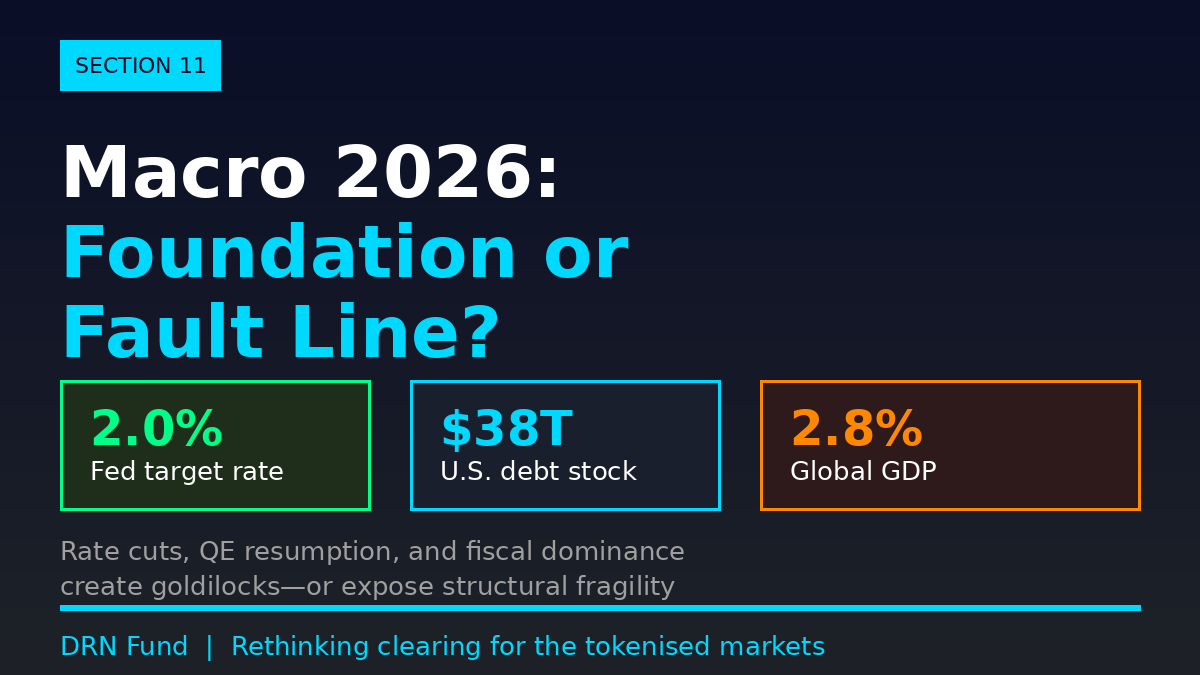
The 2026 macro environment represents a critical inflection from the post-2022 tightening regime to renewed monetary accommodation, creating precisely the liquidity conditions that institutional strategists cite as foundational for crypto's next growth phase.
Federal Reserve rate cuts driving the fed funds rate toward 2.0%, the cessation of quantitative tightening after four years of balance sheet reduction, and synchronized global monetary easing establish the financial architecture enabling institutional capital deployment into digital assets.
Yet this accommodative backdrop confronts meaningful countervailing forces: tariff-induced growth constraints, dollar weakness volatility, fiscal sustainability questions escalating with a US debt-to-GDP ratio exceeding 125%, and the US in election-year, policy uncertainty culminating in November 2026 midterms.
The macro question for 2026 is not whether monetary policy turns supportive, "that transition is already underway", but whether accommodation overwhelms structural headwinds sufficiently to deliver the cross-asset bull market that crypto's $10+ trillion market capitalization predictions depend upon.
The critical insight connecting macro to the entire institutional narrative developed across preceding sections: Crypto's adoption trajectory, regulatory frameworks enabling ETF distribution, real-world asset tokenization scaling, analysts suggest that DeFi maturation attracting institutional liquidity, prediction markets reaching mainstream relevance, depend entirely on benign macro conditions delivering the risk appetite and capital allocation flexibility that institutions require. If macro fails through recession, inflation resurgence, or fiscal crisis, the institutional thesis fractures regardless of regulatory clarity or technology readiness.
In short Macro conditions dominate almost every other factor.
Federal Reserve Policy Trajectory — The 2.0% Target
Bitcoin Suisse's 2026 Outlook establishes the monetary policy baseline that anchors institutional crypto forecasts: the US dominates all of these projections, the Federal Reserve's federal funds rate tracks to 2.0% by year-end 2026, regardless of whether inflation has fully returned to target. From the current 3.88% policy rate, this projection implies approximately 185 basis points of cuts over twelve months, roughly four to five quarter-point reductions or an accelerated path involving 50-basis-point moves should economic data deteriorate faster than consensus expectations. Bitcoin Suisse frames this trajectory not as contingent on inflation dynamics alone but as structurally necessary given fiscal imperatives: "The message from the White House is explicit. High rates are incompatible with the fiscal program, the political calendar and the rolling refinancing needs of a $38 trillion debt stock." Our note - Bitcoin Suisse explictly views the White House as ruling here not the market data, as long as the market, especially the bond market, behaves, this is ok, otherwise they are looking at the wrong entity here.
This 2.0% terminal rate sits meaningfully below most neutral rate estimates, which typically cluster in the 2.5-3.0% range, suggesting the Fed pursues not merely normalization but deliberate accommodation. The monetary policy implications for crypto are direct and historically validated. A 2.0% policy rate set against mid-2s inflation, Bitcoin Suisse projects inflation remaining sticky around 2.0-2.5%, recreates the negative-to-neutral real rate environment that historically lifted non-yielding hard assets.
Bitcoin's 2020-2021 rally from $10,000 to $69,000 occurred in precisely this configuration: near-zero nominal rates, modest positive inflation, deeply negative real rates driving capital away from fixed income into scarce assets. The 2.0% forecast matters not because it reaches some theoretical equilibrium but because it reduces the opportunity cost differential between Bitcoin (zero yield) and risk-free Treasuries (currently yielding 4%+). At 200 basis points, that opportunity cost compresses by half, making the volatility premium inherent in crypto allocation more palatable for institutional portfolios constrained by risk-adjusted return mandates. Though this overlooks the structural and balance sheet differences between the investments.
Bankless's 2026 predictions reinforce this transmission mechanism, noting that "expected rate cuts will create environment favorable to alternative assets" and that institutional Bitcoin allocations assume precisely this monetary backdrop. The consensus among crypto-native analysts is that institutional flows into Bitcoin ETFs, which began in earnest in 2024-2025 but plateaued during the high-rate regime, accelerate meaningfully once the Fed funds rate crosses below 3.0%, with further acceleration as it approaches 2.0%. BlackRock's Investment Outlook, while not crypto-focused, supports the growth-with-accommodation thesis that underpins crypto's institutional case. BlackRock projects AI capital spending will support U.S. growth in 2026, with investment contributing "three times its historical average this year," allowing growth to hold up even as labor markets cool. This configuration, resilient growth powered by capital-intensive AI buildout combined with Fed easing, represents the macro Goldilocks scenario crypto bulls require. Our note: What isn't said here by Blackrock but is between the lines, AI is going to reshape the labor market. The US growth this coming year will come from a small number of businesses, not a large diverse drive, the secondary market around these business will do ok, but it is very much a story of two markets, the US overall is in recession this is hidden by a handful of businesses driving headline growth numbers.
The counterpoint merits equal emphasis: if rate cuts derive not from controlled disinflation and soft landing but from economic deterioration and recession fears, lower rates may prove insufficient to offset risk-off sentiment. The 2022 precedent remains instructive, the Fed began cutting in response to banking sector stress and recession concerns, yet crypto experienced a 75% drawdown as institutional risk appetite evaporated. The distinction between "good cuts" (accommodation amid resilient growth) and "bad cuts" (emergency response to crisis) determines whether 2.0% rates catalyze crypto's institutional era or merely cushion a broader deleveraging. Bitcoin Suisse's base case assumes the former; their projection explicitly describes controlled economic cooling and soft landing mechanics rather than crisis dynamics. The November 2026 midterm elections add political economy complexity, rate cuts timed for pre-election fiscal stimulus would reinforce accommodation but potentially at the cost of inflation credibility if perceived as politically motivated rather than data-dependent.
Quantitative Easing Returns — Balance Sheet Expansion
The Federal Reserve's four-year quantitative tightening regime concluded on December 1, 2025, marking a decisive regime shift even before explicit quantitative easing resumes. Bitcoin Suisse's Outlook details the liquidity dynamics: "With QT ending, the liquidity impulse is set to turn positive, allowing financial market liquidity to expand more freely and support economic activity." The cessation of balance sheet runoff removes approximately $95 billion in monthly Treasury and mortgage-backed securities redemptions that had constrained systemic liquidity since early 2022. While Bitcoin Suisse notes that "full scale quantitative easing is unlikely to resume immediately," the trajectory is clear, balance sheet reinvestment policies will "gradually begin to loosen liquidity" through 2026, setting the stage for outright expansion should economic conditions warrant or fiscal financing needs demand.
The liquidity transmission mechanism matters profoundly for crypto. Global net liquidity, defined as the aggregate of global central bank asset purchases and balance sheet expansions, contracted by almost $8 trillion between 2022 and 2025 even as broad money supply (global M2) expanded by $10 trillion. This divergence, Bitcoin Suisse explains, "constrained asset markets even as broad money grew" because quantitative tightening withdrew liquidity directly from financial markets while fiscal deficits expanded money supply in the real economy. With QT ending, financial market liquidity and broad money supply realign, removing the technical headwind that weighed on risk assets through 2023-2025. For crypto specifically, the 2020-2021 precedent provides the empirical benchmark: the Fed's balance sheet expanded from $4 trillion to $9 trillion between March 2020 and March 2022, injecting approximately $5 trillion in liquidity. Bitcoin rallied from $4,000 to $69,000 (17x) while total crypto market capitalization expanded from $200 billion to $3 trillion (15x) over the same period. Correlation does not prove causation, but the directional relationship between central bank balance sheet expansion and crypto asset prices is established across a few cycles.
The global rate cutting cycle amplifies this liquidity regime shift. Bitcoin Suisse documents "more than 300 rate cuts across major economies over the past two years, accompanied by renewed stimulus programs and accommodative credit conditions." This synchronized easing extends beyond the United States to the European Central Bank, Bank of Japan (ending negative rates but maintaining accommodation), and emerging market central banks responding to dollar weakness and capital flow volatility. The "don't fight the Fed" investment maxim applies with particular force when monetary expansion is globally coordinated rather than isolated to one major central bank.
Our note: QE liquidity flows asymmetrically to spot vs derivatives markets. Spot markets benefit from direct capital inflows, liquidity enters, prices rise. Derivatives markets benefit from reduced volatility and tighter credit spreads, when financial conditions ease, counterparty risk premia compress, making bilateral clearing economically viable. The QE resumption matters for derivatives clearing not primarily through price appreciation but through reduced operational risk that enables counterparties to trust bilateral relationships without expensive mutualized default funds.
Historically, crypto performs best when the Fed, ECB, and Bank of Japan all maintain accommodative postures simultaneously, the 2016-2017 bull market occurred in precisely this configuration, as did the 2020-2021 euphoria.
Yet quantitative easing is not without crypto-specific complications. The infusion of liquidity created by QE can flow into multiple asset classes, equities, real estate, commodities, fixed income, and crypto's share of marginal liquidity depends on relative attractiveness versus alternatives. During 2020-2021, crypto captured disproportionate liquidity flows because traditional asset valuations had already expanded significantly and retail investors sought high-beta exposure. In 2026, if equities rally aggressively on AI enthusiasm and bonds offer attractive yields even as prices appreciate, crypto's claim on incremental liquidity becomes more contested. The insights4.vc Prediction Markets outlook notes that "ending quantitative tightening may modestly improve liquidity conditions" but frames this as necessary rather than sufficient for crypto outperformance. Grayscale Investments's 2026 Outlook emphasizes that "with a broadly supportive macro backdrop" institutional demand for crypto continues, but the qualification "broadly supportive" implies macro must deliver across multiple dimensions, not merely liquidity, but also growth, risk appetite, and absence of crisis shocks.
The timeline question remains open: when does balance sheet expansion transition from reinvestment to outright purchases? Bitcoin Suisse does not provide a specific trigger, but the fiscal dynamics suggest 2026 as plausible. With approximately $9 trillion in U.S. Treasury refinancing needs and a deficit exceeding 6% of GDP, the Fed may face implicit pressure to support Treasury auctions through balance sheet expansion even absent explicit QE announcements. This dynamic, sometimes termed "fiscal dominance", occurs when debt sustainability concerns force monetary policy accommodation regardless of inflation conditions. If this mechanism activates, crypto benefits from liquidity expansion but inherits the currency debasement narrative that Grayscale identifies as a primary driver of Bitcoin demand: "As long as the risk of fiat currency debasement keeps rising, portfolio demand for Bitcoin and Ether will likely continue rising as well."
Global Growth and the Soft Landing Consensus
Goldman Sachs Research projects global GDP growth of 2.8% in 2026, exceeding the consensus forecast of 2.5%, with U.S. economic growth expected to outperform international peers. This optimism regarding above-consensus growth represents a critical pillar of the institutional crypto thesis, if growth disappoints significantly, institutional risk appetite contracts regardless of accommodative monetary policy. BlackRock 's Investment Outlook frames the growth question around whether AI capital expenditure can break U.S. growth "out from its long-term 2% trend," noting that such a breakout would be unprecedented in modern economic history. BlackRock projects AI capital spending will contribute "three times its historical average" to U.S. growth in 2026, allowing expansion to persist "even as the labor market keeps cooling." This characterization, growth sustained by capital-intensive AI buildout offsetting labor market moderation, describes the narrow path of soft landing that institutional forecasters assume.
Bitcoin Suisse's analysis provides the most detailed soft landing validation. Their Outlook observes that "the soft-landing scenario has played out with textbook accuracy" thus far, distinguishing 2024-2025's cooling phase from historical recession patterns. Previous recessions featured "rapid and aggressive rate cutting cycles eliminating more than 80% of the peak policy rate within a year," whereas the current cycle has reduced the 5% peak rate by only 20%, with markets expecting a "gradual path toward roughly 3% next year, down 40% relatively only." Unemployment has risen modestly from 3.4% to 4.4% over two years, a 30% increase, compared to typical recession spikes exceeding 50-100% within twelve months. Financial conditions as measured by the National Financial Conditions Index have "eased consistently since 2022," while the ISM PMI manufacturing index "has turned upward, signaling stabilizing business activity and sentiment." These indicators collectively support continued economic expansion rather than imminent contraction. Our note: Non-US commentators talking about the US market appear to openly refer to the market as in recession and attempting to recover. That this is not being handled like other recession period, it is quite a contrast.
China's growth trajectory introduces meaningful uncertainty. Social Media-sourced predictions from macro strategists highlight China's stimulus effectiveness as a critical variable for global growth. Structural headwinds persist, property sector debt overhang, demographic decline, geopolitical tensions constraining trade and investment flows, but aggressive fiscal and monetary stimulus could offset near-term growth deceleration. For crypto, China growth matters primarily through second-order effects: commodity demand driving inflation dynamics, capital flow volatility affecting dollar strength, and manufacturing activity supporting global trade and liquidity conditions. Europe's outlook appears more challenged, with fiscal constraints limiting stimulus capacity and energy transition costs weighing on competitiveness. The ECB maintains accommodative policy, but European growth likely underperforms U.S. and Asian peers, suggesting regional divergence in institutional crypto adoption pacing.
The recession probability question dominates macro risk assessment. Bitcoin Suisse's soft landing confidence is not universally shared. Galaxy Research's 26 Predictions for 2026 acknowledges that "broader financial markets also create uncertainty, such as the rate of AI capex deployment, monetary policy conditions, and the U.S. midterm elections in November." This framing, listing AI capex deployment as uncertain, reveals skepticism about whether capital spending sustains growth or proves transitory. Grok-sourced predictions include contrarian views warning that AI capex represents bubble dynamics comparable to the late-1990s internet buildout, with eventual collapse in share prices followed by deep correction before genuine productivity gains materialize. If AI spending disappoints and the marginal growth driver evaporates, recession risk resurfaces rapidly.
For crypto specifically, growth matters less than equity markets but more than traditional fixed income. Bitcoin and Ethereum exhibit correlation to equities around 0.5-0.7, suggesting they capture roughly half the sensitivity of stock indices to growth surprises. This correlation structure implies that if GDP growth slows from 2.8% to 1.5%, still positive but well below expectations, crypto could experience 30-40% corrections even absent outright recession. The 2022 precedent demonstrated this dynamic: U.S. GDP remained positive throughout 2022, yet crypto market capitalization declined 70% as growth deceleration combined with Fed tightening to extinguish risk appetite. The institutional thesis for 2026 requires not merely positive growth but growth that meets or exceeds elevated expectations, validating the AI productivity narrative that justifies current equity valuations and crypto's claim on institutional capital.
Inflation Trajectory — Return to Target or Re-Acceleration?
The Federal Reserve's ability to cut rates to 2.0% depends critically on inflation remaining contained near the 2% target rather than re-accelerating. Bitcoin Suisse projects inflation in the "mid-2s" range, approximately 2.0-2.5%, throughout 2026, acknowledging that "inflation remains above target but has not reaccelerated" despite earlier concerns about tariff-driven price pressures. This inflation forecast occupies an awkward middle ground: insufficient progress for the Fed to declare victory and normalize policy fully, yet contained enough to permit continued rate cuts given fiscal and political imperatives. The policy implication is a Fed cutting rates toward 2.0% even with inflation sticky around 2.5%, creating a deliberate regime of negative real rates (nominal rate minus inflation) that historically benefits scarce assets including crypto.
The risk of inflation resurgence stems from multiple sources. Tariff policies represent the most immediate threat. Bitcoin Suisse notes that "tariff driven inflation fears have not materialized" thus far, but implementation remains incomplete. Social Media-sourced predictions reference proposals for 10-20% baseline tariffs on imports with potential 60% tariffs on Chinese goods specifically. Economic research from the Tax Foundation and other institutions cited in the outlook-2026 document suggests that comprehensive tariffs could raise consumer prices 1-2 percentage points and reduce GDP growth 0.5-1.0 percentage points—a stagflationary combination where both inflation and growth suffer simultaneously. For crypto, stagflation creates ambiguous dynamics: the inflation component supports Bitcoin's inflation-hedge narrative while growth deceleration argues against risk assets broadly. Historical precedent from the 1970s suggests gold rallied during stagflation; whether Bitcoin inherits that dynamic or tracks risk-off equities depends on whether institutional and retail investors perceive crypto primarily as commodity-hedge or equity-proxy. A notable mechanic though is that the holding of Bitcoin as treasury assets seems to have coincided with them becoming more cyclical, making them a terrible anti-inflation hedge.
Fiscal policy adds inflationary complexity. Bitcoin Suisse documents that the U.S. enters 2026 "with substantial fiscal firepower, including ongoing infrastructure spending, proposed $2,000 stimulus checks, expanding industrial subsidies, and structurally rising AI focused capital expenditure." With a deficit exceeding 6% of GDP and approximately $9 trillion in refinancing needs, fiscal policy operates as "both demand and supply side accelerators" simultaneously driving consumption and investment. The sheer magnitude of fiscal expansion during an expansion phase, historically, large deficits occur during recessions, creates inflation risk if demand pressures exceed supply capacity. The social media-sourced predictions include macro strategists warning that "persistent fiscal deficits and elevated household savings" could reignite inflation if fiscal stimulus hits already-tight labor markets.
Energy and commodity price shocks present additional upside risk to inflation. Geopolitical tensions affecting oil supply—Middle East conflicts, Russia-NATO tensions, Venezuela instability—could spike energy prices rapidly. (Invaded since I drafted this). AI capital expenditure drives unprecedented electricity demand from data centers, potentially straining power grids and raising energy costs. Industrial metal prices respond to green energy transition demand (copper, lithium, rare earths) and infrastructure buildout, with supply constraints in mining and refining creating bottleneck inflation. Bitcoin Suisse's cross-asset outlook projects gold reaching $4,800-5,000 and silver $65-75, representing 10-30% gains driven by "industrial demand acceleration" and "late-stage stagflation hedge trade." These commodity forecasts embed inflation expectations exceeding the Fed's 2% target.
Crypto's relationship to inflation remains empirically ambiguous despite theoretical inflation-hedge arguments. During the 2021 inflation surge (CPI reaching 9%), Bitcoin initially rallied then collapsed as the Fed tightened aggressively, demonstrating that crypto's inflation sensitivity depends critically on whether inflation prompts central bank accommodation (bullish) or tightening (bearish). Grayscale's 2026 Outlook frames this nuance correctly, emphasizing that "scarce commodities—whether physical gold and silver or digital Bitcoin and Ether—can potentially serve as a ballast in portfolios for fiat currency risks" arising from debt monetization and currency debasement. Our Note: This analysis is over simplified, it requires that these digital assets have the same cyclical behaviour through institutional adoption, DATs and a new inflation cycle. This is supposition at best. The critical distinction lies in inflation's source: cost-push inflation from tariffs or commodities creates negative real rates (nominal rates can't rise because growth suffers), supporting crypto as real-asset hedge; demand-pull inflation from fiscal stimulus and overheating requires Fed tightening, crushing crypto alongside all risk assets. Bitcoin Suisse's projection of 2.0% rates against mid-2s inflation suggests the former dynamic, the Fed tolerating slightly elevated inflation rather than tightening into growth slowdown, precisely the configuration where Bitcoin historically outperforms.
Tariff Impacts — Stagflation Risk
The outlook-2026 document acknowledges that "the tariffs' economic and market impact may be much" more significant than current consensus expects, introducing a variable that institutional forecasters struggle to model with precision. Trump administration tariff policies remain subject to negotiation and political economy dynamics, but baseline scenarios suggest 10-20% tariffs on most imports with significantly higher rates, potentially 60%, targeting Chinese goods specifically. The economic transmission mechanisms are well-understood but uncertain in magnitude: tariffs function as consumption taxes, raising import costs that partially pass through to consumer prices while reducing purchasing power and consumption. Simultaneously, tariffs disrupt supply chains, reduce trade volumes, and diminish productivity through forced deglobalization. The net effect is lower GDP growth and higher inflation simultaneously, the textbook definition of stagflation.
Quantifying tariff impacts requires assumptions about retaliation, substitution, and duration. If U.S. tariffs prompt Chinese and European retaliation, trade volumes contract more severely and global growth slows further. If businesses substitute domestic suppliers or production, the growth impact moderates but at the cost of higher production costs driving inflation. If tariffs remain temporary negotiating tactics rather than permanent policy, markets may look through short-term disruption; if tariffs become structural features of deglobalized trade architecture, long-term growth potential declines. Bitcoin Suisse notes that tariff concerns have "not materialized" yet but acknowledges ongoing "tariff negotiations" that could shift outcomes meaningfully. The social media-sourced predictions discuss tariffs primarily in the context of fiscal financing, tariff revenues providing steady income streams for debt service on proposed century bonds, suggesting tariffs may be designed deliberately as revenue measures rather than primarily trade policy, which implies persistence rather than negotiated removal.
For crypto, stagflation represents the most challenging macro regime precisely because it creates conflicting signals. The inflation component supports Bitcoin's narrative as scarce digital commodity and inflation hedge, potentially driving institutional and retail demand as real yields turn negative. The growth component undermines risk appetite broadly, driving capital toward defensive assets and away from volatile, high-beta exposures like crypto. The historical precedent from 1970s stagflation shows gold rallying 20x over the decade while equities stagnated, but crypto did not exist then and whether Bitcoin inherits gold's stagflation-hedge properties versus tracking equity risk-on/risk-off dynamics remains empirically uncertain. Grayscale's framing emphasizes the currency-debasement angle: "As long as the risk of fiat currency debasement keeps rising, portfolio demand for Bitcoin and Ether will likely continue rising as well." This narrative works if stagflation drives central banks toward accommodation (tolerating inflation to support growth), but collapses if stagflation forces central banks to prioritize inflation control even at the cost of severe recession.
The cross-border trade implications of tariffs extend beyond growth and inflation to currency and capital flow dynamics. Deglobalization reduces dollar demand for international trade settlement, potentially accelerating the dollar weakness that Bitcoin Suisse forecasts. Simultaneously, capital controls and protectionist measures in response to tariffs could increase demand for cryptocurrency as a means of circumventing capital restrictions, particularly in emerging markets experiencing currency instability. The stablecoin implications discussed in Section 4 connect directly: if tariffs disrupt international payments and banking channels, stablecoin-based settlement may substitute for traditional correspondent banking, driving adoption through trade finance necessity rather than technology preference. This use case would represent genuine fundamental demand rather than speculative positioning, potentially providing downside support during macro volatility.
Dollar Weakness and Currency Dynamics
Bitcoin Suisse forecasts the U.S. Dollar Index (DXY) declining to 95-90 by year-end 2026, representing a 3-10% depreciation from the current level of 99.5. The drivers are straightforward: Federal Reserve easing while other major central banks pause or ease less aggressively, twin deficits (fiscal and current account) expanding relative to trading partners, and ongoing reserve currency diversification as central banks and sovereign wealth funds reduce dollar concentration. The outlook-2026 document notes that "as the Fed eases policy and the dollar declines" emerging market conditions improve and capital flows toward higher-yielding international assets. For crypto, dollar weakness matters profoundly because Bitcoin exhibits negative correlation to the dollar, historically, when DXY declines, Bitcoin rallies, and when DXY strengthens, Bitcoin suffers. The 2020-2021 period demonstrated this inverse relationship clearly: DXY declined from 103 to 89 (14% depreciation) while Bitcoin rallied from $10,000 to $69,000 (7x); conversely, 2022 saw DXY surge from 89 to 114 (28% appreciation) while Bitcoin collapsed from $48,000 to $16,000 (67% decline).
The causal mechanism connecting dollar weakness to crypto strength operates through multiple channels.
First, commodity pricing: most commodities including oil, gold, and agricultural products are dollar-denominated, so dollar weakness mechanically raises commodity prices in dollar terms, and Bitcoin increasingly trades as a digital commodity with commodity-like price dynamics.
Second, international capital flows: when the dollar weakens, international investors find dollar-denominated assets cheaper in their home currency terms, increasing purchasing power and demand for U.S. assets including crypto.
Third, monetary policy expectations: dollar weakness typically reflects expectations of Fed accommodation relative to other central banks, which correlates with positive risk appetite favoring high-beta assets.
Fourth, safe-haven dynamics invert: a strong dollar reflects flight-to-safety and risk-off sentiment, while a weak dollar suggests risk-on positioning where capital seeks returns in emerging markets and alternative assets.
The stablecoin implications of dollar weakness extend the analysis into payments infrastructure discussed in Section 4. Bitcoin Suisse's cross-asset forecast table does not explicitly project non-dollar stablecoins, but the logic is straightforward: if the dollar declines 3-10%, demand for Euro-denominated, Yen-denominated, and emerging market currency stablecoins should increase as users seek to preserve purchasing power against dollar depreciation. This could accelerate the diversification of the stablecoin stack away from USDT and USDC hegemony toward multi-currency stablecoin ecosystems. Grayscale's discussion of "fiat currency debasement" driving Bitcoin demand applies equally to stablecoin substitution—if the dollar devalues, users in dollar-based economies may allocate toward Euro or Swiss Franc stablecoins for transactions and savings, while users in weaker currencies may prefer dollar stablecoins despite depreciation because dollar stability exceeds domestic alternatives.
Reserve currency status debates introduce longer-term structural considerations. Grok-sourced predictions include macro strategists discussing dedollarization trends, BRICS currency initiatives, and China's internationalization of the Renminbi through oil-for-yuan arrangements and bilateral trade settlements. While Bitcoin Suisse's 2026 forecast horizon does not encompass wholesale dollar dethronement, the gradual erosion of dollar dominance supports Bitcoin's value proposition as a neutral, non-sovereign monetary asset uncorrelated to any single fiat currency. If global trade increasingly settles in multiple currencies rather than dollar hegemony, Bitcoin and stablecoins function as bridge assets facilitating multi-currency commerce without requiring every participant to hold reserves in every trading partner's currency. This use case, neutral settlement asset in a multipolar currency system, represents a fundamental driver rather than speculative narrative, and dollar weakness in 2026 would provide empirical evidence accelerating adoption along this trajectory.
Our observation: Dollar weakness complicates derivatives clearing more than spot trading. Spot markets can denominate in any currency, if dollar weakens, just trade in Euros or Yen. Derivatives clearing requires standardized margining across counterparties, and most derivatives globally are dollar-denominated or use dollar-based collateral hierarchies.
Scenario: Dollar depreciates 10% as Bitcoin Suisse forecasts. Derivatives clearinghouse holds Treasury collateral posted by counterparties. Treasury values decline in non-dollar terms as DXY falls. Non-U.S. counterparties experience effective margin erosion, their posted collateral buys less in home currency terms. Do clearinghouses require additional margin to maintain equivalent protection? Do they accept non-dollar collateral at different haircuts? How do they manage basis risk between dollar-denominated positions and non-dollar collateral?
Traditional clearinghouses handle this through established FX margining frameworks, but crypto derivatives clearing hasn't built comparable infrastructure. Stablecoin collateral is predominantly dollar-denominated (USDT, USDC). If dollar weakness accelerates multi-currency stablecoin adoption (Euro, Yen, emerging market stablecoins), derivatives clearinghouses must develop real-time FX risk management, cross-currency collateral conversion, and basis risk calculation, operational complexity that doesn't exist for spot trading.
This explains why institutional derivatives may remain concentrated in established clearinghouses with mature FX infrastructure rather than migrating to crypto-native clearing, even if crypto offers technological advantages. Currency basis risk in derivatives clearing requires operational sophistication that spot markets don't need.
Cross-border capital flows respond asymmetrically to dollar weakness depending on whether depreciation appears orderly or disorderly. Orderly decline—the Bitcoin Suisse base case—sees capital reallocating gradually toward international assets including emerging market equities, commodities, and crypto. Disorderly decline—a tail risk scenario—triggers flight to quality where even gold and crypto suffer initially as capital rushes to Treasury bills and German bunds before stabilizing. The 2022 precedent showed disorderly dollar strength (rapid appreciation) devastating crypto; the mirror dynamic of disorderly weakness would likely prove equally problematic short-term before reversing. The key distinction: expected dollar weakness at 3-10% annual pace allows portfolio rebalancing; unexpected dollar crisis at 20%+ pace triggers systemic panic. Bitcoin Suisse's forecast implies the former, but Grok-sourced contrarian predictions acknowledge the latter remains possible if fiscal crisis or geopolitical shock undermines dollar confidence rapidly.
Cross-Asset Bull Market — Goldilocks or Bubble?
Bitcoin Suisse declares that "2026 will deliver a cross-asset class bull run," framing the investment landscape as presenting "one of the most constructive cross-asset configurations since the early 2010s." This bold assertion requires simultaneous gains across equities, bonds, commodities, and crypto, a rare outcome historically because these asset classes typically exhibit negative correlation (bonds rally when equities decline, commodities behave idiosyncratically). Achieving cross-asset bull markets demands a Goldilocks macro environment: sufficient growth to support corporate earnings and commodity demand, sufficient disinflation to allow central bank easing and bond appreciation, and sufficient liquidity to lift all assets simultaneously without triggering inflation fears that would force monetary tightening. Bitcoin Suisse's thesis is that 2026 delivers precisely this configuration: growth sustained by AI capital expenditure, inflation moderating toward target, Fed cutting rates toward 2.0%, and liquidity expanding as QT ends and balance sheet policy turns accommodative.
The equity component rests on S&P 500 targets of 7,700-8,000, representing 10-15% gains driven by "AI CapEx boom broadens, fiscal tailwinds" from proposed tax cuts and infrastructure spending. This projection implies continued earnings expansion rather than multiple contraction, requiring corporate profit margins to remain elevated despite wage pressures and rising input costs. Bitcoin Suisse anticipates the equity rally broadening beyond mega-cap technology to include small caps, with the Russell 2000 entering the year "at their largest discount to large caps since the late 1990s." The rationale: small caps benefit disproportionately from "deregulation, rate cuts, tax cuts, and easing financial conditions" because they carry more debt sensitivity and face higher financing costs. If this rotation materializes, it signals broad-based economic strength rather than narrow leadership, supporting risk appetite across asset classes including crypto.
The fixed income component assumes "long-term yields appear to have peaked in 2025" and that "further policy easing expected, especially mid-to-long-duration Treasuries offer asymmetric upside." This bond bull case requires inflation remaining contained (preventing yield spikes from re-pricing inflation risk) and recession remaining avoided (preventing credit spread widening). The trade-off is delicate: bonds rally when yields fall, but yields fall either because inflation moderates (bullish for all assets) or because recession fears drive flight-to-safety (bearish for risk assets). Bitcoin Suisse's cross-asset bull thesis implicitly assumes the former, declining yields from disinflation and Fed cuts rather than economic collapse, which would allow both bonds and risk assets to appreciate simultaneously. The historical precedent for this dynamic is limited: 2019 saw a similar configuration where Fed cuts drove bonds higher while equities rallied on growth resilience, and crypto participated in the broad rally.
The commodity segment focuses on precious metals and industrial metals. Bitcoin Suisse forecasts gold reaching $4,800-5,000 (10-20% gain) driven by "Tether and central bank buying" combined with "late-stage stagflation hedge trade continues." Silver targets $65-75 (15-30% gain) reflect "industrial demand acceleration" from green energy transition and AI infrastructure. The gold/silver ratio dynamics—silver outperforming gold—traditionally signal growth-driven commodity demand rather than purely defensive positioning, supporting the broad economic expansion narrative. Industrial metals like copper should rally if infrastructure and AI capital expenditure drives demand as projected, though Bitcoin Suisse does not provide explicit copper forecasts in the documentation reviewed.
For crypto's role in the cross-asset bull, Bitcoin Suisse positions digital assets as "increasingly behave[ing] as part of the macro framework rather than" isolated speculative instruments. This framing suggests crypto benefits from the same liquidity, growth, and risk appetite drivers lifting traditional assets while maintaining idiosyncratic upside from technology adoption and institutional onboarding. The $180,000 Bitcoin price target and $8,000 Ethereum target discussed in Section 2 embed this cross-asset bull assumption, crypto captures its proportional share of liquidity expansion plus additional gains from structural adoption trends. The risk: if cross-asset bull markets prove transitory or reverse suddenly, crypto's high beta means it suffers the most severe drawdowns. Galaxy Research's acknowledgment of "broader financial markets also create uncertainty" suggests even bullish crypto analysts recognize the cross-asset thesis is assumption rather than certainty.
The contrarian perspective questions whether simultaneous gains across all asset classes represent healthy diversification or late-cycle bubble dynamics where excess liquidity inflates everything indiscriminately. Social media-sourced predictions include warnings that "when assets trade persistently above historical medians, mean reversion becomes a probability, not a theory" and that "in crypto, that adjustment tends to be faster and more severe because intrinsic anchors are weak." This view suggests that cross-asset appreciation reflects monetary distortion, central bank balance sheets expanded $20+ trillion globally since 2008, rather than fundamental value creation, and that eventual normalization requires painful asset price corrections. If this interpretation proves correct, 2026's cross-asset bull becomes 2027's cross-asset bear as monetary policy normalizes and valuations revert. For institutional crypto adoption, this timing matters critically: if institutions allocate at peak valuations before correction, their losses could set back adoption trajectories by years as committees and boards reassess crypto's suitability for fiduciary portfolios.
Fiscal Sustainability — The Deficit Elephant
The United States enters 2026 with a federal debt stock of $38 trillion and a debt-to-GDP ratio exceeding 125%, as documented by Bitcoin Suisse. The deficit trajectory remains structurally expansionary at more than 6% of GDP, a level typically observed during severe recessions, not multi-year expansions. Approximately $9 trillion in U.S. Treasury securities require refinancing during 2026, and at prevailing yields, Bitcoin Suisse notes that "refinancing at today's yields pushes" interest expense to unsustainable levels relative to revenues. October 2025 interest payments alone reached $104 billion, a scale that compounds arithmetically as debt rolls over at higher rates. The fiscal math is straightforward but troubling: if the Fed maintains rates above 3%, interest expense continues climbing toward $1.5 trillion annually (roughly 5% of GDP), crowding out discretionary spending and accelerating deficit expansion through debt service alone.
The monetary policy implications create a fiscal dominance dynamic where the Fed faces implicit pressure to support Treasury markets regardless of inflation conditions. If the Fed maintains restrictive policy and Treasury yields spike, the federal government confronts refinancing crisis. If the Fed accommodates by cutting rates aggressively and potentially resuming QE to purchase Treasuries, inflation risks resurface. Bitcoin Suisse's projection of rates declining to 2.0% can be interpreted partially as necessary fiscal accommodation rather than purely inflation-driven policy, the debt burden makes higher rates economically and politically unsustainable even if inflation remains moderately elevated. This configuration, central bank policy constrained by fiscal needs rather than purely economic conditions, is precisely the "fiat currency debasement" dynamic that Grayscale identifies as driving institutional demand for Bitcoin as alternative store of value.
The long-term debt sustainability question is whether the United States can continue running trillion-dollar deficits indefinitely or whether markets eventually impose discipline through bond vigilante dynamics. The optimistic case holds that as long as the dollar retains reserve currency status, global demand for Treasuries remains sufficient to absorb issuance at reasonable yields. The pessimistic case warns that debt-to-GDP ratios above 100-120% historically trigger confidence crises where yields spike despite central bank easing, as occurred in the UK with the Liz Truss fiscal crisis in 2022. Grayscale's Outlook includes a chart showing "US Federal Government Debt as Share of GDP" projected to reach 140-160% by 2030 under current trajectories, emphasizing that "high and rising public sector debt and its potential implications for inflation over time" create persistent portfolio demand for scarce assets.
For Bitcoin specifically, the fiscal sustainability crisis narrative represents one of the strongest fundamental arguments for institutional adoption. If investors conclude that U.S. fiscal policy is unsustainable and that either default (impossible for the Fed-backed sovereign), austerity (politically unacceptable), or monetization (the likely path) will resolve the imbalance, allocating a portion of portfolios to Bitcoin as non-sovereign, fixed-supply asset makes risk management sense. This is not a speculative bet on price appreciation but a hedge against tail risk of currency debasement. Bitcoin Suisse's monetary policy forecast, 2.0% rates against mid-2s inflation, can be interpreted as the early stages of this dynamic playing out: the Fed prioritizing debt sustainability over inflation control, accepting slightly elevated inflation as the lesser evil compared to fiscal crisis. If this interpretation is correct, the institutional case for Bitcoin strengthens precisely because fiscal unsustainability validates the currency-hedge thesis rather than undermining it.
The counterpoint is that fiscal crises typically trigger initial flight to quality toward the dollar and Treasuries rather than away from them. When confidence falters, investors seek the deepest, most liquid safe-haven assets, historically U.S. Treasuries, before considering alternatives. The 2008 financial crisis saw Treasuries rally and yields collapse even as fiscal deficits exploded because market participants prioritized safety and liquidity over return. If 2026 witnesses fiscal crisis rather than gradual accommodation, crypto could suffer severe short-term drawdowns alongside equities and commodities before the longer-term debasement narrative reasserts. The timing and path matter enormously: institutions allocating based on fiscal-hedge thesis need conviction to hold through potential 50-70% drawdowns before vindication. Bitcoin Suisse's base case avoids this crisis scenario, assuming orderly accommodation, but the fiscal arithmetic suggests the sustainability question grows more acute each year deficits persist above 5% of GDP.
U.S. Midterm Elections — Policy Uncertainty Peak
The November 2026 midterm elections introduce concentrated policy uncertainty at a critical inflection point for crypto's institutional adoption trajectory. Galaxy Research identifies "the U.S. midterm elections in November" as one of several factors creating "uncertainty" for crypto markets in 2026. The electoral dynamics matter for crypto through multiple transmission mechanisms: regulatory policy continuity or reversal, fiscal policy debates affecting deficit and growth trajectories, and market seasonality patterns where midterm years historically exhibit elevated volatility in risk assets. The current political configuration, specific control scenarios depend on 2024 presidential results not yet occurred as of this document's composition, will determine whether divided government gridlock or unified control allows legislative action on crypto-specific issues including stablecoin frameworks, market structure bills, and tax treatment.
Divided government, one party controlling the presidency and the other controlling at least one chamber of Congress, typically produces legislative gridlock that prevents major policy changes in either direction. For crypto, gridlock may prove neutral to positive: existing regulatory frameworks remain in place, but aggressive new restrictions also face obstacles. The institutional adoption trajectory developed in Sections 5-7 depends critically on regulatory stability allowing Bitcoin ETFs to distribute through major wirehouses, banks to custody crypto without capital penalties, and tokenized RWAs to operate within clear legal frameworks. Gridlock preserves this status quo, whereas unified government control could either accelerate pro-crypto legislation or impose restrictive measures depending on political composition. Bitcoin Suisse's assumption of "anticipated U.S. market-structure bill add[ing] another layer of support, signalling that institutional rails will likely thicken further in 2026" implies optimism about legislative progress, but midterm electoral uncertainty complicates this timeline.
Election-year fiscal dynamics introduce additional macro volatility. Historically, pre-election periods see fiscal stimulus measures as incumbents attempt to boost economic conditions and voter sentiment. Bitcoin Suisse's mention of "proposed $2,000 stimulus checks" suggests fiscal expansion timed potentially for political benefit rather than purely economic necessity. If enacted, such stimulus would support near-term consumption and growth but raise medium-term inflation risks and exacerbate fiscal sustainability concerns discussed previously. For crypto, election-year stimulus represents a double-edged dynamic: increased liquidity and spending support risk appetite and crypto prices short-term, but if perceived as fiscally irresponsible, could accelerate currency-debasement narratives driving longer-term Bitcoin demand through fundamentals rather than sentiment.
Market seasonality patterns suggest that midterm years exhibit elevated volatility but often end strongly. Historical analysis indicates that U.S. equity markets typically experience weakness in the months preceding midterm elections as uncertainty peaks, followed by post-election rallies once political outcomes clarify and policy uncertainty resolves. If crypto follows this pattern, the third and fourth quarters of 2026 could witness volatility spikes and temporary drawdowns followed by year-end rallies if election results provide clarity. Institutional investors conditioned to this seasonality may reduce exposure proactively into September-October then reallocate aggressively into November-December, creating predictable technical trading dynamics. However, crypto's correlation to equities remains imperfect, and 2022 demonstrated that crypto can decouple negatively during risk-off periods regardless of electoral calendars.
The regulatory policy implications of midterm elections extend specifically to SEC and CFTC leadership and enforcement priorities. If the administration changes or if Congressional oversight intensifies following elections, regulatory postures toward crypto could shift meaningfully. Bitcoin Suisse's assumption of institutional infrastructure thickening, ETF distribution expanding, custody solutions maturing, tokenization frameworks clarifying, depends on regulatory trajectory remaining supportive or at minimum non-hostile. Electoral outcomes that empower crypto-skeptical policymakers could stall or reverse these developments even if technological capabilities exist. Conversely, elections delivering crypto-supportive majorities could accelerate stablecoin legislation, eliminate ambiguous securities classifications, and provide tax clarity that institutional allocators require. The uncertainty itself, not knowing which path materializes, creates an option value to delaying institutional allocation decisions until post-election clarity emerges, potentially suppressing institutional flows during the second half of 2026 regardless of price action.
AI Capital Expenditure — Productivity Boom or Resource Crunch?
The magnitude of AI infrastructure spending represents a historically unprecedented capital deployment cycle with profound macro implications. Bitcoin Suisse documents $600 billion in annual MAG7 AI capital expenditure, encompassing data centers, semiconductor manufacturing, power grid expansion, and networking infrastructure. BlackRock's Investment Outlook emphasizes that this AI capex is "contributing three times its historical average" to U.S. GDP growth, potentially enabling a "breakout" from the long-term 2% growth trend that has persisted since the 1970s. The scale and pace of this buildout exceed historical technology cycles including railroads, electricity, and the internet in terms of capital concentration per year, though those earlier cycles played out over longer time horizons. If AI capex sustains through 2026 and begins generating productivity gains visible in economic data, labor productivity growth accelerating, total factor productivity rising, profit margins expanding despite higher wages, then AI validates the transformative technology narrative justifying current valuations and supporting continued capital deployment.
The economic multiplier effects extend beyond direct capex to adjacent industries. Data center construction drives demand for commercial real estate development, steel, concrete, and construction labor. Semiconductor manufacturing expansion requires specialized chemicals, precision machinery, and skilled engineering workforces. Power grid reinforcement necessitates utility infrastructure investment, renewable energy projects to meet carbon-neutral commitments, and battery storage to smooth intermittent supply. These second-order effects distribute economic activity geographically and sectorally, creating broader growth impulse than if AI spending concentrated only in a few technology companies. For macro growth forecasts, this diffusion matters, if AI capex creates widespread employment and income gains, consumption remains resilient even if interest rate-sensitive sectors like housing weaken. If AI capex remains concentrated in narrow capital-intensive activities without broad labor demand, economic gains accrue primarily to capital rather than labor, potentially exacerbating inequality and limiting consumption growth.
The productivity implications determine whether AI capex represents genuine value creation or bubble dynamics. BlackRock frames this question directly: "Will it be enough to break U.S. growth out from its long-term 2% trend?" and notes that "all major innovations of the last 150 years, including steam, electricity and the digital revolution—were not enough for it to break out of this trend." The skeptical interpretation holds that AI represents marginal productivity enhancement rather than step-function improvement, and that current capex levels reflect irrational exuberance comparable to the late-1990s internet bubble or the railroad mania of the 1840s. Grok-sourced predictions include macro strategists warning that "we have had lots of these technology booms before and they begin with a massive capex expenditure... But then either the market or the board begins to work out how on earth are you going to get a return from the capex... at some stage we begin to work out that at least in a four or five year time frame there's far too much investment and no likely business and it rolls over."
This pattern, enthusiasm driving overinvestment, followed by collapse as returns disappoint, followed eventually by genuine transformation after excessive capacity clears—characterized internet stocks in 1999-2003 and railroad stocks in 1845-1850. Amazon fell 90% during the dot-com crash "even though it was the right answer," as the Grok-sourced analyst notes, because timing matters and overvaluation punishes even fundamentally correct bets. If AI follows this pattern, 2026 could witness peak capex followed by 2027-2028 corrections as investors question return on investment timelines. For crypto, this timing risk is critical: if institutional allocations occur during late 2026 or 2027 as AI enthusiasm peaks then corrects, crypto could suffer collateral damage from broader risk-off sentiment and deleveraging.
The deflationary versus inflationary effects of AI remain theoretically ambiguous and empirically uncertain. On the deflationary side, AI-driven productivity gains reduce unit labor costs, automate expensive processes, and enable more efficient resource allocation, all of which suppress prices. This dynamic would support central bank easing and positive real returns across assets. On the inflationary side, AI energy demand creates unprecedented electricity consumption, data centers collectively could consume 5-10% of U.S. power generation by 2030 according to various estimates, driving energy prices higher and straining grid capacity. Additionally, competition for scarce inputs like high-bandwidth memory chips, advanced packaging substrates, and specialized cooling systems creates bottleneck inflation in semiconductor supply chains. Bitcoin Suisse does not resolve this ambiguity definitively, instead assuming that productivity gains and inflation pressures roughly offset, allowing growth to persist without triggering inflation fears that would force Fed tightening.
The crypto-AI convergence discussed extensively in Section 1 creates direct competition for resources. AI data centers and cryptocurrency mining operations both require substantial electricity, cooling infrastructure, and physical space. In regions where power capacity is constrained, Texas, parts of the Midwest, specific European markets, AI and crypto compete directly for megawatts, potentially driving both industries toward regions with excess capacity or forcing one to relocate. The GPU market similarly exhibits competition: AI training and inference require cutting-edge Nvidia H100 and H200 GPUs, while crypto mining increasingly uses ASICs but still competes for semiconductor fab capacity, packaging, and testing resources. If AI capex crowds out crypto infrastructure investment by raising input costs or creating supply constraints, crypto's ability to scale technically could suffer even if demand increases. Conversely, if AI capex spillover drives investment in shared infrastructure, hyperscale data centers offering both AI and crypto workloads, renewable energy projects supplying both industries, synergies could accelerate crypto infrastructure maturation.
Contrarian Macro Views — When Consensus Fails
The institutional consensus embodied in forecasts from Bitcoin Suisse, BlackRock, Goldman Sachs, and Grayscale assumes macro conditions deliver soft landing, accommodative policy, controlled inflation, and cross-asset appreciation. Examining contrarian scenarios where consensus fails provides essential risk assessment for the institutional crypto thesis. The recession scenario, soft landing deteriorates into contraction, represents the most immediate tail risk. If labor markets weaken faster than Fed easing compensates, if AI capex pauses or reverses, if tariffs constrain growth more severely than forecast, or if external shocks (geopolitical conflict, pandemic resurgence, financial crisis) disrupt expansion, recession probability rises significantly above the sub-20% consensus estimates. Crypto's response to recession depends on whether downturn is shallow and short (2001-style mild recession with quick recovery) or deep and extended (2008-style financial crisis with systemic deleveraging). Historical precedent provides only one crypto recession data point: 2022 saw crypto decline 70% during Fed tightening and growth deceleration that technically avoided recession but exhibited recessionary characteristics. A true recession with rising unemployment and corporate bankruptcies could drive crypto down 50-70% as institutions de-risk and retail liquidity evaporates.
The inflation resurgence scenario, sticky inflation re-accelerates rather than moderating, forces the Fed to pause or reverse rate cuts, potentially re-tightening if inflation approaches 4-5%. Tariffs, fiscal stimulus, energy shocks, or de-globalization supply disruptions could all trigger renewed price pressures. If inflation surges while growth slows—stagflation—the Fed faces impossible trade-offs between supporting growth (requiring easing) and controlling inflation (requiring tightening). Historically, central banks prioritize inflation control, accepting recession as necessary cost. If this dynamic repeats, crypto faces the worst possible macro environment: Fed tightening crushes risk appetite while inflation erosion undermines purchasing power, creating no safe positioning. The only potential crypto-positive element in stagflation is the long-term currency debasement narrative, but institutional allocators operating on quarterly performance mandates may not sustain positions through multi-year drawdowns waiting for that narrative to validate.
Our perspective: Fiscal dominance creates profound implications for derivatives clearing infrastructure specifically. Traditional derivatives markets rely on government bonds as Tier 1 collateral: U.S. Treasuries, German Bunds, Japanese JGBs. These assets satisfy regulatory capital requirements precisely because sovereign creditworthiness anchors the collateral hierarchy.
If fiscal crisis undermines Treasury creditworthiness, credit downgrades, yield spikes from bond vigilantes, loss of reserve currency confidence, the foundation of derivatives collateral frameworks fractures. What happens to derivatives margining systems when the "risk-free" asset exhibits 20%+ volatility during crisis? How do clearinghouses recalculate initial margin requirements when Treasuries themselves become risky? How do cross-border derivatives enforce close-out netting when different jurisdictions' bonds exhibit divergent credit quality?
This is where the bifurcation between public and permissioned derivatives infrastructure becomes critical. Public chains with crypto-native collateral (BTC, ETH, stablecoins) may prove more robust during fiscal crisis if they've established functional collateral hierarchies independent of sovereign debt. Permissioned systems like Canton that assume Treasury collateral remains stable may face operational breakdowns if fiscal crisis materializes.
The institutional question: Do you build derivatives clearing infrastructure assuming fiscal stability continues (traditional approach using Treasury collateral), or assuming fiscal crisis eventually arrives (alternative approach using diversified collateral including crypto-native assets)? Current institutional forecasts assume the former. If Section 11's fiscal warnings prove correct, derivatives infrastructure built on those assumptions fails precisely when institutions need it most.
The fiscal crisis scenario, bond vigilantes emerge forcing sudden yield spikes despite Fed easing, creates systemic fragility comparable to UK's 2022 gilt crisis. If Treasury auctions fail to clear at reasonable yields, if foreign buyers (China, Japan, oil exporters) reduce dollar reserves, if credit rating agencies downgrade U.S. sovereign debt, sudden loss of confidence could spike yields rapidly. The Fed would face immediate choice: allow yields to soar and trigger debt-servicing crisis, or implement emergency QE (yield curve control) to suppress yields at the cost of currency depreciation. Either path creates extreme volatility: yields spiking crushes all asset prices initially through deleveraging; emergency QE drives flight from dollar and potentially into gold and Bitcoin as safe havens. But the transition period, when crisis is evident but policy response uncertain, would witness violent liquidation across all risk assets including crypto.
Geopolitical shocks: Taiwan conflict, Middle East escalation, Russia-NATO confrontation—introduce exogenous uncertainty that macro models cannot anticipate. If major conflict disrupts trade routes, energy supplies, or financial linkages, risk-off sentiment dominates all markets. Historical precedent from February 2022 Russia-Ukraine invasion shows crypto initially declined with equities then partially recovered as Russian capital sought sanction-resistant assets. A Taiwan conflict affecting semiconductor supply would compound economic and market impacts with physical supply chain destruction, potentially halving global chip production and triggering rationing of electronics including the servers and ASICs crypto infrastructure depends upon. Major conflict scenarios are inherently difficult to model but represent the ultimate stress test for crypto's narrative as uncorrelated, crisis-resilient, decentralized alternative to traditional finance.
Our perspective: Derivatives clearing infrastructure faces existential stress during crisis that spot markets avoid. Spot exchanges can halt trading, implement circuit breakers, or suspend withdrawals temporarily. Derivatives clearinghouses must maintain continuous margining, execute liquidations, and manage defaults in real-time because positions don't close—they have future obligations. Crisis reveals whether derivatives clearing infrastructure can maintain operations under stress, or whether operational breakdowns force emergency interventions that undermine institutional confidence permanently.
If institutions panic and liquidate all assets indiscriminately, crypto's supposed safe-haven properties prove illusory short-term; if institutions deliberately allocate toward permissionless, censorship-resistant assets during crisis, crypto validates its core value proposition.
The bubble-pop scenario, excess liquidity from QE and fiscal deficits inflates asset prices unsustainably, leading to sudden reversal, applies across all asset classes not just crypto. If the cross-asset bull market that Bitcoin Suisse forecasts materializes but reflects monetary distortion rather than fundamental value creation, mean reversion becomes inevitable once monetary conditions normalize. The trigger could be Fed balance sheet reduction resuming after brief pause, inflation forcing premature tightening, or simply investor recognition that valuations are disconnected from underlying cash flows and growth. Crypto, as the highest-volatility and most speculative component of the cross-asset rally, would suffer the largest drawdown percentage-wise during bubble deflation. Grok-sourced predictions emphasize that "in crypto, that adjustment tends to be faster and more severe because intrinsic anchors are weak" and that "no forecasts about rate cuts or stimulus are required; this follows directly from positioning, flows, and market structure." This view suggests that regardless of macro backdrop, crypto's internal dynamics, leverage, positioning, reflexivity, create fragility that eventually expresses through sharp corrections.
Synthesis — Macro as Foundation or Fault Line
The macro consensus for 2026 describes an accommodative policy environment, Federal Reserve rate cuts to 2.0%, quantitative tightening ending and balance sheet expansion resuming, 300+ global rate cuts, dollar weakness of 3-10%, creating the liquidity conditions that institutional forecasters cite as enabling crypto's next growth phase. Growth forecasts of 2.5-2.8% global GDP suggest soft landing achieved, avoiding recession while maintaining sufficient expansion to support corporate earnings and risk appetite. Inflation projections in the mid-2s range allow central banks to ease policy without fear of resurgent price pressures. AI capital expenditure of $600 billion annually provides a growth engine independent of traditional drivers, potentially breaking productivity out of its long-term 2% trend. This configuration, growth without overheating, easing without inflation, liquidity without crisis, represents the Goldilocks scenario that crypto's institutional adoption narrative requires.
Yet every element of this benign outlook confronts countervailing risks. The 2.0% Fed funds rate projection assumes fiscal imperatives dominate monetary policy, creating fiscal dominance where the central bank accommodates unsustainable deficits rather than controlling inflation independently. The debt-to-GDP ratio exceeding 125% and annual deficits above 6% of GDP force this choice: either the Fed maintains restrictive policy and triggers fiscal crisis, or accommodates through easing and balance sheet expansion accepting currency debasement as the cost. For crypto, this dynamic validates the Bitcoin-as-digital-gold thesis but creates path-dependent risk, if transition to accommodation occurs smoothly, crypto benefits; if transition triggers crisis, crypto suffers collateral damage before longer-term narrative asserts.
Our observation: The 2.0% rate environment enables derivatives clearing infrastructure differently than spot markets. Spot Bitcoin trading benefits from lower opportunity cost versus Treasuries, straightforward rate sensitivity. Derivatives clearing requires liquid, stable collateral hierarchies where participants can post margin without questioning counterparty solvency or collateral haircuts.
In high-rate environments (5%+ Fed funds), Treasury collateral dominates derivatives margin because it's liquid, yields positive carry, and satisfies regulatory capital requirements. In low-rate environments (2.0% Fed funds), the collateral hierarchy must expand—what qualifies as acceptable margin? How do you haircut stablecoins vs Treasuries when yield differential narrows? How do you value tokenized RWAs as derivatives collateral when mark-to-market becomes more subjective?
Traditional derivatives clearinghouses (CME, ICE, LCH) have decades of precedent for collateral schedules across rate regimes. Tokenized derivatives clearing infrastructure hasn't faced a full rate cycle yet, built during 2020-2021 zero rates, tested briefly during 2022-2023 high rates, now transitioning to accommodation. The 2.0% environment will reveal whether crypto derivatives can establish stable collateral hierarchies or whether collateral disputes during stress create the operational breakdowns that prevent institutional participation.
The tariff policies, election-year uncertainties, geopolitical tensions, and AI bubble risks all represent deviations from base case that could fracture the institutional consensus rapidly.
The critical insight connecting Section 11 macro analysis to the institutional crypto thesis developed across Sections 1-10: favorable macro is necessary but not sufficient for crypto's institutional era. Regulatory clarity (Section 5), technological maturation (Sections 8-9), adoption infrastructure (Section 6), and real-world utility (Section 7) all advance on their own trajectories, but institutional capital only deploys at scale if macro conditions permit risk-taking and capital allocation flexibility. The $10+ trillion crypto market capitalization that Goldman Sachs projects (referenced in Section 2) and the Bitcoin price targets of $180,000-200,000 that various institutions forecast depend entirely on the 2.0% rate environment, dollar weakness, cross-asset bull market, and fiscal accommodation playing out as projected. If any critical dependency breaks, recession instead of soft landing, inflation resurgence forcing Fed re-tightening, fiscal crisis triggering systemic deleveraging, geopolitical shock destroying risk appetite, the entire institutional narrative collapses regardless of how compelling crypto's technology or how clear its regulatory frameworks.
The paradox Section 11 reveals: crypto's value proposition strengthens in macro adversity (currency debasement, capital controls, financial repression) but crypto's price action suffers in macro stress (recession, crisis, deleveraging). Institutions allocating to crypto face this timing dilemma: if they wait for macro clarity, they sacrifice upside during the transition; if they allocate preemptively, they accept drawdown risk during inevitable volatility. Bitcoin Suisse's cross-asset bull market forecast and 2.0% rate projection provide the map institutional allocators follow, but as contrarian warnings emphasize, maps describe intended destination not guaranteed arrival.
Sources Reviewed & Key Findings
1. Bitcoin Suisse (2026 Outlook)
Fed funds rate to 2.0% by year-end 2026 (from current 3.88%)
QT ended December 1, 2025; QE resumption gradual but expected
300+ global rate cuts over past two years
U.S. fiscal deficit >6% of GDP, debt stock $38T, debt-to-GDP >125%
Refinancing needs: $9T in 2026
DXY forecast: 95-90 (down 3-10% from 99.5)
Inflation: "mid-2s" range (2.0-2.5%)
AI capex: $600B annually (MAG7)
S&P 500 target: 7,700-8,000 (10-15% gain)
Gold: $4,800-5,000, Silver: $65-75
Cross-asset bull market thesis: "most constructive configuration since early 2010s"
Soft landing validation: unemployment rose only 30% over two years vs. typical 50-100% in recessions
2. Goldman Sachs Research (via Grok)
Global GDP growth: 2.8% in 2026 vs. consensus 2.5%
U.S. economic growth expected to outperform international peers
3. BlackRock (Investment Outlook)
AI capital spending contributing 3x historical average to U.S. growth
Long-term U.S. growth trend: 2% since 1870s
AI potentially enabling first "breakout" from 2% trend in 150+ years
Growth holding up "even as labor market keeps cooling"
4. Bankless (12 Predictions 2026)
Rate cuts creating "environment favorable to alternative assets"
Persistent inflation concerns support Bitcoin as hedge
Macro tailwinds essential for 2026 crypto thesis
"Macro downturn could reduce institutional flows" (key risk)
5. Galaxy Research (26 Predictions 2026)
Acknowledges "uncertainty" from AI capex deployment, monetary policy, midterm elections
BTC volatility transitioning from "developing markets" to "traditional macro assets" pattern
Broader financial market factors creating 2026 uncertainty
6. Grayscale (2026 Digital Asset Outlook)
"Macro demand for alternative stores of value" as primary crypto driver
U.S. debt problem raises "doubts about low inflation credibility"
Debt-to-GDP chart showing trajectory to 140-160% by 2030
"As long as risk of fiat currency debasement keeps rising, portfolio demand for Bitcoin and Ether will likely continue rising"
Supportive macro backdrop limits downside risks to tokens in 2026
7. Grok-Sourced Predictions (Social Media)
Contrarian views on AI capex: comparisons to dot-com bubble, railroad mania
Tariffs discussed in debt refinancing context (century bonds revenue)
Stagflation risks from fiscal policy
"When assets trade persistently above historical medians, mean reversion becomes a probability"
Crypto adjustments "faster and more severe because intrinsic anchors are weak"
8. insights4.vc (Prediction Markets Outlook)
"Ending quantitative tightening may modestly improve liquidity conditions"
Framed as necessary but not sufficient
9. CoinShares (2026 Outlook)
Soft landing scenario for price forecasts
Three scenarios dependent on macro conditions
10. VanEck (Plan for 2026)
"Liquidity tightening somewhat because AI-driven capex fears"
Credit improvements enabling refinancing
11. outlook-2026 Document
Fed easing and dollar decline improving EM conditions
Tariffs' economic impact potentially significant
Persistent fiscal deficits and elevated household savings
Debt-to-GDP concerns
Key Findings Summary:
Federal Reserve & Monetary Policy:
Fed funds rate to 2.0% by year-end 2026 (Bitcoin Suisse)
QT ended December 1, 2025; QE resumption not immediate but expected
300+ global rate cuts over past two years
Current rate 3.88%, projected 2.0%
GDP & Growth:
Global GDP: 2.8% (Goldman Sachs) vs. 2.5% consensus
U.S. growth holding at long-term 2% trend, AI capex providing 3x historical boost
Soft landing scenario playing out successfully
Fiscal Situation:
Federal deficit: >6% of GDP
U.S. debt: $38T, debt-to-GDP ratio >125%
Refinancing needs: $9T in 2026
Interest payments: $104B in October alone
Dollar & Currency:
DXY forecast: 95-90 (down 3-10% from current 99.5)
Driven by Fed easing and QT→QE regime shift
Inflation:
Mid-2s range (around 2-2.5%)
Policy rate 2.0% against mid-2s inflation recreates favorable macro mix
AI & Capital Expenditure:
MAG7 AI CapEx: $600B annually
Contributing 3x historical average to U.S. growth
Cross-Asset Outlook:
S&P 500: 7,700-8,000 (10-15% gain)
Cross-asset bull run expected across equities, bonds, commodities, crypto
Most constructive configuration since early 2010s
Fed Rate Path Documentation
Bitcoin Suisse's 2.0% Forecast Context:
Current rate: 3.88% (as of projection date)
Target: 2.0% by year-end 2026
Rationale: "High rates are incompatible with the fiscal program, the political calendar and the rolling refinancing needs of a $38T debt stock"
Mechanism: Fiscal dominance forcing accommodation
Policy rate with "2-handle set against mid-2s inflation recreates the macro mix that historically lifted hard assets such as gold and Bitcoin"
Rate Cut Timeline:
Implies ~185 basis points of cuts over 12 months
Approximately 4-5 quarter-point moves or accelerated 50bp cuts
Market expects "gradual path toward roughly 3% next year, down 40% relatively"
Significantly below neutral rate estimates (typically 2.5-3.0%)
Comparison to Historical Patterns:
Current cycle: Peak 5% rate reduced by only 20% since easing began
Typical recession cycles: 80%+ of peak rate eliminated within a year
This differentiation supports soft landing over recession thesis
GDP Growth Forecasts
Goldman Sachs (via Grok):
Global GDP: 2.8% (above 2.5% consensus)
U.S. outperformance expected
BlackRock:
U.S. growth sustained by AI capex at 3x historical contribution
Long-term trend: 2% since 1870s
Potential for first breakout in 150 years if AI accelerates innovation
Bitcoin Suisse:
Economic activity "set to accelerate in 2026"
Soft landing "played out with textbook accuracy"
Growth drivers: fiscal stimulus ($2,000 checks proposed), infrastructure, AI capex
Regional Forecasts:
China: Stimulus effectiveness uncertain, structural headwinds persist
Europe: Constrained by fiscal limits, energy transition costs
Emerging markets: Capital flows dependent on dollar weakness
QE/QT Timeline
QT Conclusion:
Ended December 1, 2025 (specific date documented)
Four-year regime (started early 2022)
Removed ~$95B monthly Treasury/MBS redemptions
QE Resumption:
"Full scale quantitative easing unlikely to resume immediately"
Gradual balance sheet reinvestment loosening liquidity
Trigger: Fiscal financing needs ($9T refinancing in 2026) may force Fed support
Liquidity Dynamics:
Global net liquidity contracted $8T (2022-2025)
Global M2 expanded $10T (same period)
Divergence constrained financial markets despite monetary expansion
QT ending allows financial market liquidity to expand
Key Macro Predictions Documented
22 Quantitative Data Points:
Fed funds rate target: 2.0% by year-end 2026
Current Fed funds rate: 3.88%
Rate cut magnitude: ~185 basis points
Global rate cuts (past 2 years): 300+
Global GDP growth: 2.8% (Goldman Sachs)
Consensus GDP growth: 2.5%
U.S. AI capex contribution: 3x historical average
Long-term U.S. growth trend: 2%
U.S. federal deficit: >6% of GDP
U.S. debt stock: $38 trillion
Debt-to-GDP ratio: >125%
2026 refinancing needs: $9 trillion
October 2025 interest payments: $104 billion
Inflation forecast: "mid-2s" (2.0-2.5%)
DXY current level: 99.5
DXY forecast: 95-90
Dollar depreciation: 3-10%
MAG7 AI capex: $600 billion annually
S&P 500 forecast: 7,700-8,000
S&P 500 gain: 10-15%
Gold target: $4,800-5,000
Silver target: $65-75
Qualitative Themes:
Soft landing consensus validated
Cross-asset bull market expected
Fiscal dominance driving policy
Currency debasement supporting Bitcoin narrative
Tariff stagflation risks acknowledged
Midterm election uncertainty (November 2026)
AI productivity vs. bubble debate
Crypto-Macro Causality
Transmission Mechanisms Documented:
Lower Rates → Reduced Opportunity Cost 2.0% Fed funds vs. 3.88% current reduces yield alternative Bitcoin (0% yield) becomes more competitive vs. Treasuries (4%+) Historical precedent: 2020-2021 near-zero rates drove BTC $10K→$69K
QE → Liquidity → Risk Assets 2020-2022 Fed balance sheet expansion: $4T→$9T Concurrent crypto rally: $200B→$3T market cap (15x) "Don't fight the Fed" thesis applies to crypto
Dollar Weakness → Crypto Strength Historical inverse correlation: DXY↓ = BTC↑ 2020-2021: DXY 103→89 (-14%), BTC $10K→$69K (7x) 2022: DXY 89→114 (+28%), BTC $48K→$16K (-67%) Forecast: DXY 99.5→95-90 supports crypto appreciation
Fiscal Dominance → Currency Debasement $38T debt at >125% debt-to-GDP forces accommodation Fed cutting to 2.0% despite mid-2s inflation = negative real rates Validates Bitcoin "digital gold" / fiat hedge thesis
Cross-Asset Bull → Crypto Beta Capture Crypto correlation to equities: 0.5-0.7 Captures proportional liquidity flows plus structural adoption Highest beta asset in favorable regime
Critical Dependencies (How Macro Enables Institutional Thesis):
Section 5 (Regulation): Policy clarity meaningless if recession forces risk-off
Section 6 (Institutional Adoption): Capital only flows if macro permits risk allocation
Section 7 (RWA): Tokenization scales if credit markets stable, rates declining
Section 4 (Stablecoins): Dollar weakness drives multi-currency stablecoin demand
Section 2 (Bitcoin Price): $180K-$200K targets require 2.0% rates + cross-asset bull
How Macro Failure Breaks Thesis:
Recession → 50-70% crypto drawdown (2022 precedent)
Inflation resurgence → Fed re-tightening → risk-off liquidation
Fiscal crisis → flight to quality (Treasuries) → crypto tanks short-term
Geopolitical shock → indiscriminate liquidation → correlations→1.0
This first appeared on LinkedIn on January 16, 2026. If you want to comment or discuss, that's the place.