CVEX (Crypto Valley Exchange)
Pascal Protocol / Jetstream Trading
Company
Decentralised
Television Appearances
CNBC Crypto World
Bitcoin rebounds from weekend sell-off after Trump pauses Mexico tariffs (February 3, 2025)
https://www.cnbc.com/video/2025/02/03/bitcoin-rebounds-from-weekend-sell-off-after-trump-pauses-mexico-tariffs-crypto-world.html
Bitcoin drops to $67,000 level and Gemini returns more than $2 billion to users (May 29, 2024)
https://www.cnbc.com/video/2024/05/29/bitcoin-drops-to-67000-level-and-gemini-returns-more-than-2-billion-to-users-cnbc-crypto-world.html
Video Interviews
YouTube Interview
https://www.youtube.com/watch?v=vMsPp2e0Bsw
Twitter/X Spaces & Podcasts
Mario Nawfal - The Roundtable
X Space Appearance (February 13, 2025)
https://x.com/MarioNawfal/status/1890107032558285178
Major News Coverage
CoinDesk
Crypto Valley Exchange Bets 'Smart Clearing' Is DeFi Derivatives' Missing Link (April 11, 2025)
Feature article by Danny Nelson with direct quotes from James Davies as CEO
https://www.coindesk.com/business/2025/04/11/crypto-valley-exchange-bets-smart-clearing-is-defi-derivatives-missing-link
Crypto Valley Exchange to Go Live in January With Cheap On-Chain Futures and Options Trading (November 19, 2024)
Direct quotes from James Davies as CEO
https://www.coindesk.com/business/2024/11/19/crypto-valley-exchange-to-go-live-in-january-with-cheap-on-chain-futures-and-options-trading
The Block
Decentralized exchange CVEX raises $7 million ahead of upcoming mainnet launch (April 16, 2024)
https://www.theblock.co/post/288607/decentralized-exchange-cvex-raises-7-million-funding-round-ahead-of-upcoming-mainnet-launch
Yahoo Finance
Crypto Valley Exchange Raises $7 Million to Launch the Most Capital-Efficient Digital Asset Derivatives Trading Platform (April 16, 2024)
https://finance.yahoo.com/news/crypto-valley-exchange-raises-7-161500220.html
PR Newswire
Pascal and Treehouse Partner on Proof of Concept to Pioneer Smart Clearing for Decentralized Fixed Income Products (August 27, 2025)
https://www.prnewswire.com/news-releases/pascal-and-treehouse-partner-on-proof-of-concept-to-pioneer-smart-clearing-for-decentralized-fixed-income-products-302539830.html
Industry Media & Interviews
John Lothian News
James Davies of Tacans Interview (2023)
Video interview discussing Tacans, derivatives, DeFi, and TradFi
https://johnlothiannews.com/look-whos-talking/
Arbitrum Blog (Case Study)
How Pascal is Building the Clearinghouse for Onchain Finance (September 4, 2025)
Technical deep-dive featuring Pascal Protocol
https://blog.arbitrum.io/how-pascal-is-building-the-clearinghouse-for-onchain-finance/
Profile Pages & Directories
CryptoSlate People Directory
Verified profile with career history
https://cryptoslate.com/people/james-davies/
The Org
Organisation chart and biography
https://theorg.com/org/crypto-valley-exchange-protocol-cvex/org-chart/james-davies
MarketsWiki (John Lothian)
Historical profile from LDX/GMEX period
http://www.marketswiki.com/wiki/James_Davies
Conference Appearances
Consensus 2023 (Austin, TX)
Panel discussion with Marie Tatibouet covering DeFi, liquidity, decentralized exchanges, and global crypto regulations
Fabric Summit
CEO participation with portfolio company showcase
DATEs
March 2023 - November 2025
STATUS
Offline, trying to revitalise
Summary
Pascal Protocol and Jetstream represent three years of intensive R&D applying traditional clearing house methodology to decentralised finance — solving the capital efficiency problem that has constrained professional participation in on-chain derivatives markets. How do you create Wall Street and the City of London on-chain.
This project involved substantial scientific and technological uncertainty, requiring the development of novel computational approaches to portfolio risk calculation, the adaptation of established financial models for blockchain execution constraints, and the creation of new cryptographic verification systems for off-chain computation.
Handleport Limited's participation has been through IP development, technical advisory services, and protocol contributions — compensated through a combination of protocol tokens rather than conventional employment relationships.
The Problem: Why Existing Infrastructure Fails
Capital Inefficiency in DeFi Derivatives
Existing DeFi derivatives platforms (perpetual swaps, options protocols) require isolated margin per position. A trader with offsetting risk across multiple instruments must post full collateral for each — capital inefficiency that makes professional market-making uneconomic compared to centralised alternatives.
Example: A market maker with:
Long 100 BTC calls at $70,000 strike
Short 100 BTC calls at $72,000 strike
Under isolated margin, must post collateral for both positions independently. Under portfolio margining, the hedged position requires dramatically less capital because the risk offset is recognised.
The Capital Efficiency Gap
ModelCapital RequiredCapital EfficiencyIsolated Margin (DeFi standard)100% per position0% offsetTraditional CCP Portfolio Margin10-30% of notional70-90% offsetPascal Protocol15-35% of notional65-85% offset
Traditional finance solved this decades ago through central counterparty clearing: portfolio margining, cross-margining, and netting reduce capital requirements by 70-90% for hedged portfolios.
No existing on-chain protocol provided equivalent functionality before Pascal.
Technical Innovation: Core R&D Areas
1. QUBO-Based Portfolio Risk Calculation
The Fundamental Challenge:
Traditional Value-at-Risk (VaR) portfolio margining uses Monte Carlo simulation — computationally expensive methods that require overnight batch processing. This approach is incompatible with 24/7 blockchain markets requiring continuous margin updates.
The Innovation: Quadratic Unconstrained Binary Optimization (QUBO)
Pascal uses QUBO algorithms for real-time portfolio risk assessment — framing portfolio risk calculation as an optimisation problem finding worst-case loss across correlated market scenarios.
Mathematical Specification:
Maximize: L = X^T Q X

Where:
- X = binary vector of included/excluded positions
- Q = covariance matrix of position returns
- L = worst-case portfolio loss
Why QUBO:
Combinatorial Explosion Management: With N positions, there are 2^N possible loss configurations. For a 50-position portfolio: >1 quadrillion configurations. QUBO provides near-optimal solutions in milliseconds rather than hours.
Correlation Captures Reality: Unlike bucketing approaches (CME SPAN), QUBO naturally models how positions move together under stress.
Non-Linear Risk Handling: Options gamma, vega require considering portfolio-level interactions, not just position-by-position summation.
Technical Complexity:
Base computational complexity: O(n²) for n instruments (covariance matrix)
Gas minimisation through path routing optimisation
Verifiable proof generation for on-chain validation
NP-Hard problem class requiring quantum-inspired classical solving
R&D Challenge: Adapting quantum-inspired optimisation algorithms for deterministic blockchain execution while maintaining verifiable correctness guarantees.
2. Student-t Distribution Fat-Tail Modelling
The Problem: Standard Gaussian VaR models systematically underestimate tail risk in cryptocurrency markets. Extreme moves (>5σ) occur far more frequently than normal distribution predicts.
Per-Instrument VaR Calculation:
VaR_i = Position_i × Price_i × t-quantile(α, df) × σ_i

Where:
- α = confidence level (typically 99%)
- df = degrees of freedom (captures tail risk)
- σ_i = volatility of instrument i
Empirical Validation:
Backtesting against historical stress scenarios shows Student-t with df=6-8 provides:
99% VaR exceedances: 1-2% (close to theoretical 1%)
Gaussian 99% VaR exceedances: 5-7% (massive underestimation)
R&D Achievement: First on-chain risk model implementing fat-tail distributions with continuous recalibration based on market regime detection.
3. Verifiable Off-Chain Computation Architecture
The Constraint: QUBO problems are too computationally heavy to solve natively on-chain within Ethereum block times and gas limits.
The Innovation: Pascal supports a verifiable off-chain solving architecture where:
QUBO problems are formulated on-chain with full parameter transparency
Solutions computed off-chain by distributed solvers
Results submitted on-chain via oracle mechanism
Protocol verifies constraints and consistency deterministically
Outcomes auditable without trust assumptions
Technical Implementation:
Arbitrum One (L2) for collateral pool integrity and settlement
Arbitrum Orbit (custom chain) for high-frequency risk calculations and clearing logic
Cryptographic proof submission for computation verification
Decoupled mark prices from order book to prevent manipulation
R&D Challenge: Creating trustless verification schemes for complex numerical optimisation without requiring full computation replication on-chain.
4. Non-Markovian VaR Models for Blockchain
Traditional VaR assumes:
Stationary correlation structures
Time-independent volatility
Markovian (memoryless) price processes
Cryptocurrency markets exhibit:
Regime-dependent correlations
Volatility clustering
Long memory in return distributions
Pascal Innovation:
Rolling 90-day historical windows with hourly observations
Volatility weighting (recent data weighted exponentially)
Regime detection for high/low volatility states
Dynamic correlation matrix updates via oracle feeds
R&D Achievement: First implementation of adaptive non-Markovian risk models within gas-constrained blockchain execution environments.
5. Delta Collapse and Cross-Offset Methodology
The Problem: Options positions have non-linear payoffs that cannot be simply summed for portfolio margining.
The Solution:
Options positions are reduced to delta equivalents through a normalisation process:
Gamma Load Adjustments: Account for convexity in option values
Deep ITM Options: Collapsed to delta-one (equivalent to underlying)
Deep OTM Options: Notional scaled to true expected exposure
Volatility Spread Correlation: Second-order risk factor tracking regime shifts
Cross-Offset Implementation:
Normalise non-linear products into risk vectors
Net long/short deltas across product types
Offset based on correlation matrix, not naive heuristics
Concentration scaling for oversized positions
R&D Achievement: First DeFi implementation combining Student-t VaR, QUBO portfolio solving, and non-linear options normalisation in a single integrated system.
Investors -(Token prebuying)
Lars Seier Christensen
Co-founder of Saxo Bank, the Danish investment bank and online trading platform. Lars has been an active investor in blockchain infrastructure projects and brought both capital and strategic guidance to the Pascal development effort. His experience building regulated trading infrastructure provided valuable perspective on institutional adoption requirements.
SALT Fund (Anthony Scaramucci)
SkyBridge Capital's SALT Fund, led by Anthony Scaramucci, participated in Pascal's funding rounds. SALT has been active in digital asset infrastructure investments, and their involvement provided connections to traditional finance networks and potential institutional users.
Fabric Ventures
European venture capital firm focused on open-source networks and decentralised infrastructure. Fabric brought deep expertise in protocol economics and tokenomics design, contributing to Pascal's governance structure and incentive alignment.
Wave Digital Assets
Digital asset investment firm specialising in blockchain infrastructure and DeFi protocols. Wave's portfolio focus on derivatives and trading infrastructure aligned directly with Pascal's market positioning.
FunFair Ventures
Investment arm originating from FunFair Technologies, with experience in Ethereum-based protocol development and smart contract architecture. Their technical due diligence provided validation of Pascal's approach to on-chain clearing.
AMDAX
A Dutch regulated digital asset exchange and custodian — one of the first to receive DNB (De Nederlandsche Bank) registration. Their involvement brought regulatory credibility from the European market and validated Pascal's approach to institutional-grade infrastructure. They also provided perspective on exchange integration requirements and custody considerations.
Architecture: Protocol/Platform Separation — Regulatory balance
Pascal Protocol — The Clearing Layer
Pascal is a decentralised clearing protocol that operates as infrastructure — enabling any platform to build capital-efficient derivatives products.
Core Functions:
On-chain, trustless clearing
Portfolio-based margining via VaR models
Composable reference rates and oracle integration
Automated liquidation without human discretion
Default waterfall enforcement
What Pascal Does NOT Do:
Operate exchanges or trading venues
Control user funds or execute trades
Make discretionary decisions about positions
Override automated clearing logic
Governance:
Controlled by the Pascal DAO (formerly CVEX DAO):
Parameter updates via token holder voting
Risk model configuration
Treasury allocation
Protocol upgrades
The DAO cannot interfere with live clearing operations once trades are submitted.
Jetstream — The Platform Layer
Jetstream is the reference trading platform built on Pascal — demonstrating the protocol's capabilities.
Functions:
Trading interface and portfolio dashboards
Order routing and execution
User onboarding (KYC/AML where jurisdictionally required)
Market listing and instrument configuration
Liquidity programs and market maker support
Separation of Concerns:
LayerResponsibilitiesDiscretion AllowedPascal ProtocolClearing, Margining, SettlementNone — deterministicPlatform (Jetstream)Onboarding, UX, ControlsOptional, loggedDAO GovernanceParameters, UpgradesConstrained by process
Operational Independence:
Jetstream is operated independently from CVEX Labs AG. Multiple platforms can be built on Pascal:
DAO-operated internal hedging desks
RWA (Real-World Asset) exchanges
Permissioned institutional-only venues
Exotic derivatives platforms
Smart Contract Architecture
Two-Layer Arbitrum Implementation
1. Collateral Pool: Arbitrum One (L2 Mainnet)
Location of all posted collateral
Deployed on Arbitrum One, Ethereum-secured L2
Anchors margining, liquidation, and P&L tracking
Verifiable, permissionless, fully on-chain
Collateral pools isolated per platform — no cross-platform risk sharing
2. Clearing, Risk & Matching: Arbitrum Orbit (Custom Chain)
Risk engine, clearing logic, and position state
Optional matching engine for native order routing
Supports both CLOB-style trading and OTC submission
High-speed margin updates and position changes
All trades must clear through Pascal's immutable risk logic
Collateral Policy
Jetstream exclusively accepts native USDC (issued directly on Arbitrum) as margin collateral:
Eliminates bridge and wrapper risk
Simplifies margin accounting
Avoids non-deterministic collateral behaviour
Decouples product risk from collateral risk
Wrapped tokens, bridged assets, or synthetic stablecoins are explicitly excluded.
Oracle Integration
Risk calculations depend on platform-selected oracles providing:
Mark price curves for each instrument and expiry
Correlation and covariance matrices for risk aggregation
Volatility surface data for options pricing
Oracle Requirements:
Transparency
Decentralisation
Auditability
Independence from order book manipulation
Operational Mechanics
Trade Lifecycle
Trade Submission: Counterparties execute trades bilaterally (OTC) or on venue
Validation: Pre-trade checks (capacity, margin impact) via risk engine
Acceptance: Trade accepted and submitted to Pascal
Position Recording: Immutable record on Arbitrum ledger
Margin Calculation: QUBO optimisation determines required collateral
Collateral Movement: Atomic settlement via smart contract
Continuous Monitoring: Real-time margin recalculation as markets move
Liquidation Process
Margin Breach Detection: Automated monitoring against thresholds
Alert Generation: Counterparty notification
Grace Period: Opportunity for voluntary collateral top-up
Liquidation Trigger: Execution via permissionless liquidation bots
Position Unwind: Order routing for position closure
Loss Allocation: Waterfall processor determines distribution
Settlement: Atomic on-chain completion
Key Protections:
Decoupled mark prices from order book manipulation
Circuit breakers during extreme volatility
Auctions to stabilise forced unwind events
Default Waterfall
In default scenarios:
Defaulting account's margin exhausted first
Platform-specific collateral pool absorbs residual
Protocol-defined loss allocation rules apply
No cross-platform contagion — risk fully siloed per venue
Market Context
Why This Matters
The crypto options market remains in a pre-clearing world:
Billions in notional traded off-chain weekly
No netting, no deterministic margin
No portfolio offsets, no system-wide transparency
Full bilateral counterparty risk
Status quo: TradFi processes from the 1980s, executed on-chain.
OTC Clearing as Go-to-Market
Most crypto options volume doesn't happen on exchanges — it happens OTC:
Token hedging for project treasuries
Structured yield notes
Block trades via brokers
Treasury protection for DAOs
Pascal + Jetstream delivers OTC execution with centralised clearing benefits:
Protocol-level margin requirements
Risk netting across strategies
Automated liquidations
Transparent, on-chain exposure state
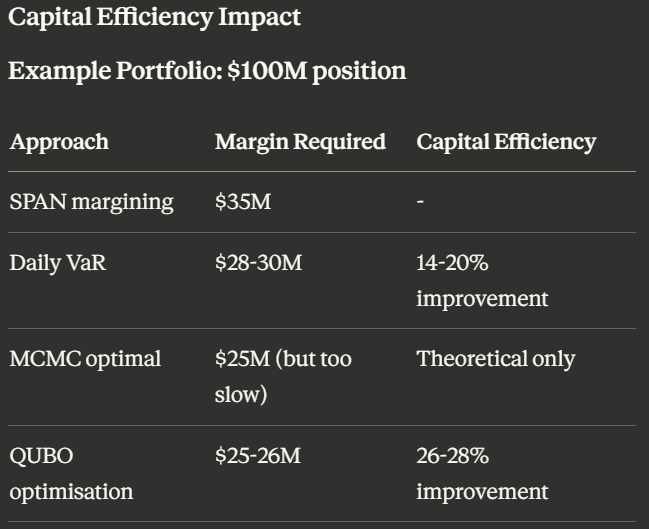
Capital Efficiency Impact
Example Portfolio: $100M position
Real-time capability: Sub-second recalculation vs. overnight batch processing.
Partnership: Block Scholes
Pascal has partnered with Block Scholes — the oracle and analytics provider behind over 80% of options DEX activity — to deliver:
Real-time verifiable pricing feeds
Institutional-grade volatility surfaces
Reference rate construction for settlement
This partnership ensures Pascal's risk calculations use the same data quality relied upon by major institutional participants.
Development Status
Completed Milestones
Pascal Protocol smart contracts deployed on Arbitrum testnet
QUBO risk engine operational with verifiable off-chain computation
Jetstream platform UI and API development
Block Scholes oracle integration
Portfolio margining across BTC/ETH options and futures
Liquidation bot infrastructure
Active Development
Mainnet deployment preparation
Additional asset support (SOL, AVAX, DeFi tokens)
Physical delivery options
Cross-asset derivatives
RWA tokenised derivatives infrastructure
Decentralised Structure & Token Economics
Governance via Pascal DAO
The Pascal Protocol is governed by a decentralised autonomous organisation (DAO):
Token holders vote on parameter changes
Multi-signature requirements for critical upgrades
Time-locked proposals with community review periods
Treasury allocation for development grants
CVEX Labs AG — Independent Contributor
CVEX Labs AG (Switzerland) is an independent contributor to Pascal development:
Provides technical development, risk modelling, and infrastructure support
Does not operate exchanges, platforms, or touch user funds
Compensated through treasury grants and token allocation
No operational control over clearing or settlement
Token-Based Compensation
Handleport Limited's involvement has been as a technical contributor and advisor to the protocol development:
Compensation: Combination of protocol tokens (CVEX) and service arrangements
Nature of relationship: IP development and technical advisory, not employment
Deliverables: Risk model specification, smart contract architecture, protocol design documentation
IP ownership: Contributed to open-source protocol codebase
This structure reflects the decentralised nature of protocol development — contributors are compensated through token allocation rather than conventional employment, aligning incentives with protocol success.
R&D Expenditure Categories
Scientific and Technological Uncertainty
The project faced substantial uncertainty in multiple domains:
1. Computational Feasibility
Whether QUBO-based portfolio optimisation could achieve sufficient accuracy within blockchain gas constraints
Whether verifiable off-chain computation could maintain trustlessness guarantees
Whether real-time risk calculation was achievable for complex portfolios
2. Financial Model Adaptation
Whether fat-tail distributions could be implemented within deterministic smart contracts
Whether cross-asset correlation matrices could be maintained accurately via decentralised oracles
Whether options delta normalisation would produce economically meaningful margin requirements
3. System Integration
Whether two-layer Arbitrum architecture would provide necessary performance
Whether oracle integration would maintain price integrity under adversarial conditions
Whether liquidation mechanisms would function correctly under extreme market stress
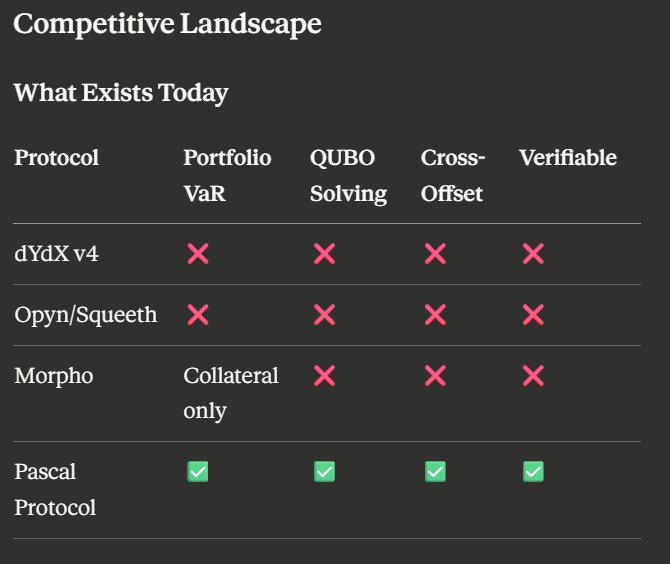
Competitive Landscape
Pascal is the only DeFi protocol combining:
Student-t VaR
QUBO portfolio solver
Bid/offer-aware mark-to-market
Non-linear cross-offset
Verifiable off-chain liquidations
References & Technical Documentation
Academic Foundations
Quantum-Inspired Portfolio Optimisation in the QUBO Framework (Lu et al., 2024)
Systemic Risk and Central Clearing (Duffie, 2011)
ISDA SIMM Standard Initial Margin Model (Industry standard)
CME SPAN and Options Risk Frameworks (Exchange methodology)
Protocol Documentation
Pascal Protocol Technical Specification
CVEX Labs AI Diligence File
Jetstream Platform Documentation
Smart Contract Audit Reports (pending mainnet)
Summary
Pascal Protocol and Jetstream represent a significant technological advancement in decentralised finance infrastructure — the first system capable of providing institutional-grade portfolio margining and clearing for on-chain derivatives markets.
The R&D investment has produced:
Novel QUBO-based real-time risk calculation
First fat-tail VaR implementation on blockchain
Verifiable off-chain computation architecture
Separation of protocol (deterministic) and platform (configurable) layers
This work continues to advance the state of the art in cryptographic financial systems, with ongoing development toward mainnet deployment and broader asset coverage.
Current work includes engaging major trading firms to purchase this IP and continue development to enable tokenised trading of assets to actually start.