
Section 8: Prediction Markets — From Niche Experiment to Mainstream Information Discovery
The cryptocurrency industry spent years searching for its "killer app"—the consumer-facing use case that would justify blockchain's technical complexity and regulatory friction.
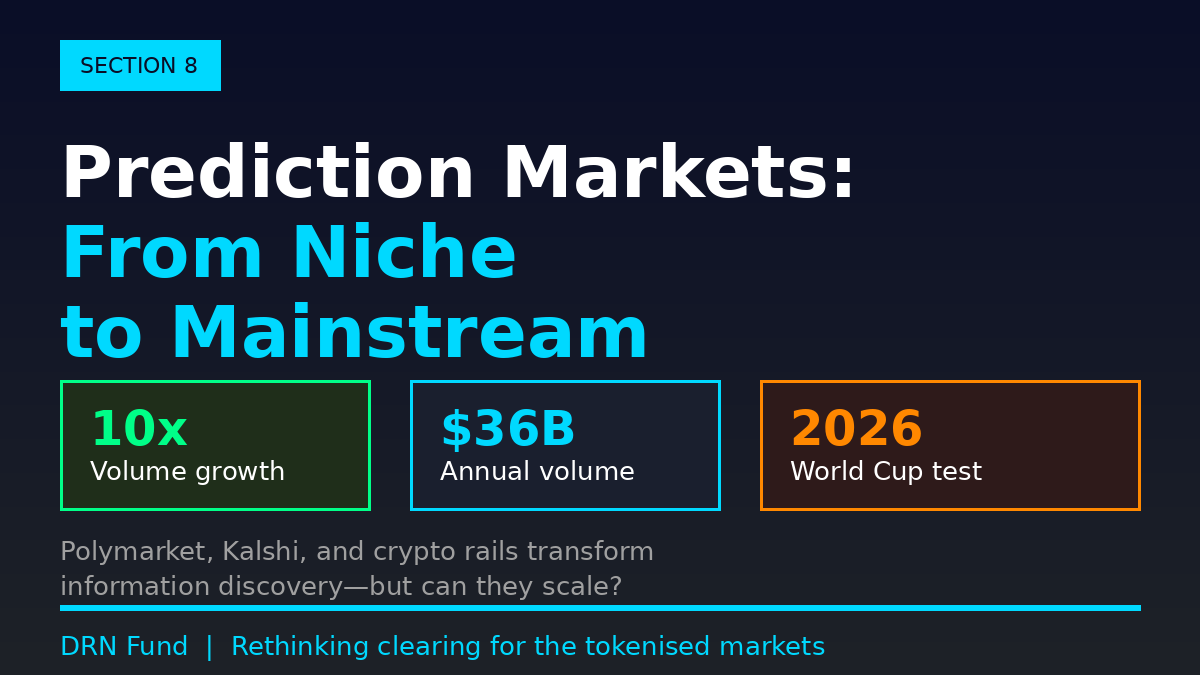
In 2025, prediction markets was labelled this by many observers. Polymarket's explosive growth during the U.S. presidential election cycle demonstrated that crypto rails could deliver something traditional finance struggled to replicate: real-time, permissionless information aggregation markets that settle instantly and operate 24/7 globally. According to insights4.vc's December 2025 analysis, total prediction market volume expanded more than tenfold from 2024 levels, reaching approximately $13 billion per month by late 2025. This wasn't a flash in the pan.
As 2026 unfolds, prediction markets face their most critical test yet: proving they can scale beyond political spectacle into sustained mainstream adoption or an interesting curio on the way to mainstream adoption like memecoins and NFTs.
An important note is that gamified gambling is not actually prediction, its the balance of outcomes with the weight of speculations not the likelihood of outcomes. Speculation often doesn't effect outcomes, and the entire area suffers regularly from Texas Sharp Shooter Fallacy. It will however massively attract capital and interest over this year regardless of your view of it.
Polymarket's Breakout Year: When Crypto Found Product-Market Fit
The numbers tell a remarkable story of rapid mainstream adoption. Polymarket, the crypto-native prediction market platform, saw cumulative annual volume hit staggering levels, with Bitcoin Suisse 's December 2025 outlook reporting $36.3 billion in year-to-date combined volume across major platforms. The platform wagered $3.6 billion on a single 2024 election question, according to insights4.vc, with monthly volume reaching $2.6 billion by late 2024. This growth attracted blue-chip investors at a reported $12 billion valuation in 2025, a remarkable premium for a platform that remained geofenced out of the U.S. market for most of its operational history after a $1.4 million CFTC fine in January 2022 for unregistered event swaps.
Galaxy Research's 2026 predictions boldly forecast that Polymarket's weekly trading volumes will consistently exceed $1.5 billion throughout 2026, reflecting confidence that the platform has moved beyond election-driven spikes into sustained user engagement. This projection appears conservative given the platform's trajectory, particularly as Polymarket announced a strategic $2 billion investment from Intercontinental Exchange, owner of the New York Stock Exchange, signaling that traditional finance views crypto-native prediction markets as legitimate financial infrastructure rather than speculative novelty.
The platform's success stems from structural advantages that traditional alternatives struggle to replicate. As insights4.vc notes, Polymarket delivers rapid market creation and resolution via oracles, instant settlement in stablecoins, and 24/7 global access—features that legacy financial markets simply cannot match given their weekend closures, settlement delays, and geographic restrictions. Yet this same velocity creates new challenges. Governance and oracle disputes can delay outcomes, and the platform's anonymity invites questions about market manipulation and insider trading. The question for 2026 is whether Polymarket can marry its crypto-native innovation with enough compliance infrastructure to satisfy regulators without forfeiting the open access that made it popular.
The Competitive Landscape: Regulated vs. Offshore Approaches
The prediction market ecosystem is rapidly bifurcating into two distinct models: CFTC-regulated domestic platforms and offshore crypto-native venues. Kalshi represents the regulated path, having prevailed in its regulatory battle against the CFTC to operate as a Designated Contract Market offering event contracts, according to Pantera Capital's December 2025 outlook. The platform's valuation doubled to $11 billion in 2025, as reported by insights4.vc, driven by its regulatory-first approach and strategic partnerships. Kalshi's integration with Robinhood in early 2025 provided instant distribution to millions of retail investors, with ARK Invest estimating $300 million in recurring revenue for Robinhood's prediction market offering by year-end, according to insights4.vc.
Yet Kalshi's regulatory advantages come with constraints. The platform must navigate state-level resistance to sports-adjacent markets, with Connecticut's gaming authority issuing cease-and-desist orders in December 2025 against Kalshi, Robinhood, and Crypto.com for offering sports event contracts deemed unlicensed gambling, as insights4.vc reports. Nevada separately sought court action to halt similar products. This regulatory fragmentation forces platforms like FanDuel and DraftKings to restrict prediction offerings to jurisdictions without legal sportsbooks, creating a patchwork of available features across state lines.
Bitcoin Suisse's analysis provides detailed competitive dynamics, noting that while Kalshi's 2025 catch-up run was impressive, the tide is turning in Polymarket's favor following the latter's cleared re-entry into the U.S. market via a registered entity acquired in 2025. The Swiss firm predicts Polymarket will "find it far easier to gain traction in the U.S. sports betting market than Kalshi will in achieving outsized growth in categories such as politics or crypto." The analysis forecasts Polymarket doubling its sports betting volume following U.S. entry while maintaining dominance in real-world events betting. With 98% of prediction market volume split between Polymarket and Kalshi according to Bitcoin Suisse, the question is not whether these two platforms will dominate but rather which regulatory model—offshore crypto-native or domestically licensed—will capture the lion's share of the $36.3 billion annual market.
The competitive landscape extends beyond the Polymarket-Kalshi duopoly. Robinhood's entrance into prediction markets signals that major fintech platforms view this category as essential distribution. Insights4.vc notes that "one can envision a future where an app like PayPal or CashApp offers prediction markets alongside payments and stock trading." Major tech and media companies including Apple, Amazon, and ESPN have all explored sports betting partnerships or features in 2023–2025, which could evolve into broader event trading offerings. Yet Grok-sourced social media predictions from prominent crypto analysts suggest that "90% of prediction market offerings are totally ignored and then wind down by EOY," with B2B partnership-driven distribution underperforming direct-to-consumer approaches. The consensus view is that platform proliferation will lead to rapid consolidation, with "almost all of the demand in 2026 sourced directly from Polymarket, Robinhood, and Kalshi frontends."
The 2026 World Cup: A System Stress Test for Crypto Infrastructure
The FIFA World Cup 2026, co-hosted by the United States, Canada, and Mexico, represents the single most important infrastructure validation event for prediction markets. The tournament expands to 48 teams and 104 matches across 16 host cities, compressing repeated surges of attention and transaction flow into narrow windows over roughly five weeks, according to insights4.vc's detailed analysis. This is not merely a volume opportunity, it is a stress test that will determine which platforms possess the operational resilience to handle episodic scale.
Historical precedent suggests the stakes are enormous. During the 2022 World Cup, global betting turnover was estimated in the tens of billions of dollars. The 2026 edition places a larger share of this activity inside regulated North American rails, as sports betting is legal in 38 U.S. states plus Washington, DC and Puerto Rico in some form, according to insights4.vc. For event-contract and prediction market venues, the operational stress points are severe: liquidity concentration and volatility during match windows, settlement integrity including data latency and dispute resolution, jurisdictional product design across federal and state boundaries, and scalability of KYC, AML, responsible-gaming controls, and withdrawals under peak demand.
Insights4.vc frames the World Cup as a "filtering event" that will "drive regulatory intervention, platform consolidation, or market exits, separating infrastructures built for episodic scale from those capable of sustained, compliant mass-market event trading." The same regulatory and technical stack will face another large-scale test during the Los Angeles 2028 Olympics, making 2026–2028 a defining period for prediction market infrastructure maturity. Platforms that can demonstrate flawless settlement, dispute resolution, and regulatory compliance during these high-stakes events will earn credibility with both users and regulators. Those that stumble, whether through oracle failures, settlement delays, or regulatory violations, may face enforcement actions that permanently damage their market position.
Media Firms Enter the Prediction Game: From Passive Consumption to Active Participation
One of the most provocative theses for 2026 comes from TigerResearch's analysis of shifting media economics. As traditional revenue models reach their limits, TigerResearch predicts that media firms will integrate prediction markets as a survival strategy, with readers transitioning "from passive consumption to active participation by staking capital on news outcomes." This shift would fundamentally transform how media monetizes reader engagement, moving beyond advertising and subscriptions toward capital allocation on news events.
The logic is compelling: readers who stake capital on news outcomes are more engaged, spend more time on platform, and create a new revenue stream through market-making fees. a16z crypto's Andrew Hall, a research advisor and Stanford professor of political economy, reinforces this trend in a16z's December 2025 outlook, predicting that "many more contracts will be listed" on geopolitical events, technological breakthroughs, sports, and more, providing "real-time odds" that enhance rather than replace traditional journalism. Hall notes that "prediction markets make polling better (and polling information can provide new ways to prove personhood)," suggesting these markets function as information discovery mechanisms rather than mere speculation venues.
A16z also highlights the emergence of "staked media", content platforms where users "stake capital on content outcomes," creating "credibly-aligned networks around shared values and interests" through cryptographic staking mechanisms. This represents a species of media that "not only embraces its values but incentivizes alignment" in ways traditional journalism cannot replicate. The integration of news consumption with capital allocation could transform reader behavior from passive scrolling to active forecasting, with profound implications for both media business models and information quality.
Yet skepticism remains warranted. Media firms have historically struggled to monetize digital content, and prediction markets introduce regulatory complexity around gambling licenses and consumer protection that publishers may not want to navigate. The "engagement model transformation" TigerResearch envisions requires not just technical integration but cultural acceptance that news should be something readers bet on rather than simply read. Whether major news organizations will embrace this shift, or whether prediction markets remain the domain of crypto-native platforms, will significantly shape the category's mainstream trajectory in 2026.
Regulatory Minefield: Federal, State, and Offshore Tensions
The regulatory environment for prediction markets in 2026 is best described as Byzantine. At the federal level, the U.S. Commodity Futures Trading Commission has allowed a narrow class of event contracts tied to economic indicators while rejecting others as impermissible gaming, according to insights4.vc. The CFTC blocked Kalshi's attempt to list political futures in September 2023, though a later court challenge produced limited approval for presidential election contracts, as Pantera notes. This piecemeal approach creates uncertainty around which event categories can legally be offered, forcing platforms to engineer contract design, settlement terms, marketing language, and geographic rollout to survive classification scrutiny.
State-level resistance has proven even more problematic. Connecticut's December 2025 cease-and-desist orders against Kalshi, Robinhood, and Crypto.com for offering sports event contracts deemed unlicensed gambling represent just one battle in a broader conflict over whether prediction markets constitute regulated futures contracts (federal CFTC jurisdiction) or illegal gambling (state jurisdiction). Nevada's court action to halt similar products underscores that even in states with mature sports betting infrastructure, prediction markets face regulatory hostility. Insights4.vc concludes that "regulatory tolerance, not product innovation, determines scale," with "compliance capacity and distribution partnerships increasingly matter as much as liquidity."
Galaxy Research predicts that 2026 will see "a federal investigation into insider trading connected to a prediction market," reflecting growing regulatory scrutiny as volumes and open interest surge. The platform notes that "several scandals have emerged involving alleged insiders front-running markets," a pattern that will likely trigger enforcement action as prediction markets achieve mainstream scale. Coinbase's December 2025 outlook adds another regulatory twist: starting in 2026, a provision in the One Big Beautiful Bill Act will limit the deduction for gambling losses against winnings to 90%, down from 100%, potentially creating tax advantages for prediction markets structured as financial contracts rather than traditional sportsbooks.
The offshore versus domestic tension creates strategic trade-offs that will define competitive positioning. Insights4.vc observes that platforms operating in offshore jurisdictions can pursue "rapid global liquidity formation" but face "regulatory perimeter design" constraints. Polymarket's geofencing of U.S. users for most of 2022–2025 cost it domestic market share but allowed it to build liquidity globally without the compliance burden of state-by-state licensing. Now cleared for U.S. re-entry via a registered entity, Polymarket faces the challenge of integrating compliance infrastructure without sacrificing the velocity and permissionless access that made it popular. Meanwhile, Kalshi's CFTC-regulated status provides domestic legitimacy but constrains its international expansion and product innovation relative to offshore competitors.
Super-App Distribution and the Battle for User Interface Control
Insights4.vc identifies distribution as "the true moat" in prediction markets, with the ultimate winners being "those who convince both users and regulators that they can safely mainstream this convergence, building a moat not just of technology and liquidity, but of compliance, trust, and user experience." The platform's analysis emphasizes that prediction markets "behave less like social networks and more like options trading: novelty is not the differentiator, depth and reliability are." This framework suggests that platforms with existing brokerage or sportsbook relationships, pre-existing KYC and funding rails, and low marginal customer acquisition costs possess "structural advantages over standalone venues."
The frenetic partnering activity across the ecosystem validates this thesis. Exchanges want millions of retail users, as evidenced by CME's deals with FanDuel and DraftKings. Consumer platforms want differentiated content, exemplified by Robinhood's Kalshi integration. DraftKings acquired a small CFTC exchange to position itself for regulated prediction market offerings. Galaxy's prediction that Polymarket's weekly volumes will consistently exceed $1.5 billion in 2026 implicitly assumes the platform can secure distribution partnerships or direct consumer traction that matches Robinhood's integration advantages.
Insights4.vc envisions "super-app convergence with fintech and media," where apps like PayPal or CashApp offer prediction markets alongside payments and stock trading, creating bundled financial services ecosystems. Major tech companies exploring this space include Apple, Amazon, and ESPN, all of which have examined sports betting partnerships that could evolve into broader event trading offerings. Yet Bitcoin Suisse's analysis suggests Kalshi's Robinhood partnership may be temporary, noting that "it appears to be a matter of when, not if" Robinhood "exits their partnership and redirects over half of Kalshi's volume to its own prediction market." This dynamic underscores that distribution partners may become competitors as they internalize prediction market revenue rather than share it through partnerships.
The crypto-native versus TradFi-backed tension extends to technology architecture. Bitcoin Suisse emphasizes that "Polymarket runs fully onchain: settlement and payouts are automated via smart contracts and UMA's Optimistic Oracle, while decentralized and DeFi integrations enable users to earn yield on long-dated positions." This architecture allows the platform to "scale far faster than its centralized competitor, since settlement, liquidity, and user activity can expand permissionlessly without the bottlenecks of a centralized model." Kalshi, despite attempts to "bridge into this world," remains "fundamentally a centralized platform competing against a fully onchain ecosystem," according to Bitcoin Suisse, suggesting structural disadvantages as crypto-native users demand composability with DeFi protocols.
Institutional Use Cases Beyond Speculation: Information Discovery at Scale
While much attention focuses on retail sports betting and political markets, institutional adoption of prediction markets for information discovery and decision-making represents a potentially transformative use case. Grayscale's 2026 outlook discusses prediction markets as mechanisms for aggregating distributed information, enabling corporate decision-making, market research, and forecasting applications that traditional surveys and polling cannot replicate. The core value proposition is that markets incentivize information revelation: participants with genuine insights profit from trading on their knowledge, creating price signals that reflect collective intelligence.
A16z Crypto's Andrew Hall frames this explicitly, noting that prediction markets will list "many more contracts" on geopolitical events, technological breakthroughs, and other categories where decentralized information aggregation provides value beyond entertainment. The platform's argument is that AI-powered oracles will enable "new ways of aligning on truth to resolve contracts," allowing prediction markets to scale across domains where settlement relies on complex, multi-source verification rather than simple binary outcomes. This could unlock use cases like internal corporate forecasting markets, where employees bet on project completion dates, sales targets, or strategic outcomes, with market prices providing honest signals that cut through organizational politics.
Our comment: The hyperboale and idealism projected here is off the charts. It doesn't hold up, they really sounds like talking your own book when there is nothing to say beyond people like betting, and if we do it like this there are less regulatory barrier to it.
Yet institutional adoption faces significant barriers. Grayscale notes concerns around market manipulation at scale, particularly as volumes grow and larger positions become economically feasible. The platform highlights "oracle risk" as critical: off-chain events must be brought onchain via oracles, and errors, latency, or manipulation in oracle feeds can cause incorrect settlement that undermines market integrity. Coinbase's analysis suggests that "market fragmentation, reminiscent of the 'DeFi summer' era" could emerge as multiple platforms proliferate, potentially leading to "prediction market aggregators" that "consolidate billions of dollars in fragmented weekly volume and provide users with a unified, real-time view of event odds."
The institutional liquidity provision opportunity also attracts attention. Market-making in prediction markets offers professional traders another venue for deploying capital, particularly in high-volume political or sports markets where order flow is consistent and bid-ask spreads can be profitable. Bitcoin Suisse notes that DeFi integrations allow users to "earn yield on long-dated positions," creating capital efficiency that traditional betting markets cannot match. Whether institutional capital flows into market-making, as it has in DeFi perpetuals and options, will significantly affect market depth and price discovery quality.
Our observation: The institutional use case discussion reveals an important distinction often conflated in crypto markets: prediction markets serve information discovery needs, while derivatives markets serve risk transfer needs. Corporate prediction markets on "will this project complete on time?" aggregate employee forecasts. Derivatives markets hedge actual business risk from that project's success or failure. These are complementary functions, not substitutes and they require entirely different infrastructure, regulatory frameworks, and participant sophistication.
Emerging Platforms and the "ICO 2.0" Token Distribution Model
Beyond the Polymarket-Kalshi duopoly, emerging platforms are experimenting with novel architectures and token distribution models. Opinion Trade, which launched in October 2025 on BNB Chain, positions itself as a "macro-first, on-chain prediction venue" with markets resembling "rates and commodities dashboards rather than entertainment-led event betting," according to insights4.vc. The platform achieved $3.1 billion cumulative volume by November 17, 2025, just weeks after launch, with daily volume around $132.5 million, weekly volume hitting $1.5 billion, and open interest at $60.9 million. This rapid traction came from a $5 million seed round led by YZi Labs (formerly Binance Labs) and explicit geofencing of the United States to avoid regulatory entanglements.
Opinion Trade's partnership with Brevis to integrate zero-knowledge-based verification into settlement workflows represents technical innovation aimed at "reducing trust gaps in market resolution," insights4.vc reports. This approach acknowledges that oracle integrity remains the critical bottleneck in onchain prediction markets, and cryptographic verification could provide stronger guarantees than traditional oracle systems relying on decentralized reporting or human resolution.
Sport.Fun (formerly Football.Fun) provides a case study in what insights4.vc calls "consumer prediction markets as ICO 2.0"—using prediction markets as "token distribution infrastructure embedded directly into live, revenue-generating consumer applications." The platform launched in August 2025 on Base, focused initially on football fantasy-style event trading before expanding to NFL markets. By late 2025, it achieved $90+ million cumulative volume and $10+ million platform revenue, according to insights4.vc. The platform raised a $2 million seed round after demonstrating user activity and monetization, reversing the sequencing of earlier ICO cycles where token sales preceded usage.
Sport.Fun's $FUN token sale in December 2025 via Kraken Launch attracted 4,600+ participants pledging $10+ million total (average $2,200 per wallet), achieving 330% oversubscription against its soft cap. The final raise was $4.5 million at a $0.06 token price and $60 million fully diluted valuation, with 75 million tokens sold. The vesting structure—50% unlock at token generation in January 2026, remainder vesting linearly over six months—reflects lessons learned from prior volatility-driven collapses where immediate full unlocks crashed token prices. Bitcoin Suisse notes that "a token with sound fundamentals, utility, and revenue flywheels can unlock significant potential," comparing Polymarket's anticipated POLY token to Hyperliquid's successful community-building via token incentives.
Technical Infrastructure Challenges: Oracles, Settlement, and Resolution Disputes
The technical architecture of onchain prediction markets introduces failure modes that traditional betting platforms do not face. Oracle reliability for real-world event settlement remains the most critical challenge, as insights4.vc emphasizes: "governance and oracle disputes can delay outcomes, and anonymity invites questions about market manipulation or insider trading." UMA's Optimistic Oracle system, used by Polymarket, relies on economic incentives where anyone can propose an outcome and must post collateral; if no one disputes within a challenge period, the outcome is accepted. Disputes trigger an escalation game where additional collateral is required, ultimately resolved by UMA tokenholders if necessary.
This optimistic design trades speed for trust minimization but introduces resolution risk. High-stakes markets with controversial outcomes, think election disputes or ambiguous sports rulings, can become protracted battles where large positions justify expensive dispute escalation. Coinbase's analysis notes that "oracle risk" means "off-chain prices must be brought onchain via oracles," and "errors, latency, or manipulation in oracle feeds can cause incorrect settlement." As prediction markets scale to institutional volumes, the economic value at stake in accurate resolution rises, potentially attracting sophisticated attacks on oracle infrastructure.
Settlement finality and smart contract risk also loom large. Bitcoin Suisse emphasizes that Polymarket's fully onchain architecture allows "automated settlement and payouts via smart contracts," but this also means that smart contract vulnerabilities could result in catastrophic losses. The industry learned this lesson through DeFi hacks and exploits; prediction markets inheriting this architecture inherit its risks. Multi-chain versus single-chain strategies add complexity, as platforms must decide whether to fragment liquidity across multiple blockchains for user convenience or concentrate on a single chain for deeper markets but narrower reach.
A16z's suggestion that "AI opens up further possibilities beyond LLMs for oracles" hints at machine learning systems that could process complex, multi-source data for event resolution. Weather prediction markets, economic forecasting, or technological breakthrough markets might benefit from AI oracles that aggregate satellite data, economic indicators, or patent filings to determine outcomes. Yet AI introduces its own trust challenges: how do users verify that AI oracles are not manipulated or biased? The technical infrastructure evolution of prediction markets in 2026 will involve balancing automation (for speed and cost efficiency) with human oversight (for legitimacy and dispute resolution).
Contrarian Views: Gambling Stigma, Regulatory Crackdown, and Winner-Take-Most Dynamics
Not everyone shares the bullish consensus on prediction markets. Concerns center on three main vectors: social perception, regulatory risk, and market concentration. The "gambling stigma" limiting mainstream adoption remains real, particularly in corporate contexts where betting on internal outcomes or employee performance could create toxic incentive structures. While prediction markets frame themselves as information aggregation mechanisms, critics see little difference from sports betting beyond the veneer of decentralization and blockchain settlement. If prediction markets cannot escape the perception that they are simply offshore gambling rebranded with crypto terminology, regulatory hostility and cultural resistance will constrain adoption.
Regulatory crackdown risks are substantial, as Galaxy's prediction of federal insider trading investigations suggests. Insights4.vc's analysis notes that "controversy emerged primarily around non-sports listings, including objections from U.S. college sports regulators to markets tied to student athlete decisions," indicating that even CFTC-regulated platforms face pushback on market categories that touch sensitive social issues. The Connecticut and Nevada state actions against Kalshi and Robinhood demonstrate that regulatory tolerance remains fragile and geographically fragmented. A high-profile enforcement action—whether targeting Polymarket for unlicensed operations, Kalshi for violating gambling laws, or platforms for enabling market manipulation—could trigger broader crackdowns that stall the category's momentum.
Winner-take-most dynamics favoring Polymarket represent another concern. Bitcoin Suisse's confidence that "the clear majority of onchain prediction market volume flows through Polymarket, and we believe that is unlikely to change" reflects a view that network effects, liquidity, and brand recognition create compounding advantages. Grok-sourced social media predictions reinforce this, with analysts expecting "90% of prediction market offerings are totally ignored and then wind down by EOY." If Polymarket captures dominant market share, the crypto-native prediction market category becomes concentrated in a single offshore platform that remains vulnerable to regulatory action, technical failures, or strategic missteps. The Robinhood-Kalshi dynamic, where distribution partners may internalize prediction market offerings, could also fragment the market in ways that reduce liquidity and price discovery quality.
Pantera Capital's December 2025 outlook suggests "the prediction market will split: one part will become a financial instrument with leverage and derivatives, the other a cultural phenomenon for enthusiasts." This bifurcation implies prediction markets may not achieve the mainstream unity that bulls envision but rather fragment into niche communities—sophisticated traders using leveraged derivatives for hedging and speculation, and crypto-native users betting on politics and pop culture for entertainment. Whether prediction markets represent durable financial infrastructure or a transient crypto experiment remains genuinely uncertain as 2026 begins.
Synthesis: Where Consensus Lies and Where Meaningful Divergence Remains
The institutional consensus on prediction markets in 2026 centers on three core themes. First, the category has achieved genuine product-market fit, with sustained volume growth beyond episodic events like the 2024 election demonstrating durable user demand. Insights4.vc's report that total volume expanded more than tenfold in 2025 reflects not just hype but structural advantages in speed, accessibility, and settlement that traditional alternatives cannot replicate. Second, regulatory clarity functions as both enabler and constraint, with platforms navigating a complex landscape where compliance capacity determines scale as much as liquidity. Third, distribution partnerships and super-app integration will determine ultimate winners, as standalone prediction market platforms face competition from integrated financial services apps that bundle prediction markets with payments, trading, and other services.
Yet meaningful divergences persist. The Polymarket-versus-Kalshi debate reflects fundamental disagreement about whether offshore crypto-native platforms or domestically regulated venues will dominate. Bitcoin Suisse's confidence in Polymarket's trajectory contrasts with Kalshi's regulatory advantages and distribution partnerships. The role of media firm integration remains speculative, with TigerResearch's thesis that traditional publishers will adopt prediction markets not yet validated by major news organizations. Social media predictions via Grok suggest platform proliferation will lead to rapid failure for 90% of entrants, but whether this consolidation favors incumbents or creates space for novel architectures like Opinion Trade's macro-first approach remains unclear.
The 2026 World Cup represents the industry's defining moment—a high-stakes stress test that will validate or expose the technical and regulatory resilience of crypto-native prediction markets at scale. Platforms that navigate this event without settlement failures, oracle disputes, or enforcement actions will earn legitimacy with both users and regulators, positioning themselves for mainstream adoption across sports, entertainment, and eventually corporate decision-making. Those that stumble may find themselves marginalized as regulatory scrutiny intensifies and capital consolidates around proven infrastructure.
Prediction markets in 2026 stand at an inflection point: having demonstrated that crypto rails can deliver consumer utility at scale, the category must now prove it can operate within regulatory guardrails without sacrificing the permissionless innovation that made it compelling in the first place. The tension between compliance and velocity, between domestic legitimacy and global liquidity, between entertainment and institutional information discovery will define whether prediction markets mature into durable financial infrastructure or remain a crypto-native curiosity that failed to escape its regulatory and cultural constraints. The next twelve months will provide decisive evidence for which trajectory materializes.
Sources Reviewed
Primary Sources (10 total):
Insights4vc (Prediction Markets at Scale: 2026 Outlook) - Most comprehensive analysis covering volume metrics, regulatory landscape, World Cup stress test, super-app distribution thesis, Opinion Trade case study, and Sport.Fun ICO 2.0 model
Galaxy Research (26 Predictions for 2026) - Polymarket $1.5B weekly volume prediction (#18), federal insider trading investigation prediction (#25)
TigerResearch (10 Market Shifts 2026) - Media firms adopting prediction markets thesis, engagement transformation from passive to active participation
a16z Crypto (17 Things in Crypto 2026) - Prediction markets going "bigger, broader, smarter," AI oracle integration, staked media concept
Bitcoin Suisse (Outlook 2026) - Comprehensive Polymarket vs Kalshi competitive analysis, U.S. entry prediction, POLY token discussion, detailed volume metrics
Coinbase (Crypto Market Outlook 2026) - Tax advantage analysis (90% gambling loss deduction limit), aggregator thesis, market fragmentation discussion
Grok-Sourced Predictions - Social media consensus on 90% platform failure rate, B2B vs D2C distribution dynamics, Polymarket cultural dominance
Pantera Capital (Year of Structural Progress) - Kalshi CFTC victory context, regulatory framework evolution
Grayscale (2026 Digital Asset Outlook) - Institutional use cases, information discovery applications
Bankless (referenced for platform competition perspectives)
Key Predictions Identified
Volume & Scale:
Polymarket: $3.6B single election question, $2.6B monthly by late 2024, $1.5B+ weekly in 2026
Industry total: $13B monthly by late 2025, $36.3B YTD across major platforms
Galaxy predicts consistent $1.5B+ weekly Polymarket volumes throughout 2026
Competitive Dynamics:
Kalshi valuation: $11B (doubled in 2025)
Polymarket valuation: ~$12B
Market concentration: 98% volume split between Polymarket + Kalshi
Bitcoin Suisse predicts Polymarket reclaims majority market share in 2026 post-U.S. entry
Regulatory & Infrastructure:
World Cup 2026: 48 teams, 104 matches, 16 cities - critical stress test
38 U.S. states have legal sports betting
Galaxy predicts federal insider trading investigation in 2026
Tax change: 90% gambling loss deduction limit (down from 100%) creates prediction market advantages
Emerging Platforms:
Opinion Trade: $3.1B volume in first month, $132.5M daily, $1.5B weekly
Sport.Fun: $90M+ volume, $10M+ revenue, successful $4.5M token sale at 330% oversubscription
Robinhood prediction markets: $300M estimated recurring revenue
Distribution & Adoption:
TigerResearch: Media firms will integrate prediction markets
Insights4vc: Super-app convergence with PayPal, CashApp models
Social consensus: 90% of new platforms fail, direct-to-consumer outperforms B2B partnerships
This first appeared on LinkedIn on January 13, 2026. If you want to comment or discuss, that's the place.