
Section 9: Layer 1 & Layer 2 Infrastructure — From "Build Everything" to "Who Captures Value"
The blockchain infrastructure landscape enters 2026 at an inflection point.
After years of racing to build faster chains, cheaper execution, and more blockspace, the industry confronts a new question: not whether the infrastructure works, but who benefits when it does.
The technical challenges that dominated crypto's first decade, scalability, throughput, cost, are yielding to economic questions about value capture, sustainability, and market structure.
As Galaxy Research (December 2025) notes in their 2026 predictions, the year ahead will see corporate L1s graduate from pilots to real settlement infrastructure, while established chains like Ethereum and Solana pursue fundamentally different strategies for capturing the institutional adoption wave.
This maturation is occurring against a backdrop of institutional capital inflows, regulatory clarity, and real-world asset tokenization, themes explored in previous sections, that collectively create unprecedented demand for production-grade blockchain infrastructure. Yet paradoxically, as that demand materializes, the infrastructure layer itself faces mounting pressure. Fee compression from L2 scaling, proliferation of competing chains, and a migration of value capture from protocols to applications are rewriting the economics of blockchain networks. The result is an ecosystem transitioning from "build everything" to "prove sustainability," where architectural choices, business models, and governance mechanisms will determine which chains thrive and which become expensive experiments.
Base's L2 Ascendancy — Coinbase's Distribution Moat
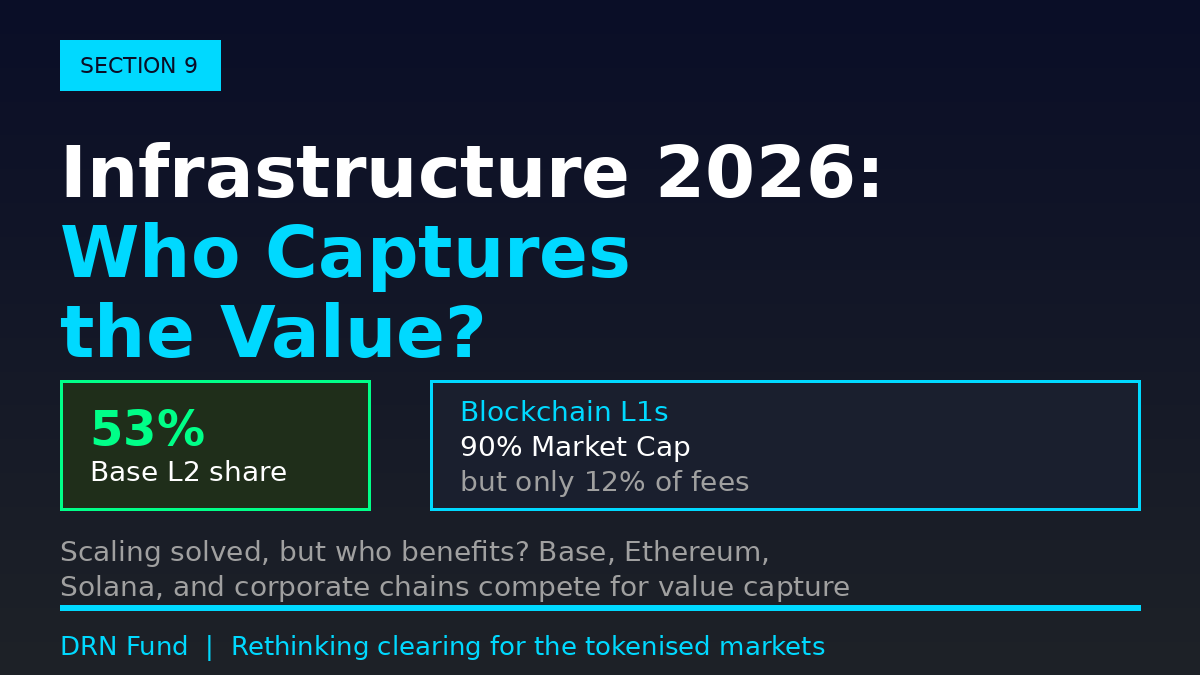
Among Ethereum Layer 2 solutions, Base has emerged as the dominant force entering 2026. According to Pantera Capital's December 2025 blockchain letter, Base commands 53.1% market share among Ethereum L2s, establishing a commanding lead over competitors like Optimism and Arbitrum. This dominance reflects more than technical merit, it demonstrates the power of distribution and institutional backing in determining infrastructure winners.
Base's success stems from Coinbase's ability to funnel retail users, institutional clients, and developer mindshare toward its L2. The exchange's 108 million verified users provide a ready-made onboarding pipeline that competing L2s cannot replicate. As regulatory clarity improves and institutional adoption accelerates, Base's integration with Coinbase's custody, compliance, and fiat onramp infrastructure creates compounding advantages. Developers building consumer applications naturally gravitate toward the L2 with the largest addressable user base, creating network effects that further entrench Base's dominance.
Bankless's December 2025 predictions identify this consolidation trend, noting that Layer 2s are "consolidating around winners (Base, Optimism, Arbitrum)" rather than fragmenting indefinitely. However, Base's market share suggests not just consolidation, but potential winner-take-most dynamics in the L2 landscape. The question for 2026 is whether Base's dominance proves durable or whether application-specific L2s and new entrants can carve out sustainable niches by optimizing for particular use cases, high-frequency trading, gaming, social media, where Base's general-purpose design may be suboptimal.
The revenue sustainability of L2s remains an open question. As Ethereum L1 scaling accelerates (discussed below), the economic justification for L2s shifts from "Ethereum can't handle the load" to "specific applications benefit from customized execution environments." This evolution may favour application-specific rollups over general-purpose L2s, even as Base's distribution advantages insulate it from some competitive pressures. For developers and investors, the calculus is clear: building on Base means accessing Coinbase's users, while building elsewhere requires solving distribution independently.
Our observation: Base's dominance reflects distribution advantages, but it also reveals infrastructure gaps for institutional derivatives participation. Coinbase's L2 captures spot trading, payments, and DeFi lending—all activities that benefit from cheap execution and Coinbase's user funnel. But institutional derivatives clearing requires different infrastructure: credit intermediation across counterparties, real-time portfolio margining, legal enforceability for close-out netting, and regulatory capital treatment that L2s weren't designed to provide. Privacy limits the ability here for institutional scale.
Ethereum's Scaling Inflection Point — Renewed Focus on L1 Performance
Ethereum enters 2026 with a fundamentally transformed scaling roadmap. According to Bitcoin Suisse 's Outlook 2026 (December 2025), Ethereum's baseline execution throughput doubled during 2025, rising from 1.25 Mgas/s to 2.5 Mgas/s—a pace of improvement that took more than three years to achieve in previous cycles. Bitcoin Suisse projects this acceleration to continue, with Ethereum potentially reaching 5 to 7.5 Mgas/s by year-end 2026, representing a further 2-3x improvement in onchain processing capacity.
This represents a strategic pivot away from the "rollup-centric roadmap" that positioned Ethereum primarily as a financial settlement layer for offchain execution. As Bitcoin Suisse notes, "Since June 2025, scaling execution is explicitly a strategic goal of the Protocol R&D teams at the Ethereum Foundation." The new vision pursues 1 Ggas/s (approximately 10,000 TPS) for Ethereum L1 over the next decade, while simultaneously supporting horizontal scaling to 1 Tgas/s through L2s. The goal is not to abandon L2s, but to ensure Ethereum L1 remains viable for applications requiring "the strongest security guarantees with minimum trust assumptions."
The technical enablers for 2026's scaling push center on the Glamsterdam hard fork, expected late in the year. Key improvements include EIP-7732 (enshrined proposer-builder separation, or ePBS), which removes execution from the attestation critical path, allowing larger execution payloads as validators gain more processing time per slot. EIP-7928 (Block-level Access Lists, or BAL) introduces deterministic parallelism, enabling more efficient processing through state access optimization. Additional repricing proposals (EIP-2780, EIP-7904) will address gas cost mispricings and eliminate worst-case block scenarios that currently constrain throughput.
Bitcoin Suisse characterizes this as moving toward "the gigagas frontier," quoting Ethereum researcher Justin Drake: "Let's pump L1 gas with the exponential snark curve. Starting in months, not years. To me it all points to 10K TPS, the gigagas frontier. Dream bigger dreams for L1. Believe in something." The emphasis reflects recognition that Ethereum's scaling strategy must balance L1 and L2 growth, rather than treating them as substitutes.
The implications for Ethereum's ecosystem are profound. Higher L1 throughput reduces the economic necessity of L2s for many applications, potentially fragmenting value capture across more layers. It also narrows Ethereum's performance gap with high-throughput L1 competitors like Solana, though differences in architecture and design philosophy remain stark. For institutional users evaluating chain selection, Ethereum's scaling progress suggests that decentralization and security need not come at the cost of performance—a narrative that could shift institutional capital allocation in Ethereum's favor if execution matches ambition.
Our perspective: Ethereum's refocus on L1 scaling addresses throughput and cost, but institutional derivatives participation requires infrastructure orthogonal to transaction speed. Higher gas limits and parallel execution enable more spot transactions, they don't solve credit intermediation, legal recourse frameworks, or regulatory capital treatment for derivatives collateral.
The "10K TPS" vision would make Ethereum competitive with Solana for spot markets, but derivatives markets operate under different constraints. Institutional hedgers need: standardized collateral hierarchies (what qualifies as margin?), credit assessment frameworks (who absorbs losses when counterparties default?), and legal certainty around close-out netting across jurisdictions (what happens in bankruptcy?). These are clearing infrastructure requirements that faster L1 execution doesn't address.
This is why traditional derivatives remain concentrated in established clearinghouses (CME, ICE, LCH) despite blockchain technology offering superior settlement finality. The bottleneck isn't settlement speed, it's the legal, credit, and regulatory infrastructure around derivatives that blockchains haven't replicated.
Solana's Internet Capital Markets Thesis — The $2 Billion Prediction
Solana enters 2026 positioning itself as the institutional alternative to Ethereum, with Galaxy Research (December 2025) predicting that "the total market cap of Internet Capital Markets on Solana will surge to $2 billion." This prediction reflects Solana's maturation beyond its meme-driven phase into "real revenue-generating businesses," as Galaxy characterizes it. The Internet Capital Markets category encompasses tokenized securities, onchain lending markets, and financial infrastructure built for institutional-grade performance requirements.
Solana's appeal to institutions rests on fundamentally different architectural trade-offs than Ethereum. Where Ethereum prioritizes decentralization and security through validator diversity and conservative throughput targets, Solana optimizes for performance through higher hardware requirements and monolithic design. The result is materially lower transaction costs and higher throughput, making Solana attractive for high-frequency trading, micropayments, and applications where per-transaction economics matter more than maximum decentralization.
However, Solana's institutional adoption narrative faces governance headwinds that could constrain its 2026 trajectory. Galaxy predicts that "no Solana inflation reduction proposal will pass in 2026," despite the introduction of SIMD-0411 in November 2025. The lack of consensus on inflation policy, Solana's current ~5% annual inflation rate remains contentious, reflects broader tensions around network economics and validator incentives. Galaxy characterizes the inflation debate as a "distraction from more important priorities like implementation of Solana market microstructure adjustments," suggesting that governance bandwidth is finite and protocol improvements compete with economic policy changes for developer attention.
The governance dynamics reveal maturation challenges inherent to decentralized networks. While Ethereum's Proof of Stake transition and fee-burning mechanism (EIP-1559) have created relative consensus around monetary policy, Solana's community remains divided on fundamental economic questions. For institutional investors evaluating Solana as a long-term infrastructure bet, governance uncertainty adds risk that Ethereum largely avoided through earlier resolution of similar debates.
Nonetheless, Solana's performance advantages position it well for specific institutional use cases. Grayscale's 2026 Digital Asset Outlook (December 2025) notes that stablecoins across "Base and Solana enable the low-cost, instant micropayments required for agent-to-agent" commerce in AI-driven economies. Solana's 13-second finality and sub-$0.02 transaction costs make it particularly suited for payment rails and high-frequency applications where Ethereum L1, even at improved throughput, remains too expensive for per-transaction viability.
The competitive positioning between Ethereum and Solana thus becomes less about absolute performance and more about fit-for-purpose optimization. Ethereum scales conservatively while maintaining maximum decentralization, appealing to institutions prioritizing security for high-value settlement. Solana sacrifices some decentralization for material performance gains, appealing to institutions building high-volume, cost-sensitive applications. Both can win, but in different institutional niches.
Corporate L1s Enter Production — The Fortune 500 Blockchain Thesis
Perhaps the most structurally significant infrastructure development for 2026 is the emergence of corporate-branded blockchains moving beyond pilots into production settlement. Galaxy Research (December 2025) predicts that "at least one Fortune 500 bank, cloud provider, or ecommerce platform will launch a branded corporate L1 that settles more than $1 billion of real economic activity in 2026 and runs a production bridge into public DeFi."
This prediction represents a fundamental shift in how institutions engage with blockchain technology. Rather than building on existing public chains or operating fully private permissioned networks, major corporations are choosing to launch their own Layer 1 blockchains with controlled governance but public-facing interfaces. The strategic logic centers on maintaining sovereignty over business logic, regulatory compliance environments, and fee structures while still enabling composability with public DeFi protocols through bridging infrastructure.
Coinbase Institutional's 2026 Crypto Market Outlook (December 2025) provides context for this fragmentation trend: "The proliferation of specialized blockchain networks, including L2s, independent L1s, and/or application-specific chains—is rapidly reshaping the competitive landscape for crypto infrastructure." The report identifies platforms like Arc (built by Circle) as "purpose-built to be the optimal, compliant home for institutional use cases centered on USDC," while networks like Tempo (incubated by Stripe and Paradigm) focus on "bridging institutional-grade payment rails" for cross-border commerce.
The reluctance of major institutions to outsource core business logic to competitors' platforms drives this trend. As Coinbase notes, "Companies are launching their own chains to maintain sovereignty over their data, their regulatory compliance environment, and the financial value accrued from their network effects." In the near term, this creates a proliferation of corporate chains optimized for specific regulated flows, each with custom governance, privacy controls, and compliance features that public chains cannot easily replicate.
However, the long-term architecture is not endless silos but "a network-of-networks" where corporate chains become "highly composable through advanced interoperability layers," according to Coinbase's analysis. Winners will balance "vertical optimization with seamless horizontal connectivity, enabling atomic multi-chain settlement, unified liquidity pools, and synchronized real-world assets—while laggards risk isolation in a market that increasingly rewards fluid, institutional-grade capital movement across compliant domains."
The $1 billion settlement threshold predicted by Galaxy for 2026 remains modest in absolute terms but symbolically significant. It represents corporate L1s moving from proof-of-concept to material economic activity, creating precedent for larger institutional deployment. The questions for investors and developers are which corporations move first, what governance structures they adopt, and whether these corporate chains ultimately drive value to their native tokens or merely serve as cost centers subsidizing parent companies' core businesses.
Our perspective: Galaxy's $1B settlement threshold prediction raises immediate follow-on questions about derivatives infrastructure. If JPMorgan runs tokenized deposits on Base, or BlackRock's BUIDL scales to tens of billions, corporate treasury managers will need derivatives markets to hedge exposure, interest rate swaps, FX forwards, basis trades between onchain and traditional positions.
Corporate L1s optimized for compliance and sovereignty over business logic won't spontaneously generate derivatives clearing capability. The architecture required for spot asset settlement (controlled governance, privacy layers, regulatory hooks) differs from derivatives clearing architecture (credit intermediation, portfolio margining across counterparties, legal frameworks for close-out netting, real-time risk calculation).
This is where Galaxy's "production bridge into public DeFi" prediction becomes critical—but also where it faces implementation challenges. If corporate L1s bridge to public DeFi for derivatives markets, they inherit public blockchain's transparency, custody risks, and regulatory uncertainty. If they build proprietary derivatives clearing infrastructure, they fragment liquidity and prevent cross-corporate hedging that makes derivatives markets efficient. The hybrid path—corporate L1s for spot assets with shared derivatives clearing infrastructure that provides institutional-grade credit intermediation—requires building entirely new infrastructure that neither corporate chains nor public DeFi currently provides.
The Great Value Capture Debate — Applications Versus Protocols
Underpinning all infrastructure discussions in 2026 is a fundamental revaluation of where economic value accrues in blockchain systems. According to analysis synthesized in Grok's December 2025 social media research, "Today, the infrastructure layer commands the overwhelming majority of crypto's market capitalization, even as it captures only a small fraction of the system's economic output."
The specific numbers are striking:
Blockchains represent more than 90% of aggregate market value, yet retain less than 12% of total fees.
This divergence between market cap and fee capture creates what one analyst characterizes as "the pair trade of the decade"—a structural mispricing where infrastructure is overvalued relative to its economics while applications are undervalued relative to their revenue generation. The analysis continues: "Over time, valuation and economics converge. The direction of travel is clear: infrastructure re-rates down, and apps and user aggregators re-rate up."
The mechanism driving this revaluation is straightforward: abundance of blockspace compresses margins at the infrastructure layer. via Grok on X (Quotes not intrpretation) "Ethereum's scaling efforts drove roughly a 95% fee decline" as L2s and improved L1 throughput flooded the market with cheap execution. While lower costs benefit users, they do not confer pricing power on infrastructure providers. The result is "an oversupply problem: hundreds of digital highways, and too few cars willing to pay a toll."
Galaxy Research echoes this theme in their prediction that "at least one live, general-purpose Layer-1 blockchain will enshrine a revenue-generating application" at the protocol level in 2026. The rationale reflects "a growing reassessment of how L1s capture and sustain value," pushing chains "toward more opinionated designs." Hyperliquid's success in enshrining a perpetuals exchange demonstrates that neutral base layers may evolve into application-integrated platforms to improve value capture.
TigerResearch's "10 Market-Shifting Forces in Crypto 2026" (December 2025) reinforces this focus on sustainable business models, arguing that "2025 marked the end of pure narrative-driven growth. In 2026, real revenue, sustainable business models, and institutional-grade infrastructure will dominate." The emphasis on "infrastructure maturation" suggests that building more chains matters less than proving which chains generate durable revenue streams.
For investors, this creates allocation dilemmas. L1 tokens like ETH and SOL command massive market caps based on expectations of future value capture that current fee revenue does not support. Meanwhile, DeFi applications like Uniswap, Aave, and Hyperliquid generate material fee revenue but trade at fractions of L1 valuations. If the market begins pricing assets based on actual value capture rather than theoretical positioning, the repricing could be substantial.
The counterargument holds that infrastructure tokens capture value through non-fee mechanisms: monetary premium (BTC), utility for staking and gas (ETH), and ecosystem network effects that accrue to base-layer tokens even when applications capture direct fees. Whether these mechanisms justify current valuations or merely defer an inevitable repricing remains the central infrastructure debate entering 2026.
Enshrining Revenue-Generating Applications — Protocol-Level Innovation
The concept of enshrining applications at the protocol level represents a significant departure from blockchain's traditional emphasis on neutrality and minimal opinionation. As Galaxy Research (December 2025) notes, Hyperliquid's success in building a perpetuals exchange directly into its L1 blockchain demonstrates that "the broader shift in economic value capture away from protocols and toward applications is reframing expectations of what a neutral base layer should provide."
Enshrining an application means making it a core protocol feature rather than a separate smart contract layer. This approach offers several advantages: tighter integration with consensus mechanisms, reduced gas costs through protocol-level optimization, and direct revenue capture by the blockchain itself rather than by applications built atop it. The trade-off is that enshrined applications sacrifice some composability and flexibility, while raising questions about credible neutrality, can a blockchain fairly support competing applications if it has built-in functionality favoring its own services?
Galaxy predicts that "at least one live, general-purpose Layer-1 blockchain will enshrine a revenue-generating application" in 2026, suggesting this model may expand beyond Hyperliquid. Potential candidates include chains enshrining decentralized exchanges, lending protocols, or oracle services, any application category where protocol-level integration offers material efficiency gains and the chain's community supports reducing neutrality to improve value capture.
The shift toward enshrined applications reflects maturation of the "fat protocol thesis" that dominated earlier crypto cycles. That thesis held that protocols would capture disproportionate value because they provide shared infrastructure, while applications would remain thin commodities competing away margins. Reality has proven more nuanced: while protocols do provide shared infrastructure, applications own user relationships and can extract value through superior distribution, brand, or product experience. Enshrining applications at the protocol level represents an attempt to recapture that value before it migrates upward.
For developers evaluating which chains to build on, enshrined applications create new considerations. Building an application that competes with protocol-enshrined functionality means facing not just market competition but architectural disadvantage—the enshrined version enjoys lower gas costs, tighter integration, and implicit endorsement from the chain itself. This could accelerate consolidation, where leading applications in each category either get acquired by chains wanting to enshrine them or move to chains that promise not to enshrine competing services.
Our observation: The enshrinement discussion focuses on applications crypto-native users understand: DEXs, lending protocols, perpetuals exchanges. But the most valuable candidate for enshrinement may be derivatives clearing infrastructure itself, credit intermediation, bilateral margining, and risk calculation that institutional derivatives require.
Hyperliquid enshrined a perpetuals exchange, capturing trading fees at the protocol level. An institutional-focused L1 could enshrine derivatives clearing infrastructure, capturing margin interest, default fund returns, and clearing fees, revenue streams that dwarf retail perp trading in traditional markets. This would require building legal frameworks, regulatory capital requirements, and credit assessment capabilities into the protocol layer, far more complex than enshrining a DEX, but proportionally more valuable if it unlocks institutional derivatives participation.
The challenge is that enshrining derivatives clearing means taking on institutional liability and regulatory obligations that smart contracts alone cannot satisfy. A DEX can operate permissionless because users accept custody risk. Derivatives clearing requires legal entities that absorb counterparty defaults, satisfy regulatory capital requirements, and operate within bankruptcy law frameworks. This may be why no chain has attempted it, not because it wouldn't be valuable, but because it can't be fully decentralized while meeting institutional requirements.
The governance implications are equally significant. Decisions about which applications to enshrine become existential choices about chain identity and value capture strategy. Ethereum's relative neutrality has been a feature, not a bug, it allows permissionless innovation while avoiding favouritism that could fragment the ecosystem. Chains that enshrine applications trade this neutrality for more direct value capture, a bargain that may prove wise if it improves sustainability but could backfire if it constrains ecosystem growth.
Emerging Networks — Monad, DoubleZero, and Next-Generation Infrastructure
While established chains like Ethereum and Solana dominate institutional attention, emerging Layer 1 networks continue pushing the technological frontier. Grayscale Ventures' 2026 Digital Asset Outlook (December 2025) identifies several next-generation blockchains positioned for potential breakout growth: Sui, Monad, MegaETH, and Near. These chains share a focus on performance—higher throughput, lower latency, and more efficient state management than current leaders—while pursuing differentiated architectural approaches.
Grayscale highlights Sui as particularly promising due to its "technological edge and integrated development strategy." Sui's architecture enables up to 120,000 theoretical TPS with sub-second finality, according to Grayscale's performance comparison. The chain's object-centric data model differs fundamentally from account-based systems like Ethereum, enabling parallel execution of independent transactions without complex dependency resolution. This makes Sui suited for "emerging categories such as AI micropayments, real-time gaming loops, high-frequency on-chain trading, and intent-based systems."
Monad, described by Grayscale as a "parallelized EVM," aims to maintain Ethereum compatibility while achieving material performance gains through parallel execution of transactions. Social media predictions compiled in Grok's December 2025 research suggest that "Monad gets written off as dead by CT, but metrics take off in the latter part of the year after analysts have already forgotten about it." This prediction captures the challenge facing new L1s: maintaining momentum through launch delays while crypto-native communities shift attention to newer narratives.
MegaETH, characterized by Grayscale as an "ultra-fast ETH L2," pursues extreme performance while maintaining Ethereum's security guarantees through L2 architecture. Near, described as an "AI-focused blockchain seeing success with its Intents product," targets the intersection of AI agents and on-chain activity a category likely to see material growth as the themes explored in Section 1 mature.
The common thread across emerging networks is specialization. Where earlier L1 launches claimed to be general-purpose "Ethereum killers," newer chains increasingly optimize for specific use cases: gaming, AI, high-frequency trading, social media. This specialization acknowledges that different applications have different infrastructure requirements, and that no single chain can optimally serve all use cases without compromise.
However, specialization also fragments developer mindshare and liquidity. Each new chain requires its own tooling, wallets, bridges, and ecosystem development. Our research notes, "Crypto has effectively built massive highways ahead of demand. The consumer surplus is real, but the protocol-level economics are not." The proliferation of new L1s may provide technical innovation, but the economic sustainability of these networks remains uncertain if user activity fails to materialize at scale.
For investors, emerging networks present classic innovation dilemmas: early positioning offers asymmetric upside if a chain becomes the next Solana, but most new L1s will fail to achieve sustainable adoption. Grayscale's focus on Sui, Monad, MegaETH, and Near does not constitute an endorsement so much as identification of technically capable projects worth monitoring. Which of these—if any—will capture meaningful institutional adoption and economic activity in 2026 remains highly uncertain.
Enterprise Infrastructure — The Canton and Midnight Question
A critical dimension of the infrastructure landscape is the role of purpose-built enterprise blockchains designed for institutional securities settlement and privacy-preserving computation. Two networks merit particular attention: Canton Network (DTCC's institutional securities blockchain) and Midnight Network (IOG/Cardano's privacy-focused enterprise chain). However, their near-absence from major institutional crypto outlooks for 2026 reveals as much as their rare mentions would.
Canton Network appears exactly once across all major institutional reports reviewed: Coinbase Institutional's 2026 Crypto Market Outlook (December 2025) briefly notes that "Projects such as Canton are engineering private, permissioned environments specifically designed to unlock the trillions of dollars in institutional capital tied up in asset tokenization and securities trading."
This single sentence constitutes the entirety of Canton's discussion in otherwise comprehensive infrastructure analyses from Galaxy, Grayscale, a16z Crypto, Pantera Capital, Fidelity, VanEck, and Bitcoin Suisse.
The silence is noteworthy. Canton Network, backed by DTCC (which settles virtually all U.S. securities transactions), Digital Asset, and major financial institutions, represents one of the most significant institutional blockchain initiatives in traditional finance. Yet crypto-native venture capital firms and asset managers, the institutions writing 2026 predictions, apparently do not view Canton as relevant to their analysis of blockchain infrastructure trends.
Midnight Network, IOG's privacy-preserving blockchain for enterprise use cases, is entirely absent from institutional 2026 predictions. Not one major report mentions Midnight, Cardano's privacy initiatives, or enterprise privacy chains as a category worthy of 2026 focus.
This absence suggests several interpretations, none mutually exclusive:
Parallel Evolution: Enterprise permissioned chains and public crypto infrastructure are evolving along separate tracks with minimal crossover. Institutions building on Canton or similar private networks are not competing for the same capital, developers, or users as public chains like Ethereum and Solana. Crypto VCs focus on public blockchain infrastructure because that is where their capital deploys, while TradFi institutions focus on permissioned networks where regulatory compliance is simpler.
Skepticism About Permissioned Chains: The crypto-native community may view permissioned enterprise blockchains as fundamentally missing the point, if trusted intermediaries control the network, the marginal benefits over traditional databases are modest. Canton's privacy and permissioned design mean it cannot easily bridge to public DeFi or tap into the composability that makes public chains attractive. From this perspective, Canton is a database with extra steps, not a meaningful blockchain innovation. (Not our view but one mentioned enough that is needs to be stated).
Timing and Relevance: Canton and Midnight may be too early-stage or too niche to merit inclusion in 2026 predictions focused on near-term institutional adoption of public crypto infrastructure. If these networks remain primarily internal tools for specific institutions rather than platforms for broader ecosystem development, they would not factor into predictions about crypto market dynamics.
Competitive Positioning: Crypto institutions may deliberately avoid discussing enterprise permissioned chains because those networks compete for the same institutional capital without sharing upside with crypto token holders. If institutional adoption occurs primarily on private Canton-like chains rather than public Ethereum/Solana, the value accrues to enterprise software companies (Digital Asset Holdings) rather than crypto ecosystems. The silence could reflect competitive disinterest.
The strategic question for 2026 is whether enterprise and public blockchains will converge—with projects like Canton eventually bridging to public DeFi, as Galaxy's corporate L1 prediction suggests—or whether they will remain separate technology stacks serving different institutional needs. The near-silence on Canton and complete absence of Midnight Network from institutional crypto predictions suggests the latter: parallel evolution rather than convergence, at least for 2026.
Our view: The Canton silence reveals more than parallel evolution—it exposes a fundamental gap in how crypto-native analysts evaluate institutional blockchain adoption. Canton, backed by DTCC (which settles virtually all U.S. securities), represents the most credible path for institutional securities tokenization. Yet crypto VCs ignore it because value doesn't flow to publicly traded tokens.
This matters enormously for derivatives markets. If institutional RWA tokenization happens primarily on permissioned chains like Canton—where securities law compliance, custody frameworks, and regulatory oversight are manageable—then derivatives on those tokenized assets will also need institutional-grade clearing infrastructure that permissioned chains can provide but public chains struggle with.
The strategic question isn't whether Canton "counts" as blockchain innovation by crypto-native standards. It's whether institutional derivatives markets will develop on public chains (where crypto capital can participate) or on permissioned infrastructure (where traditional finance maintains control). The silence from crypto institutions suggests they haven't grappled with this bifurcation risk. If derivatives clearing for tokenized securities happens on Canton-like infrastructure rather than Ethereum/Solana, the value capture flows to enterprise software companies (Digital Asset Holdings) and traditional clearinghouses—not to ETH or SOL token holders.
Canton's privacy-preserving architecture specifically enables the competitive confidentiality institutions require for derivatives trading, counterparties don't want their positions visible to competitors. Public blockchains struggle with this requirement, which is why Midnight Network's complete absence from institutional predictions is equally telling. Privacy infrastructure for institutional derivatives isn't optional, it's mandatory. The fact that crypto-native analysts don't discuss it suggests either: they believe institutions will compromise on privacy requirements (unlikely), or institutional derivatives will remain on permissioned infrastructure where crypto can't capture value (more likely).
For institutions evaluating blockchain strategies, the Canton/Midnight absence highlights a choice: build on public chains to access composability, liquidity, and crypto-native innovation, or build on permissioned networks to prioritize control, privacy, and regulatory simplicity. The prediction from Galaxy that corporate L1s will "run a production bridge into public DeFi" represents a middle path, controlled environments that maintain interoperability with public infrastructure, but whether this hybrid model proves viable remains to be demonstrated in 2026.
Multi-Chain Reality Versus Consolidation Pressure
The proliferation of Layer 1 blockchains, Layer 2 solutions, and application-specific chains creates fundamental questions about long-term market structure: Will the ecosystem consolidate around a few dominant chains, or will a multi-chain future persist with liquidity and users fragmented across dozens of networks?
Bankless's December 2025 predictions characterize the trend as "Layer 2s consolidating around winners (Base, Optimism, Arbitrum)," suggesting at least some consolidation pressure within the L2 category. However, the broader picture remains fragmented. Ethereum's ecosystem alone includes multiple L2s (Base, Optimism, Arbitrum, zkSync, Starknet, Polygon), while alternative L1s (Solana, Avalanche, BNB Chain, Sui) maintain independent ecosystems with their own applications and liquidity.
The economics favor consolidation. Liquidity fragmentation imposes costs—users moving between chains face bridge risks, slippage, and latency. Developers building applications must choose which chains to support, fragmenting their addressable markets. As Grok's research notes, "Unlike physical infrastructure, digital, open-source systems are easy to replicate. The result is an oversupply problem: hundreds of digital highways, and too few cars willing to pay a toll."
Yet consolidation faces countervailing forces. Different applications have genuinely different infrastructure requirements—high-frequency trading needs different optimization than social media or gaming. Corporate chains and permissioned networks serve institutional needs that public chains cannot easily replicate. Developer preferences and institutional relationships create stickiness that prevents wholesale migration to a single dominant chain.
Coinbase's analysis suggests the endpoint is "a network-of-networks architecture where these purpose-built chains became highly composable through advanced interoperability layers." This vision assumes that improved bridging, cross-chain messaging, and shared security mechanisms will allow multiple chains to coexist while maintaining capital efficiency and composability. Whether this proves technically and economically viable remains uncertain.
For institutional chain selection, the multi-chain versus consolidation debate creates strategic dilemmas. Building exclusively on Ethereum means accessing maximum liquidity and composability but potentially missing specialized performance optimizations. Building on Solana or other high-performance L1s means accepting lower liquidity and fewer existing applications in exchange for material cost and speed advantages. Building corporate L1s means maintaining control but accepting isolation unless bridges prove robust.
The prediction space for 2026 lacks consensus on whether consolidation accelerates or multi-chain fragmentation persists. Bankless suggests L2 consolidation around three winners. Galaxy predicts corporate L1 proliferation. Grayscale discusses next-generation L1s capturing specific use cases. TigerResearch emphasizes infrastructure maturation and business model sustainability. These predictions are not contradictory—all could occur simultaneously—but they reflect uncertainty about which forces will dominate: network effects driving consolidation, or specialization supporting fragmentation.
Contrarian Views — Infrastructure Overbuilding and Value Capture Uncertainty
Not all infrastructure perspectives entering 2026 are optimistic. A substantial body of contrarian analysis suggests that the blockchain ecosystem has overbuilt infrastructure relative to actual demand, creating economic sustainability problems that no amount of technical improvement can solve.
The core contrarian thesis, articulated comprehensively in December 2025 on social media research, it holds that "crypto spent its first decade optimizing supply. We built faster chains, cheaper execution, and more blockspace. That work is largely complete." The marginal cost of computation has collapsed, settlement has become abundant, and from a technical perspective "the system now resembles reliable infrastructure rather than innovation."
The problem is demand. As the analysis continues, "What did not follow at the same pace was demand. This creates a central tension: tens of millions of active users support a market capitalization that rivals entire public-market sectors. In most industries, such a mismatch resolves through explosive adoption or prolonged valuation compression."
Ethereum's scaling efforts illustrate the dynamics. Bitcoin Suisse projects Ethereum L1 throughput increasing from 2.5 Mgas/s to potentially 7.5 Mgas/s in 2026—a 3x improvement—while L2s simultaneously scale horizontal capacity. Yet fees have already collapsed 95% from peak levels as blockspace abundance outpaced demand growth. As Grok's research notes, "Lower costs benefit users, but they do not confer pricing power on infrastructure providers nor do they necessarily translate to more demand overnight."
The result is "hundreds of digital highways, and too few cars willing to pay a toll." Infrastructure tokens command massive market capitalizations based on expectations of future value capture that current economics do not support. As detailed earlier, blockchains represent more than 90% of crypto market value while capturing less than 12% of fees, creating structural overvaluation that contrarians argue must eventually correct.
The Ethereum "ultrasound money" narrative—the idea that EIP-1559's fee burning would make ETH deflationary and thus appreciating—faces pressure in this environment. If fees remain low due to abundant blockspace and L2 competition, the burn rate stays minimal and the deflationary mechanism fails to materialize. This would undermine a key component of ETH's investment thesis, particularly for institutions that bought ETH expecting it to function as a scarce store of value similar to Bitcoin.
Solana faces different but related concerns. Centralization worries persist despite network improvements—the hardware requirements for running validators remain high, and the relatively small validator set compared to Ethereum creates concentration risk. Galaxy's prediction that no inflation reduction proposal will pass in 2026 suggests governance gridlock that could constrain Solana's institutional adoption if uncertainty around monetary policy continues.
The corporate L1 proliferation predicted by Galaxy could exacerbate fragmentation rather than solving it. If dozens of major institutions each launch branded blockchains for specific use cases, the result is not a network-of-networks but a fragmented landscape where liquidity, developers, and users split across incompatible systems. The "production bridge into public DeFi" that Galaxy envisions may prove technically or economically infeasible if corporate chains prioritize control over composability.
More fundamentally, contrarians question whether blockchain technology has found product-market fit at scale. Stablecoins work. Some DeFi protocols generate real revenue. But as Grok's analysis notes, "When incumbents adopt crypto rails, most of the savings remain with the business that owns the customer relationship and the balance sheet. The rails enable change; they do not capture it." If value accrues primarily to applications and aggregators rather than infrastructure, then infrastructure tokens remain overvalued relative to their actual economic contribution.
Our observation: The infrastructure overbuilding thesis applies to settlement and execution layers, but notably excludes derivatives clearing infrastructure, which remains critically underbuilt relative to institutional demand. Crypto built hundreds of chains optimized for spot transactions while ignoring the credit intermediation, legal frameworks, and risk management infrastructure that institutional derivatives require. This suggests market opportunity inversion: oversupply in settlement infrastructure, undersupply in clearing infrastructure.
The risk is not that crypto fails but that infrastructure valuations compress toward levels justified by actual value capture. For investors holding ETH, SOL, and other infrastructure tokens based on expectations of exponential growth in network fees, this would mean material drawdowns even if the technology succeeds in enabling new applications. The "pair trade of the decade", long applications, short infrastructure, represents this contrarian view crystallized into an investment thesis.
Synthesis — Infrastructure's Uncertain Path to Sustainability
The blockchain infrastructure landscape entering 2026 reflects maturation, fragmentation, and fundamental uncertainty about long-term value capture. Consensus exists around several themes: institutional adoption is accelerating, Layer 2 solutions are consolidating around a few winners (particularly Base), Ethereum is refocusing on L1 scaling, and corporate chains are moving from pilots to production. These developments represent genuine progress in making blockchain infrastructure more capable, accessible, and integrated with traditional finance.
Yet beneath this progress, profound questions remain unanswered. The proliferation of chains—Layer 1s, Layer 2s, corporate L1s, specialized networks—creates fragmentation that may undermine the composability and network effects that make blockchains valuable. The migration of fee capture from infrastructure to applications challenges the sustainability of infrastructure business models, raising questions about whether L1 tokens can justify current valuations. The near-silence on enterprise permissioned chains like Canton and Midnight suggests that institutional blockchain strategy may bifurcate between public crypto infrastructure and private institutional networks without meaningful convergence.
The divergence between Ethereum and Solana strategies illustrates broader strategic tensions. Ethereum scales conservatively while maintaining maximum decentralization, appealing to institutions prioritizing security for high-value settlement. Solana sacrifices some decentralization for material performance gains, appealing to institutions building high-volume, cost-sensitive applications. Both approaches have merit, but their coexistence highlights that no single architecture optimally serves all use cases, the multi-chain future may be inevitable not by choice but by necessity.
The value capture debate, whether economic benefits accrue to infrastructure protocols or to applications built atop them, will likely define investment returns in 2026 and beyond. Current market capitalizations price infrastructure tokens as if they will capture the lion's share of ecosystem value, yet actual fee data suggests applications and user aggregators capture most economic surplus. If markets begin pricing assets based on demonstrated value capture rather than theoretical positioning, the repricing could be substantial.
For institutions deploying blockchain strategies in 2026, the infrastructure choices carry long-term consequences. Building on Base means accessing Coinbase's distribution but accepting that Coinbase controls the platform. Building on Ethereum means accessing maximum liquidity and composability but accepting higher costs until L1 scaling fully materializes. Building on Solana means accepting centralization risks in exchange for superior performance. Launching corporate L1s means maintaining control but risking isolation if bridges fail to deliver seamless interoperability.
What 2026 will reveal is not which chain "wins", the multi-chain reality appears durable, but which business models and value capture mechanisms prove sustainable. Infrastructure that generates material fee revenue and defends pricing power will be valued as utility infrastructure. Infrastructure that fails to capture value despite enabling innovation will be repriced downward as investors recognize the disconnect between market cap and economics. Applications that own user relationships and aggregate demand will be revalued upward as markets recognize where economic surplus actually accrues.
The infrastructure phase is not ending, but it is maturing. The question is no longer whether blockchains can scale, but whether scaled blockchains can build sustainable economic models. The answer will determine not just which tokens appreciate, but whether the blockchain revolution transforms finance as comprehensively as its proponents envision or settles into a more modest role as incremental infrastructure improvement in a financial system still dominated by traditional intermediaries. The Canton and Midnight silence—the absence of permissioned enterprise chains from crypto-native predictions—hints that the latter outcome may be more likely than bulls acknowledge. If institutional blockchain adoption occurs primarily on private networks invisible to crypto capital markets, the infrastructure tokens that dominate today's market caps may capture far less of that value than current prices imply.
Sources Reviewed and Key Findings
Primary Sources Analyzed (12 institutional sources):
Galaxy Research (December 2025) - Corporate L1s prediction ($1B+ settlement), Solana Internet Capital Markets ($2B), enshrining revenue-generating apps, inflation proposal gridlock
Bitcoin Suisse Outlook 2026 - Ethereum L1 scaling roadmap (2.5 → 5-7.5 Mgas/s), Glamsterdam hard fork details, shift from rollup-centric to L1 focus
Pantera Capital (December 2025) - Base market share data (53.1%), L2 consolidation themes
Coinbase Institutional (December 2025) - Canton Network mention, fragmentation analysis, network-of-networks architecture, corporate chain sovereignty
Grayscale 2026 Outlook - Next-gen infrastructure (Sui, Monad, MegaETH, Near), performance metrics, institutional chain selection
Bankless 12 Predictions - L2 consolidation around Base/Optimism/Arbitrum
TigerResearch - Infrastructure maturation, sustainable business models, revenue focus
Grok Social Media Research - Infrastructure phase ending, value capture dynamics (90% market cap vs 12% fees), Monad/DoubleZero predictions
a16z Crypto 17 Things - Referenced for general infrastructure perspectives
Fidelity/VanEck/CoinShares - Reviewed but limited infrastructure-specific content
Canton & Midnight Status — The Story of Silence
Canton Network (DTCC):
ONE mention found in Coinbase report: briefly described as "engineering private, permissioned environments specifically designed to unlock the trillions of dollars in institutional capital tied up in asset tokenization and securities trading"
Complete absence from: Galaxy, Grayscale, a16z, Pantera, Bitcoin Suisse, Bankless, TigerResearch, Fidelity, VanEck
Midnight Network (IOG/Cardano):
ZERO mentions across all reviewed sources
No discussion of enterprise privacy chains as a 2026 trend
Key Predictions & Data Points Identified
Quantitative Metrics (15 data points with attribution):
Base: 53.1% L2 market share (Pantera Capital, December 2025)
Ethereum throughput: 2.5 Mgas/s (2025) → 5-7.5 Mgas/s target (2026) (Bitcoin Suisse)
Ethereum throughput: Post-Fusaka ~4.15 Mgas/s considered safe (Bitcoin Suisse)
Ethereum long-term goal: 1 Ggas/s (~10,000 TPS) (Bitcoin Suisse)
Corporate L1s: $1 billion+ settlement volume threshold (Galaxy Research)
Solana Internet Capital Markets: $2 billion total market cap prediction (Galaxy Research)
Infrastructure value capture: Blockchains >90% market cap, <12% of fees (Grok research)
Application value capture: DeFi protocols >70% of fees, <10% market cap (Grok research)
Ethereum fee decline: ~95% from peak levels (Grok research)
Sui theoretical throughput: 120,000 TPS (Grayscale)
Sui finality: <1 second (Grayscale)
Solana actual TPS: 1,071 average (Grayscale)
Solana cost per transaction: $0.020 (Grayscale)
Ethereum finality: ~12 minutes (Grayscale)
DoubleZero: 80%+ stake on Solana predicted (Grok research)
Key Themes Synthesized:
Base dominance driven by Coinbase distribution moat and institutional backing
Ethereum scaling pivot from rollup-centric roadmap back to L1 performance focus
Solana institutional positioning as high-performance alternative with governance challenges
Corporate L1 emergence (Fortune 500 banks/cloud/ecommerce) moving to production
Value capture migration from infrastructure to applications creating repricing risk
Enshrining apps at protocol level as new value capture strategy (Hyperliquid model)
Next-gen infrastructure (Sui, Monad, MegaETH, Near) pushing performance frontier
Multi-chain fragmentation vs consolidation tension without clear resolution
Infrastructure overbuilding relative to demand as contrarian risk factor
This first appeared on LinkedIn on January 13, 2026. If you want to comment or discuss, that's the place.