
Section 6: Institutional Adoption - From Experimentation to Allocation
Summary
If 2025 marked the year when regulatory frameworks began solidifying and product infrastructure matured, 2026 promises to be the year when institutional capital moves decisively from the side-lines into active allocation. The confluence of factors explored in previous sections,
regulatory clarity enabling compliant participation,
stablecoin frameworks legitimizing digital payment rails,
DeFi protocols reaching bank-scale utility,
and ETF products providing familiar investment vehicles
has created conditions where institutions can no longer afford to ignore digital assets as an asset class. According to Grayscale Investments' December 2025 outlook, the crypto ecosystem is entering the "Dawn of the Institutional Era," a characterization echoed across nearly every major institutional analysis published for the year ahead.
This section synthesizes predictions from fifteen institutional sources to map where consensus lies on institutional adoption trajectories, which institutions are positioned to lead, and where skepticism persists about the pace and scale of mainstream integration.
The ETF and ETP Explosion Continues
The launch of spot Bitcoin ETFs in January 2024 fundamentally transformed institutional access to crypto assets, and 2026 is poised to deepen and broaden this transformation dramatically. Grayscale reports that global crypto ETPs have attracted $87 billion in net inflows since the US Bitcoin ETF launch, while Coinbase Institutional more specifically notes that US spot Bitcoin ETFs alone have seen $58 billion in net inflows since inception. CoinShares frames the scale even more dramatically, reporting that US spot Bitcoin ETFs have attracted over $90 billion in total assets. These figures represent not just product success but a fundamental shift in how institutional capital interacts with crypto assets—through regulated, audited, tax-efficient vehicles that fit seamlessly into existing portfolio management infrastructure.
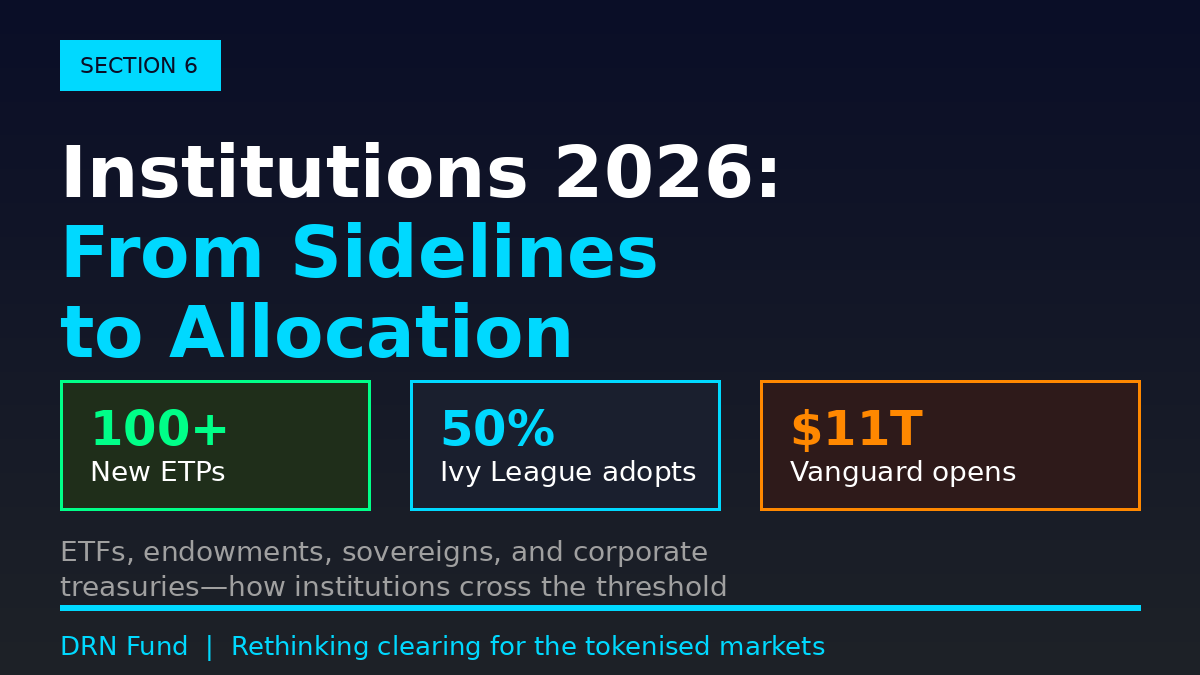
The regulatory shift that occurred in late 2025 promises to accelerate this trend substantially. Coinbase highlights that the SEC's approval of generic listing standards for spot commodity exchange-traded products in September 2025 shortened the maximum approval schedule for new crypto ETFs from 270 days to just 75 days. This streamlined process has already borne fruit: multiple Solana ETFs launched in 4Q25, including Bitwise's Solana Staking ETF (BSOL), which Coinbase reports posted the strongest day-one trading volumes of any altcoin ETF launched to date. The floodgates appear open for altcoin ETF proliferation. Bitwise's 2026 predictions, compiled through Grok's social media research, forecast that more than 100 new crypto ETPs will launch in the US as regulatory barriers fall and product innovation accelerates. Galaxy Research similarly anticipates that the generic listing standards will enable rapid launches of spot ETFs for alternative assets including Solana, XRP, and other major protocols.
The implications extend beyond simply more products. Bitcoin Suisse argues that the ETF era has transformed Bitcoin and Ethereum into "benchmark assets for institutional" portfolios, fundamentally altering how institutions conceptualize digital asset exposure. Rather than exotic alternatives requiring specialized infrastructure, crypto assets are increasingly treated as standard portfolio components accessible through conventional brokerage channels. Bitwise goes further, predicting that crypto ETFs will purchase more than 100% of new Bitcoin, Ethereum, and Solana supply in 2026 as institutional adoption accelerates—a supply-demand dynamic that would fundamentally alter price formation mechanisms across major crypto assets.
Wealth Management Platforms Open the Doors
While ETF products provide the vehicles, the critical question for institutional adoption is which distribution channels will offer access to client accounts. Here, predictions suggest 2026 will mark a decisive shift. CoinShares LLC forecasts that major wirehouses—the wealth management arms of firms like Merrill Lynch, Morgan Stanley, and Wells Fargo Advisors—will formally open Bitcoin ETF allocations to client portfolios in 2026. This represents a crucial milestone because wirehouses manage trillions in advised wealth and serve as the primary interface between financial advisors and their mass affluent and high-net-worth clients. Grayscale notes that less than 0.5% of US advised wealth is currently allocated to crypto assets, suggesting enormous headroom for growth once platform restrictions lift.
The mechanics of this shift matter enormously. According to Grayscale's analysis based on 13F filings, approximately 50% of crypto ETP assets are already held by "investment advisors," which the firm considers an upper bound on the share held by wealth management intermediaries. As platforms complete due diligence processes, build capital market assumptions into their modelling tools, and incorporate crypto into recommended model portfolios, advisor-driven allocation is expected to accelerate dramatically. CoinShares specifically predicts that at least one major 401(k) retirement plan provider will enable crypto ETF access in 2026, opening institutional retirement accounts to digital asset exposure for the first time at scale.
The client demand picture is equally compelling. Bitcoin Suisse notes that ETF flows are "entering their second act" as major platforms remove restrictions, while BVC observes that crypto is transitioning from "retail-driven to institution-led markets" where institutions will "increasingly dominate market flows." This institutional dominance brings different behavioral patterns: longer time horizons, less reactivity to short-term volatility, and allocation decisions driven by portfolio theory rather than speculative momentum. Coinbase emphasizes this point, noting that institutional investors "often view bitcoin as a hedge against excess money supply creation or a diversifier within a broader portfolio," contributing to "a more stable and less volatile demand profile" compared to retail-driven cycles.
University Endowments Break the Taboo
Among institutional investors, university endowments occupy a unique position: large pools of capital managed with multi-generational time horizons, relative freedom from short-term performance pressures, and historical willingness to pioneer alternative asset classes before they achieve mainstream acceptance. The endowment model pioneered by Yale's David Swensen—emphasizing illiquid alternatives, venture capital, and contrarian positioning—has consistently delivered outperformance precisely by entering asset classes early. Crypto appears positioned to follow this pattern in 2026.
Bitwise's prediction, captured through Grok's analysis, boldly forecasts that half of Ivy League university endowments will invest in crypto during 2026, "legitimizing the asset class for global institutions." This represents not just financial allocation but cultural validation—if Harvard, Yale, Princeton, and their peers publicly allocate to digital assets, it signals that crypto has crossed the threshold from speculative fringe to institutionally acceptable investment. Grayscale reports that Harvard Management Company has already adopted crypto ETPs in its portfolio, alongside Mubadala, one of Abu Dhabi's sovereign wealth funds, suggesting that early movers are establishing precedents that peer institutions are likely to follow.
The allocation sizes matter less than the symbolism at this stage. Even modest endowment allocations—in the range of 0.5% to 3% of total portfolio value—would represent billions in aggregate capital and, more importantly, permission structures for other institutional capital pools that look to endowments as sophistication signals. Foundation portfolios, corporate pension funds, and even public pension systems historically follow endowment leadership with a lag of several years. The endowment move into crypto in 2026 thus represents not just immediate capital but the unlocking of future institutional waves that require precedent-setting before they can proceed.
The Vanguard Question: When Will the Giant Yield?
Perhaps no single institutional development would signal mainstream acceptance more powerfully than Vanguard reversing its stance on crypto products. As Pantera Capital documents, when US Bitcoin ETFs launched in January 2024, Vanguard—the world's largest provider of mutual funds—took a firm position against offering access to crypto products, effectively sidelining 50 million client accounts representing $11 trillion in assets under management. This decision, rooted in founder Jack Bogle's philosophy of long-term value investing in productive assets, created a stark competitive disadvantage as rivals BlackRock, Fidelity, and Charles Schwab all embraced crypto ETF offerings.
Pantera reports that in late 2025, Vanguard reversed its ban on crypto ETFs and mutual funds, declaring that "that valve is now open." This reversal carries enormous implications for several reasons. First, sheer scale: 50 million accounts and $11 trillion in AUM represents institutional distribution capacity that dwarfs most competitors. Second, client demographic: Vanguard's customer base skews toward long-term, passive, buy-and-hold investors—precisely the institutional behavior patterns that crypto advocates argue are appropriate for digital asset allocation. Third, legitimacy signaling: Vanguard's reversal effectively declares that crypto assets are not inconsistent with prudent long-term portfolio management, contradicting the speculative narrative that has dominated mainstream financial media.
The competitive dynamics driving Vanguard's reversal are straightforward. As Pantera notes, convenient access through ETFs and digital asset treasuries (DATs) has brought $150 billion in capital into crypto over just two years. With BlackRock's iShares Bitcoin Trust (IBIT) becoming one of the most successful ETF launches in history, and Fidelity's crypto custody and trading services capturing institutional market share, Vanguard faced pressure from both clients and financial advisors demanding competitive product offerings. CoinShares frames Vanguard's move as "validating digital assets as an investable category alongside equities, fixed income, commodities, and alternatives"—an important step toward "integrating crypto into the core of global capital markets."
Not all predictions assume rapid Vanguard participation, however. Some analysts suggest the reversal may proceed cautiously, with limited product offerings and substantial guardrails around allocation sizes. The cultural question looms large: can an institution built on low-cost index funds and passive management philosophies fully embrace an asset class that still trades with substantial volatility and requires active management of custody, security, and regulatory risk? The answer in 2026 will significantly influence broader institutional adoption trajectories.
Sovereign Wealth Funds Enter Strategic Allocation
If endowments provide cultural validation and wirehouses provide distribution, sovereign wealth funds bring the scale that could fundamentally alter crypto market capitalization. These massive pools of state-owned capital—often derived from commodity exports, trade surpluses, or strategic reserves—manage trillions in assets with mandates to preserve national wealth across generations. Their entry into crypto represents both portfolio diversification thesis and geopolitical positioning.
Grayscale notes that Mubadala, one of Abu Dhabi's sovereign wealth funds, is among the early institutional adopters of crypto ETPs, establishing precedent for sovereign allocation. Bitcoin Suisse frames sovereign accumulation as one of the key drivers in its 2026 Bitcoin price forecast, predicting the $150,000-$180,000 range will be driven in part by "institutional/sovereign accumulation" alongside ETF inflows. Bankless similarly identifies "sovereign wealth fund allocations" as a central theme in Bitcoin's positioning as an institutional safe haven, with "geopolitical factors driving institutional adoption."
The investment thesis for sovereign funds differs somewhat from traditional institutional investors. For nations concerned about dollar dominance, inflation in reserve currencies, or geopolitical sanctions risk, Bitcoin offers attributes that traditional reserves lack: truly neutral settlement layer not controlled by any nation-state, fixed supply immune to monetary policy manipulation, and 24/7 global liquidity outside traditional banking channels. These characteristics particularly appeal to nations seeking to diversify away from dollar-denominated reserves or build resilience against potential financial system exclusion.
Allocation sizes remain modest in aggregate terms—sovereign funds are more likely to begin with basis point allocations (0.01%-0.1% of total portfolio) rather than percentage-point positions—but the sheer scale of sovereign wealth means even minimal allocations represent billions in committed capital. More significantly, visible sovereign participation removes stigma and provides cover for other institutional investors who have been waiting for "respectable" participants to establish precedent. The Gulf states, Singapore, Norway, and potentially Asian sovereign vehicles are all watched closely by the institutional investor community for signals about legitimacy and long-term viability.
Corporate Blockchain Moves from Pilot to Production
While much institutional adoption discourse focuses on passive investment in crypto assets, another dimension involves corporations deploying blockchain infrastructure for operational purposes. Galaxy Research makes one of the most specific predictions in this domain: "At least one Fortune 500 bank, cloud provider, or ecommerce platform will launch a branded corporate L1 that settles more than $1 billion of real economic activity in 2026 and runs a production bridge into public DeFi." This prediction captures a fundamental shift from experimental pilots to production-scale deployment.
The corporate blockchain thesis argues that large enterprises will increasingly deploy proprietary Layer 1 blockchains for specific business functions—supply chain tracking, cross-border settlements, tokenized securities issuance, or customer loyalty programs—while maintaining interoperability bridges to public DeFi protocols. Galaxy's $1 billion settlement threshold represents meaningful economic activity, not just testnet experiments. This model differs from earlier "enterprise blockchain" initiatives that built private, permissioned systems with no connection to public crypto infrastructure. The Galaxy prediction assumes Fortune 500 companies will run production bridges into public DeFi, suggesting hybrid architecture where private corporate chains interoperate with public protocols like Ethereum, Solana, or Base.
Examples of this trajectory are already emerging. Coinbase notes that JPMorgan deployed tokenized deposits on Base network (Coinbase's Layer 2), BlackRock's BUIDL tokenized money market fund has grown substantially on Ethereum, and PayPal's PYUSD stablecoin demonstrates traditional finance "building on public blockchains" rather than merely observing. Bankless identifies "corporate and enterprise adoption" as a key 2026 theme, emphasizing "enterprise stablecoin adoption" and "cross-border settlement improvements" as driving use cases.
The critical question is which Fortune 500 entities will lead. Banks face regulatory constraints but have clear settlement use cases. Cloud providers like Amazon Web Services or Microsoft Azure have infrastructure capabilities and enterprise customer bases that could rapidly scale blockchain services. Ecommerce platforms like Shopify or Amazon could deploy blockchain-based payment rails or supply chain transparency tools. Stripe's incubation of Tempo network, aimed at "bridging institutional-grade payment rails" as Coinbase notes, suggests fintech infrastructure companies may be first movers. Regardless of which specific company achieves Galaxy's prediction first, the broader pattern is clear: corporations are moving beyond experimentation toward production deployment at scale.
Our perspective: Galaxy's prediction about Fortune 500 blockchain deployment reaching "$1 billion of real economic activity" raises an infrastructure question: what happens when corporations want to hedge exposure from these blockchain operations? If JPMorgan runs tokenized deposits on Base or BlackRock's BUIDL scales to tens of billions, treasury managers will need derivatives markets to manage volatility—which requires institutional-grade clearing infrastructure that doesn't yet exist for tokenized markets.
The gap isn't technology—it's credit intermediation, legal recourse, and real-time risk management that corporate treasurers require before committing material capital to derivatives markets on tokenized rails. This is why corporate blockchain deployment can reach production scale for payments/settlements while derivatives markets remain constrained to traditional infrastructure. Again to realise the expectation of many the predictions lots of work remains to be done.
Digital Asset Treasuries Become Corporate Strategy
A distinct but related institutional trend involves corporations adding digital assets directly to their balance sheets as treasury management strategy. This phenomenon, pioneered by MicroStrategy's aggressive Bitcoin accumulation beginning in 2020, has accelerated dramatically through 2025. CoinShares reports that corporate treasuries have accumulated more than 1 million BTC across 190 publicly traded companies—nearly four times the count from eighteen months prior. This represents not isolated experiments but an emerging asset-liability management approach where corporations view Bitcoin as superior to cash for storing excess reserves.
Coinbase observes that 2025 saw publicly traded companies—termed Digital Asset Treasuries (DATs)—add Bitcoin to their balance sheets "en masse," with this "new class of larger players" exerting "far greater influence on market sentiment and price action" than retail participants. The accounting rule changes that went into effect in December 2024, allowing fair-value accounting for crypto holdings rather than impairment-only treatment, removed a significant barrier to corporate adoption by eliminating the asymmetry where unrealized losses appeared on income statements but unrealized gains did not.
Bitcoin Suisse forecasts that "DATs grow institutional ownership by" significant percentages in 2026, though specific numerical predictions vary across sources. The corporate treasury thesis rests on several arguments: Bitcoin's fixed supply makes it superior to cash for long-term value preservation; public companies can use Bitcoin holdings to attract equity premium from investors viewing the holdings as leveraged Bitcoin exposure; and corporations with global operations benefit from holding a borderless, instantly liquid reserve asset. Critics counter that Bitcoin's volatility creates earnings unpredictability, concentrated crypto holdings increase single-asset risk, and shareholders may prefer companies return excess cash via dividends or buybacks rather than speculating on digital assets.
The shareholder reception question looms large. Some DAT companies have seen stock prices perform extraordinarily well—MicroStrategy being the prominent example—while others have experienced shareholder pressure to divest crypto holdings or limit allocation sizes. The 2026 test will be whether corporate Bitcoin accumulation becomes normalized treasury management practice or remains a niche strategy pursued by crypto-believer executives. If a major S&P 500 corporation with diversified operations adds Bitcoin to its balance sheet in meaningful size (not token experimental allocation), it could catalyze broader corporate adoption. Conversely, if economic conditions turn and Bitcoin's volatility creates earnings pain for highly exposed companies, the corporate treasury trend could stall.
Our observation: Corporate treasuries accumulating BTC face a hedging constraint: without institutional-grade derivatives clearing for tokenized markets, they can't employ traditional treasury risk management strategies (options, futures, swaps) that would typically accompany volatile asset holdings.
Custody Infrastructure and Compliance Maturation
Underlying all institutional adoption predictions is the assumption that custody infrastructure, compliance frameworks, and operational risk management have matured sufficiently to support institutional-scale participation. CoinShares specifically forecasts that "custody banks provide direct institutional settlement services" in 2026, representing a critical infrastructure milestone. Traditional custody banks—State Street, BNY Mellon, Northern Trust—serve as the backbone of institutional finance by holding and safeguarding assets, processing settlements, and providing reporting. Their entry into crypto custody would normalize digital asset holdings across institutional portfolios.
Regulatory clarity around qualified custodian standards has accelerated this development. The SEC and other regulators have provided frameworks for what constitutes appropriate custody for digital assets held by registered investment advisers, resolving years of uncertainty. This clarity enables traditional financial institutions to build or acquire crypto custody capabilities without fear of retroactive rule changes. Insurance products for crypto holdings—previously limited and expensive—are becoming more available as actuarial models improve and the asset class matures.
BVC emphasizes "institutional-grade security and compliance" as baseline requirements for DeFi evolution in 2026, noting that protocols must meet institutional standards around audit trails, access controls, and disaster recovery to attract serious capital. TigerResearch goes further, predicting that "privacy tech as core institutional infrastructure" will become essential, as institutions require confidential transaction capabilities to protect trading strategies and comply with client confidentiality obligations. The privacy technology developments explored in regulatory contexts now appear positioned to become competitive requirements for institutional participation.
Prime brokerage services—offering margin lending, securities lending, and trade execution services—are expanding in crypto markets as institutional demand grows. Coinbase, Galaxy, and other crypto-native firms have built institutional trading desks offering services comparable to traditional prime brokers, while traditional firms like Goldman Sachs and Citigroup have launched or expanded crypto trading capabilities. The maturation of these services reduces the operational friction of institutional participation, allowing asset managers to interact with crypto markets using familiar workflows and counterparty relationships.
Our observation: Custody infrastructure maturation addresses holding and safeguarding digital assets—but custody infrastructure ≠ derivatives clearing infrastructure. CoinShares predicts custody banks will "provide direct institutional settlement services," which solves asset custody but not counterparty risk management for derivatives markets. It also massively underestimates the complexity here for true custody, not just holding assets, but managing their allocation for funds.
Institutional participation in derivatives requires: credit intermediation when counterparties default, real-time margining for 24/7 markets, legal recourse frameworks, and portfolio-level risk calculation across multiple counterparties. These are clearing functions, not custody functions. The infrastructure buildout institutions require extends beyond "where do we safely hold assets" to "how do we manage counterparty risk when trading derivatives at institutional scale."
Pension Funds: The Final Frontier?
If endowments represent the vanguard of institutional adoption and sovereign funds represent geopolitical positioning, pension funds represent the mass-market institutional test. Public and private pension funds manage retirement assets for hundreds of millions of workers, typically with conservative mandates emphasizing capital preservation and stable income generation. Their entry into crypto would signal mainstream acceptance at the broadest institutional level, but their fiduciary duties and political constraints make pension fund adoption particularly complex.
Predictions around pension fund allocation remain cautious. CoinShares mentions retirement plan restrictions lifting as part of Bitcoin's mainstream transformation but does not provide specific forecasts for pension fund allocation sizes. Bankless notes that institutions are "transitioning to institutional frameworks," implying that retail-era participation patterns are giving way to institutional-grade approaches suitable for pension fund adoption. The key question is not whether pension funds will allocate at all—some already have through indirect exposure via venture capital or hedge fund investments—but whether direct allocation to crypto assets through ETFs or custody arrangements will occur at meaningful scale.
The precedent-setting nature of pension fund participation creates both opportunity and risk. If a prominent public pension system—CalPERS in California, for example, or a major union pension fund—announces direct Bitcoin allocation, it provides political and legal cover for peer institutions to follow. State legislatures in some jurisdictions have explicitly authorized or encouraged pension fund consideration of digital assets, while others have prohibited such allocations. This regulatory patchwork means pension fund adoption will likely be gradual and geographically varied rather than uniform.
The allocation thesis for pension funds differs from endowments. Pension funds cannot afford Yale-style alternative asset bets; they need stable, predictable returns to meet benefit obligations to retirees. The case for modest Bitcoin allocation (1-3% of portfolio) rests on diversification arguments: adding an asset with low correlation to stocks and bonds improves risk-adjusted returns through Modern Portfolio Theory optimization. Critics argue that Bitcoin's volatility and lack of cash flows make it unsuitable for institutions with spending commitments, particularly when bond yields have risen to levels providing reasonable real returns without crypto risk.
Our view: The pension fund allocation debate focuses on passive investment (buying and holding BTC through ETFs), but pension funds have different needs than endowments. Pension funds manage liability-driven portfolios requiring interest rate hedging, duration management, and inflation protection—all typically accessed through derivatives markets.
Even if pension funds allocate to crypto assets, they can't employ institutional hedging strategies without derivatives clearing infrastructure. This limits crypto to "buy and hold" allocation rather than integrated portfolio management tool. The infrastructure gap isn't ETF availability—it's the ability to hedge crypto exposure with institutional-grade derivatives that have proper clearing, which constrains how pension funds can actually deploy crypto in portfolio construction.
The 2026 pension fund question may not be whether large systems allocate but whether smaller, more nimble pension funds and defined contribution plans begin offering crypto options to participants. If several mid-sized systems announce successful initial allocations with appropriate risk management, it could catalyze broader adoption in 2027-2028 as larger systems complete longer due diligence cycles.
Contrarian Voices and Adoption Headwinds
Not all institutional predictions assume smooth, rapid adoption. Several sources identify significant headwinds and express skepticism about the pace of mainstream integration. The most prominent contrarian position involves Vanguard itself: while Pantera reports Vanguard reversed its ETF ban, some analysts question whether this reversal will translate into aggressive product offerings or whether Vanguard will maintain philosophical resistance rooted in founder principles. Jack Bogle famously dismissed Bitcoin as lacking intrinsic value, and institutional culture at Vanguard may constrain how fully the firm embraces crypto products despite competitive pressure.
TigerResearch warns that "institutional capital will remain concentrated in Bitcoin and Ethereum" while "the days of retail-driven speculation in altcoins are waning." This concentration dynamic suggests that institutional adoption will not lift all crypto assets equally—instead, capital will flow overwhelmingly to established assets meeting institutional standards while niche protocols struggle for attention. The implication is that altcoin bulls expecting institutional capital to drive broad-based rallies may be disappointed as institutions focus on Bitcoin and Ethereum as the only sufficiently mature, liquid, and decentralized options for fiduciary investment.
Custody and security concerns persist despite infrastructure improvements. The FTX collapse in 2022 and other exchange failures created lasting institutional skepticism about counterparty risk in crypto markets. While qualified custodians and insurance products have improved, some institutions remain uncomfortable with the operational complexity and tail risks of digital asset custody. Bankless identifies "institutional-grade security and compliance" as requirements that are still being built out rather than fully mature, suggesting adoption may proceed more slowly than bulls anticipate as these infrastructure layers are completed and tested.
Our observation: The infrastructure gap extends beyond custody and compliance to derivatives market participation. Institutions can buy and hold crypto through ETFs or custody accounts, but they cannot trade derivatives at institutional scale without: bilateral clearing infrastructure for 24/7 markets, real-time portfolio margining across counterparties, and credit intermediation with legal recourse. This distinction matters because institutional treasury management, corporate hedging, and pension fund liability matching all require derivatives markets—yet the infrastructure for institutional derivatives participation remains nascent compared to investment infrastructure (ETFs, custody, compliance).
Generational dynamics within institutional decision-making also create friction. CoinShares notes that institutional adoption is accelerating but faces "challenges around custody and regulatory compliance" that require senior leadership buy-in. In many institutions, investment committees and boards are dominated by executives who built careers in traditional finance and may view crypto skeptically regardless of younger portfolio managers' enthusiasm. This generational divide means institutional adoption may require not just product availability and regulatory clarity but also leadership transition as digital-native executives rise to decision-making positions.
Finally, several sources caution about the gap between adoption rhetoric and actual allocation sizes. While institutions may announce crypto capabilities and allocate token amounts to establish positions, the percentage of assets under management actually deployed to crypto may remain far smaller than public attention suggests. Grayscale's estimate that less than 0.5% of US advised wealth is in crypto suggests enormous headroom for growth, but it also means that current allocation levels are trivial relative to stocks, bonds, and cash. Even doubling or tripling these allocations would still leave crypto as a tiny fraction of institutional portfolios—meaningful for the crypto ecosystem but not transformative for institutional investors' overall performance.
Where Consensus Lies and Where Uncertainty Remains
Synthesizing across fifteen institutional sources reveals clear consensus on several dimensions of 2026 adoption trajectories. First, virtually all predictions agree that institutional participation will accelerate substantially, driven by regulatory clarity, product availability through ETFs, and infrastructure maturation. The days of institutions claiming they "cannot" participate due to regulatory uncertainty or custody constraints are ending; 2026 will test whether those were genuine barriers or convenient excuses for skepticism.
Second, there is broad agreement that adoption will be tiered and sequential rather than uniform. Endowments and family offices will lead, followed by wirehouses opening platform access for advised wealth, then potentially sovereign funds making strategic allocations. Pension funds represent a later-stage adoption wave that may not fully materialize until 2027-2028. This sequencing matters for understanding market dynamics: early adoption drives price discovery and volatility, while later-stage institutional flows bring stability and reduced drawdown risk.
Third, Bitcoin and Ethereum will capture disproportionate institutional attention relative to alternative protocols. TigerResearch's observation that "institutional capital will remain concentrated in Bitcoin and Ethereum" while market growth concentrates on "assets that meet institutional standards" reflects fiduciary obligations and risk management requirements that favor established, liquid, decentralized protocols over newer alternatives. This does not preclude institutional interest in specific altcoins—Solana's ETF launches demonstrate some diversification—but suggests that capital flows will be heavily skewed toward the top two assets by market capitalization.
The major divergences in predictions center on pace, scale, and catalysts. Optimistic projections—like Bitwise's forecast of half of Ivy League endowments investing or crypto ETFs purchasing 100%+ of new supply—suggest rapid adoption that could drive substantial price appreciation and market structure transformation. More conservative views—like TigerResearch's emphasis on concentrated capital flows and institutional caution—suggest slower adoption that may disappoint bulls expecting explosive growth. The difference between these scenarios likely depends on macro factors (interest rates, inflation, equity market performance) and idiosyncratic events (major institution announcements, regulatory developments, market structure innovations) that cannot be predicted with certainty.
The Vanguard reversal, if executed meaningfully, could serve as the catalyst that accelerates adoption beyond even optimistic forecasts. With 50 million accounts and $11 trillion in assets under management, Vanguard's full-throated embrace of crypto ETFs would instantly make digital assets accessible to a client base largely excluded from participation to date. Conversely, if Vanguard's reversal proves cautious and constrained—offering only token access with substantial guardrails—it may signal that institutional adoption will be slower and more circumscribed than bulls anticipate.
Looking forward, the institutional adoption question in 2026 is not binary—whether institutions will participate or not—but rather one of magnitude, pace, and distribution. Will institutional allocation proceed gradually, with 2026 marking incremental progress toward a multi-year integration process? Or will 2026 be the year when a cascade of announcements—major endowments allocating, Vanguard platform opening, sovereign funds declaring positions, Fortune 500 companies launching blockchain infrastructure—creates a tipping point that shifts crypto from alternative asset to mainstream portfolio component? The predictions surveyed suggest the answer likely falls between these extremes: meaningful acceleration in institutional participation without the explosive adoption that would require hundreds of basis points of wealth management portfolios shifting into crypto assets within a single year. The foundation is being laid in 2026; the question is whether the building will rise quickly or gradually in the years that follow.
Sources Referenced:
Grayscale - 2026 Digital Asset Outlook: Dawn of the Institutional Era (December 2025)
Coinbase - Crypto Market Outlook 2026 (December 2025)
Galaxy Research - 26 Predictions for 2026 (December 2025)
Pantera Capital - 2025: The Year of Structural Progress for Crypto (December 2025)
CoinShares - 2026 Outlook: Digital Assets Move From Disruption to Integration (December 2025)
Bitcoin Suisse - Outlook 2026 (November 2025)
Bitwise (via Grok social media aggregation) - 10 Big Predictions for 2026 (December 2025)
TigerResearch - 10 Market Shifts Defining 2026 (December 2025)
Bankless - 12 Predictions for 2026 (December 2025)
21shares - Crypto for Everyone (2025)
a16z Crypto - 17 Things We're Tracking in Crypto for 2026 (December 2025)
InvestAnswers (via Grok) - 2026 Predictions (January 2026)
Fidelity - 2026 Crypto Market Outlook (2025)
BlackRock - 2026 Investment Outlook (2025)
VanEck - Plan for 2026: Predictions from Our Portfolio Managers (2025)
22 specific quantitative metrics
$87 billion (Grayscale): Global crypto ETP net inflows since January 2024
$58 billion (Coinbase): US spot Bitcoin ETF net inflows
$90 billion (CoinShares): Total US spot Bitcoin ETF assets
270 to 75 days (Coinbase): ETF approval timeline reduction via generic listing standards
100+ new ETPs (Bitwise/Grok): Predicted US crypto ETP launches in 2026
<0.5% (Grayscale): Current allocation of US advised wealth to crypto
50% (Grayscale): Share of crypto ETP assets held by investment advisors per 13F filings
50 million accounts, $11 trillion AUM (Pantera): Vanguard scale
$150 billion (Pantera): Capital brought in by ETFs and DATs over two years
Half of Ivy League (Bitwise/Grok): Predicted endowment adoption
1 million+ BTC (CoinShares): Corporate treasury holdings across 190 public companies
4x increase (CoinShares): Growth in number of companies holding BTC over 18 months
$1 billion+ (Galaxy): Predicted settlement volume for Fortune 500 corporate L1
100%+ of new supply (Bitwise/Grok): Predicted ETF purchases relative to Bitcoin/Ethereum/Solana issuance
$7,000-$9,000 (Bitcoin Suisse): ETH price target driven by institutional integration
$150,000-$180,000 (Bitcoin Suisse): BTC price target driven by institutional/sovereign accumulation
70-200% (Bitcoin Suisse): Expected ETH return driven by institutional adoption and staking ETFs
50-120% (Bitcoin Suisse): Expected BTC return driven by ETF inflows and sovereign accumulation
$23 billion (Galaxy): 2025 net inflows expected to accelerate in 2026
$13 billion (CoinShares): Ethereum ETF net inflows
190 companies (CoinShares): Number of publicly traded companies holding BTC
$3 trillion (CoinShares): US Treasury Secretary projection for stablecoin market by 2030
This first appeared on LinkedIn on January 12, 2026. If you want to comment or discuss, that's the place.