
Section 7: Real World Assets & Tokenization - The TradFi Integration Bridge
Summary
The convergence of traditional finance and blockchain infrastructure reached an inflection point in 2025, setting the stage for what industry observers expect will be an accelerated migration of real-world assets onchain throughout 2026.
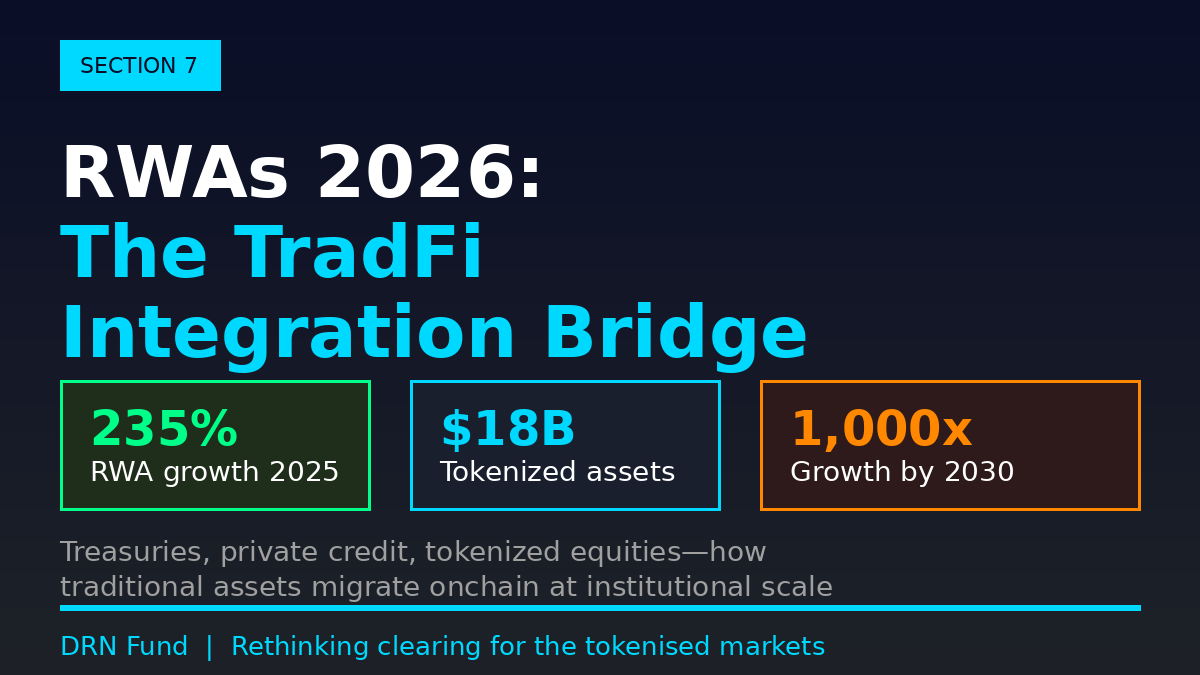
According to Pantera Capital's December 2025 outlook, real-world asset (RWA) value onchain surged by 235% during 2025, while Coinbase (January 2026) reports that distributed RWAs now account for approximately $18 billion in value—an 18-fold increase since 2022. This dramatic expansion reflects not merely technological capability but a fundamental shift in how institutional capital views blockchain infrastructure: no longer as speculative technology but as superior settlement rails for traditional financial products.
The narrative arc from previous sections culminates here. Regulatory clarity achieved through the GENIUS Act and SEC policy reversals (Section 5) created the legal framework enabling tokenized securities. The influx of institutional capital via ETFs and digital asset treasuries (Section 6) generated demand for yield-bearing onchain products. The maturation of DeFi protocols (Section 3) provided venues capable of handling institutional-grade settlement. And the proliferation of stablecoins (Section 4) established the payment rails necessary for delivery-versus-payment mechanics. In 2026, these elements combine to enable what multiple institutional forecasts describe as the integration year—when traditional assets don't just experiment onchain but begin operating at meaningful scale on public blockchains.
The Treasury Tokenization Wave: BlackRock and the Institutional Flood
Tokenized U.S. Treasuries emerged as the dominant entry point for conservative institutional capital moving onchain. According to Coinbase's 2026 outlook, tokenized U.S. Treasuries more than doubled in total asset value during 2025, driven primarily by institutional-grade issuers packaging short-duration sovereign exposure into tokens with daily yield accrual. BlackRock's BUIDL fund, issued via Securitize, now ranks as one of the largest individual RWA protocols with several billion dollars tokenized and distributed across multiple chains. CoinShares' 2026 outlook notes that tokenized assets led by private credit and U.S. Treasuries more than doubled in 2025, with U.S. Treasury Secretary Scott Bessent projecting a $3 trillion stablecoin market by 2030.
Ondo Finance's products including OUSG and related wrappers provide tokenized access to short-term Treasury exposure and have integrated into both DeFi protocols and institutional platforms. Pantera Capital reports that as of December 2025, tokenized Treasuries reached $6.5 billion, representing 39% of the distributed RWA market. Coinbase characterizes these products as "core building blocks for institutional onchain strategies" serving two primary functions: first, they're becoming base collateral for the onchain system as lending protocols, derivatives venues, and institutional platforms accept them as margin; second, they offer structurally superior liquidity compared to traditional wrappers, trading 24/7 with near-instantaneous settlement rather than wire transfers subject to cut-off times.
The appeal extends beyond yield mechanics. Bitcoin Suisse's 2026 outlook emphasizes that yield-bearing stablecoins and Treasury wrappers solve the opportunity cost problem for institutional investors facing traditional deposit rates near 0.4% while short-term Treasuries yield approximately 4%. As institutions increasingly adopt these onchain yield products, Coinbase projects tokenized Treasuries will remain "the core entry point for traditional money moving onchain" throughout 2026—offering low-volatility, high-clarity instruments that can sit alongside BTC, ETH, and SOL in onchain wallets and DeFi protocols.
Our observation: The institutional embrace of tokenized Treasuries as "base collateral" reveals a critical distinction often missed in RWA narratives. Treasury tokenization succeeded first not because treasuries are simple to tokenize—they're not, given regulatory complexity around securities treatment—but because they solve institutional collateral hierarchy requirements.
Institutions need Basel III-compliant collateral that risk officers recognize. Tokenized treasuries from regulated issuers like BlackRock's BUIDL can potentially qualify as high-quality liquid assets (HQLA) for capital adequacy calculations, unlike most crypto assets. This explains why treasury tokenization reached $6.5B while more "obvious" candidates like real estate struggled to reach $1B—it's not about yield or settlement efficiency, it's about fitting institutional collateral frameworks.
However, the "base collateral" claim assumes institutional acceptance for derivatives margining and portfolio financing. We're seeing tokenized treasuries used as lending collateral in DeFi protocols, but traditional prime brokers haven't yet accepted them for margin lending against derivatives positions. Until tokenized RWAs qualify for institutional margining frameworks, they remain investment vehicles rather than integrated portfolio management tools.
Private Credit Comes Onchain: The Alternative Asset Migration
While Treasury tokenization captured headlines, private credit represents what several sources identify as the fastest-growing segment of RWA tokenization. CoinShares LLC notes private credit as one of the two asset classes leading tokenized asset growth alongside U.S. Treasuries. Coinbase observes that major financial institutions from JPMorgan's Kinexys platform to UBS and Apollo have deployed tokenized funds, bonds, deposits, and private credit products throughout 2025, with banks and asset managers exceeding $2 billion in total asset value representing approximately 25% of all tokenized U.S. Treasuries.
The private credit migration addresses what Coinbase identifies as structural inefficiencies in traditional securitization markets. For alternative allocators, tokenized private credit and real estate offer higher yields with programmable covenants embedded in smart contracts. The onchain structure compresses intermediation layers that traditionally add cost and complexity, particularly in cross-border transactions. Moreover, tokenization enables fractional ownership that democratizes access to private credit markets previously gatekept for accredited investors and large institutions.
Pantera Capital's analysis shows institutional funds representing $2.4 billion or 15% of the distributed RWA market as of December 2025. This figure likely understates true private credit tokenization scale, as Coinbase notes their methodology excludes large platforms like Figure that don't support wallet-level portability—if included, private credit would emerge as the largest RWA category overall. The discrepancy highlights the ongoing debate around what constitutes "true" tokenization versus traditional databases with blockchain characteristics.
Our perspective: The private credit tokenization thesis faces a credit assessment challenge that blockchain infrastructure doesn't solve. Traditional private credit markets developed sophisticated underwriting frameworks, covenant enforcement mechanisms, and restructuring processes over decades. Moving these instruments onchain doesn't automatically improve credit risk management, it often makes it worse by introducing technical complexity that obscures fundamental credit analysis.
The concern isn't tokenization technology, it's whether crypto-native capital allocators possess the credit underwriting expertise to evaluate private credit risk. DeFi lending protocols handle over-collateralized loans secured by liquid crypto assets with real-time liquidation. Private credit requires assessing business cash flows, enterprise value, covenant structures, and workout scenarios. These are fundamentally different skill sets.
This explains why institutional fund managers like Apollo and UBS are tokenizing their own private credit origination rather than relying on crypto-native intermediaries. They're using blockchain as settlement rails while maintaining traditional credit underwriting. The question for 2026 is whether crypto-native platforms can build genuine credit assessment capabilities or whether "tokenized private credit" becomes a euphemism for poorly underwritten loans with blockchain wrappers.
Tokenized Equities: From Pilots to Production Scale
Tokenized equities sit at what Coinbase describes as "the intersection of public markets and DeFi" but remain modest in absolute scale at under $1 billion compared to approximately $28 billion for tokenized Treasuries and private credit combined. However, several 2025 developments set the stage for meaningful 2026 expansion. Robinhood launched hundreds of tokenized U.S. stocks and ETFs settled on-chain via Arbitrum and accessible from familiar brokerage interfaces, what Coinbase characterizes as "the first clear example of a mainstream brokerage distributing tokenized equities at scale to non-U.S. retail users." Pantera Capital's outlook notes Robinhood's tokenized stock launch as one of 2025's structural milestones.
Crypto-native exchanges expanded tokenized equity offerings as well. Kraken and Bybit listed tokenized U.S. blue-chip stocks issued by Backed Finance as Solana-native tokens, creating what Coinbase describes as a structure "where a regulated token issuer, a high-performance L1, and a centralized orderbook interlock to offer stock exposure with DeFi composability underneath." Meanwhile, traditional infrastructure institutions including Nasdaq and DTCC piloted tokenized equity settlement systems focused on reducing settlement risk, collateral fragmentation, and netting complexity rather than replacing existing exchanges.
The utility case centers on three core advantages according to Coinbase's analysis. First, settlement acceleration from T+1 to near-instant atomic delivery-versus-payment (DvP) on shared ledgers reduces counterparty risk, margin requirements, and settlement failures. Second, intermediation cost compression particularly benefits private and cross-border equity markets where multiple intermediaries add friction. Third, tokenization enables pre-IPO access to late-stage private companies like OpenAI and SpaceX through platforms offering retail users exposure to markets previously limited to accredited investors.
However, challenges remain significant. Orderbooks for tokenized stocks remain thin with slippage and volatility significantly higher than underlying equity markets, especially during post-market hours. Oracle risk emerges as off-chain prices must be brought onchain via oracles, creating vulnerabilities around errors, lags, or manipulation that can break economic equivalence. Regulatory fragmentation across jurisdictions imposes different rules on ownership and secondary transfers, and the choice between "Walled Garden" (non-transferable) and "Freely Transferable" token designs adds complexity.
Our view: The tokenized equity challenges reveal why spot asset tokenization ≠ derivatives infrastructure readiness. Oracle risk, thin orderbooks, and regulatory fragmentation are problems for holding tokenized equities. They become catastrophic for trading derivatives on tokenized equities.
Consider a scenario: An institution holds tokenized AAPL as collateral for a derivatives position. During market stress, the oracle feeding AAPL price onchain experiences a 30-second lag. Traditional derivatives systems have established procedures for pricing disputes, margin call timing, and close-out netting. What's the legal framework when smart contracts auto-liquidate based on stale oracle data? Which jurisdiction governs disputes when the token issuer is in Cayman, the blockchain nodes are globally distributed, and the counterparties are in different regulatory regimes?
These questions explain why institutional derivatives clearing remains concentrated in established jurisdictions with decades of legal precedent. Tokenized equity settlement for spot transactions is solvable. Derivatives on tokenized equities require legal infrastructure that smart contracts alone cannot provide.
Galaxy's Bold Predictions: Collateral, Securities, and Payment Rails
Galaxy Research's 26 predictions for 2026 includes three specific forecasts around RWA tokenization that would represent major institutional adoption milestones. Prediction #7 anticipates the SEC will grant some form of exemptive relief for expanding the use of tokenized securities in DeFi. Galaxy argues that while tokenized equities have remained peripheral and limited to DeFi experiments and private blockchains, "core infrastructure providers in traditional finance are now accelerating their shift toward blockchain-based systems." The exemptive relief would provide regulatory clarity enabling tokenized securities to circulate as collateral in lending markets and underlying assets in structured products.
Prediction #11 forecasts that a major bank or broker will accept tokenized equities as collateral in 2026. This milestone would represent validation of blockchain-based collateral infrastructure within traditional prime brokerage systems. The acceptance of tokenized equities as margin would unlock capital efficiency gains and cross-margin opportunities while potentially reducing custody complexity compared to traditional securities settlement.
Perhaps most ambitious, Prediction #12 anticipates at least one top-three global card network will route more than 10% of its cross-border settlement volume through public-chain stablecoins in 2026. Galaxy notes that stablecoin transactions already eclipse major credit card networks like Visa and process roughly half the transaction volume of the ACH system. The migration to public blockchain rails for cross-border settlement would leverage stablecoins' near-instantaneous settlement and lower friction compared to correspondent banking networks.
Our observation: Galaxy's three predictions: SEC exemptive relief, tokenized equities as collateral, and card network blockchain rails, reveal the sequencing challenge for RWA adoption. These predictions are structurally dependent, not independent forecasts.
Card networks can route cross-border settlement through stablecoin rails relatively easily, that's a payment infrastructure question. Banks accepting tokenized equities as collateral requires regulatory clarity (the SEC relief Galaxy predicts) plus operational infrastructure for valuing, margining, and liquidating tokenized collateral in prime brokerage systems. This is years of systems integration, risk model development, and legal framework establishment.
The prediction that "at least one major bank" will accept tokenized equities as collateral in 2026 signals how nascent institutional infrastructure remains. If tokenized collateral infrastructure were mature, the prediction would be "majority of prime brokers" not "at least one." This suggests 2026 is the pilot year, not production scale. Institutions will test tokenized collateral in contained scenarios with limited exposure, not integrate it into core prime brokerage operations where it supports institutional derivatives books.
TradFi Builds Proprietary Infrastructure: Public vs. Private Chains
A fundamental question shaping RWA's 2026 trajectory centers on whether traditional financial institutions will build on public blockchains or develop proprietary private chains. TigerResearch's 2026 outlook explicitly predicts "traditional finance will build their own blockchains for RWA" arguing that as primary suppliers for the RWA market with needs for asset control and security, the benefit of using third-party platforms remains low. The forecast suggests these firms will build proprietary chains to maintain market leadership, potentially marginalizing RWA projects lacking independent asset supply.
However, evidence from 2025 suggests a more nuanced picture. CoinShares' integration-themed outlook emphasizes that BlackRock's BUIDL fund, JPMorgan's tokenized deposits on Base (Coinbase's L2), and PayPal's PYUSD stablecoin demonstrate "traditional finance is no longer observing from the sidelines, it is building on public blockchains." The decision to deploy on Base—a public Ethereum L2—rather than a permissioned network signals recognition of public chain advantages including network effects, composability with DeFi protocols, and avoiding the "walled garden" trap that plagued earlier enterprise blockchain initiatives.
Bankless' 2026 predictions note "banks building proprietary blockchain infrastructure" as a central theme, while emphasizing the distinction between building proprietary applications versus proprietary networks. The emerging architecture appears hybrid: financial institutions deploying regulated products on public chain infrastructure while maintaining control over compliance layers, identity management, and business logic. This approach captures public chain liquidity and interoperability while satisfying regulatory requirements around KYC/AML and custody.
Our perspective: The public vs private chain debate is really a custody and legal recourse debate disguised as a technology choice. Institutions aren't choosing public chains for "decentralization", they're choosing them for liquidity network effects and avoiding the "walled garden" trap that killed enterprise blockchain 1.0.
But notice what institutions are actually deploying on public chains: payment rails (stablecoins), treasury products (BUIDL), and tokenized deposits. These are relatively simple instruments with clear legal ownership, straightforward custody, and minimal counterparty risk. When institutions need complex derivatives books with portfolio margining across multiple counterparties, real-time risk calculation, and legally enforceable close-out netting—they still use traditional infrastructure.
This isn't because public chains can't handle the throughput. It's because institutional risk officers require legal frameworks that decades of derivatives case law established. Smart contracts can execute logic, but they can't replace bankruptcy court precedent for derivatives netting, collateral perfection across jurisdictions, or regulatory capital treatment. The hybrid architecture institutions are building—regulated entities operating on public chain settlement rails—reflects recognition that settlement can be tokenized while risk management and legal recourse remain off-chain.
The network competition for institutional RWA flows reflects these dynamics. According to Coinbase, Ethereum L1 and L2s have emerged as the primary settlement layer holding approximately 52% of RWA market share as institutions prioritize security and liquidity depth. However, late 2025 marked a clear shift toward multi-chain distribution. Solana gained share backed by BUIDL allocations and tokenized equity issuers; Avalanche attracted flows from BUIDL and Janus Henderson CLO funds; Polygon captured BUIDL and JusToken commodity allocations; and BNB Chain became a key venue for Circle's USYC money market fund. Bitcoin Suisse specifically notes RWA flows on Solana quadrupling during 2025.
The Perpification Debate: Derivatives vs. Full Tokenization
a16z crypto's 2026 outlook introduces what it terms the "perpification vs. tokenization" debate—two competing approaches to bringing traditional assets onchain. The perpification path uses synthetic representations like perpetual futures allowing "deeper liquidity and often simpler implementation" from a regulatory standpoint since derivatives face different treatment than spot securities. Platforms can offer exposure to equities, commodities, and other traditional assets without navigating securities law complexities around custody, transfer restrictions, and settlement.
Full tokenization represents the opposite approach: bringing the actual asset onchain with smart contracts encoding ownership rights, transfer mechanics, and compliance requirements. While more complex from a regulatory perspective, tokenization enables what Coinbase describes as DeFi composability—tokenized assets can serve as collateral in lending protocols, underlying assets in structured products, and components of onchain portfolio construction. The composability unlocks capital efficiency impossible with derivative structures.
a16z argues both approaches will expand during 2026, with optimal strategies varying by use case. For assets where regulatory clarity exists and custody solutions are mature, full tokenization provides superior composability. For assets facing regulatory ambiguity or where derivative liquidity exceeds spot markets, perpification offers a pragmatic path. The firm predicts "more crypto-native RWA tokenization" regardless of approach, emphasizing the distinction between merely porting traditional assets onchain versus creating crypto-native financial products that couldn't exist in legacy systems.
Our take: The perpification vs tokenization debate misses a third path: tokenized settlement with traditional risk management. a16z frames this as binary—either synthetic derivatives or full tokenization. But institutions are building hybrid architectures: off-chain credit assessment, risk calculation, and legal agreements with on-chain settlement finality. A rare view a16z is simply wrong here.
This matters because the debate focuses on what to tokenize (the asset itself vs synthetic exposure) rather than how to manage risk in tokenized markets. Perpetual futures on equities might offer "simpler implementation" from a securities law perspective, but they introduce funding rate complexity and basis risk that make them unsuitable for institutional hedging, as we've seen with crypto perps. Crypto does not succeed with the introduction of another tool for gamblers to access stocks, the world does not run on retail flows.
Full tokenization of spot assets enables composability but doesn't solve counterparty credit risk for derivatives markets. The institutional path forward likely involves tokenized underlying assets with off-chain derivatives clearing infrastructure that provides credit intermediation and legal recourse, then on-chain settlement. This combines public chain settlement efficiency with institutional-grade risk management—neither pure perpification nor pure tokenization but rather a practical hybrid.
Delivery-vs-Payment and Settlement Infrastructure
The institutional adoption of tokenized assets depends fundamentally on settlement infrastructure meeting banking standards. Coinbase emphasizes delivery-versus-payment (DvP) settlement mechanics as critical infrastructure enabling atomic transactions where asset transfer and payment occur simultaneously on-chain, eliminating counterparty risk inherent in traditional T+1 or T+2 settlement cycles. The report characterizes near-instant atomic DvP on shared ledgers as reducing "counterparty risk, margin requirements, and settlement failures" while unlocking "capital efficiency plus programmatic settlement."
Bitcoin Suisse notes tokenized dollars now process multi-trillion-dollar annual settlement volumes rivaling or surpassing card networks like Visa and far outpacing PayPal and traditional remittance rails. This infrastructure maturation enables what Galaxy predicts will be mainstream adoption as payment rails for cross-border settlement. The settlement acceleration from days to seconds fundamentally changes margin calculations, collateral requirements, and working capital needs for financial institutions.
However, DvP implementation requires coordinating multiple components: onchain oracle infrastructure to bring price data onchain reliably, custody solutions meeting institutional standards for hybrid assets, compliance frameworks embedding KYC/AML requirements into smart contracts, and cross-chain bridges enabling settlement across multiple networks when counterparties hold assets on different chains. Coinbase notes these infrastructure requirements explain why Ethereum and its L2s captured the majority of institutional RWA market share—the ecosystem offers the most mature custody, compliance, and oracle infrastructure.
The Third Pillar Emerges: Conservative, Alternative, and Growth Allocations
Looking ahead to 2026, Coinbase characterizes RWAs as "becoming a third pillar of digital assets alongside stablecoins and 'pure crypto' (BTC, ETH, DeFi, etc.)." The firm emphasizes that RWA flows have proven uncorrelated with pure crypto performance, providing diversification for institutional portfolios. Three distinct investor segments drive adoption with different objectives and risk profiles.
Conservative capital gravitates toward tokenized U.S. Treasuries and money market funds offering "onchain cash with transparent yield." These products appeal to institutional investors seeking yield superior to traditional bank deposits while maintaining low volatility and regulatory clarity. The 24/7 settlement and instant liquidity enable sophisticated treasury management impossible with traditional money market funds subject to cut-off times and T+1 settlement.
Alternative allocators target tokenized private credit and real estate offering higher yields with programmable covenants. These products democratize access to traditionally gatekept markets while embedding compliance and reporting requirements directly into smart contracts. The programmability enables automated distribution waterfalls, covenant enforcement, and portfolio rebalancing that reduce operational overhead compared to traditional private credit structures.
Growth-oriented investors view tokenized equities and niche assets as providing "a bridge from traditional risk assets to DeFi composability." While orderbook depth remains thin relative to traditional exchanges, the ability to use tokenized equities as collateral in DeFi lending protocols or underlying assets in structured products appeals to sophisticated investors willing to trade current liquidity for future optionality as markets mature.
Grayscale's Moonshot: 1,000x Growth Projection
The most ambitious forecast comes from Grayscale's 2026 outlook, which notes tokenized assets represent just 0.01% of global equity and bond market capitalization today but projects potential for approximately 1,000-fold growth by 2030. The firm argues this expansion will be "facilitated by more mature blockchain technology and improved regulatory clarity," driving value to blockchains processing tokenized asset transactions as well as supporting infrastructure providers. Grayscale identifies Ethereum, BNB Chain, and Solana as leading chains for distributed tokenized assets while highlighting Chainlink's oracle infrastructure as "especially well placed given its unique suite of software technologies."
The 1,000x projection assumes accelerating adoption as network effects compound. As more assets move onchain, liquidity deepens, transaction costs decline, and custody infrastructure matures—creating positive feedback loops attracting additional capital. Regulatory clarity removes adoption barriers while DeFi composability unlocks use cases impossible in traditional finance. Smart contract programmability enables automated compliance, fractional ownership, and instant settlement that provide genuine improvements over legacy securitization infrastructure.
However, Pantera Capital's more conservative forecast provides useful contrast. Their prediction that RWAs (excluding stablecoins) would account for 30% of onchain total value locked (TVL) by end of 2026 fell short when 2025 closed at 16% despite 21% growth—highlighting that even in bullish scenarios, adoption faces friction around custody complexity, regulatory uncertainty across jurisdictions, and competition from traditional securitization markets offering familiar processes and legal protections.
Our observation: Grayscale's 1,000x projection assumes infrastructure scaling to match asset growth. But tokenizing $280 trillion in global securities (0.01% → 10% adoption) requires not just settlement infrastructure but portfolio risk management systems, cross-border legal frameworks, and derivatives markets that institutional portfolio construction depends on. The infrastructure buildout required for 1,000x asset growth takes longer than the asset tokenization itself. This isn't happening in 2026. Early is wrong in the prediction game.
Contrarian Perspectives and Adoption Barriers
Despite consensus optimism around RWA growth, several contrarian perspectives and structural barriers deserve attention. The "pilot versus production" debate questions whether 2025's RWA activity represents genuine adoption or primarily institutional experimentation. TigerResearch warns that "RWA projects that lack independent asset supply will lose their competitive edge and face exclusion" as traditional financial institutions build proprietary infrastructure rather than rely on crypto-native intermediaries.
Social media predictions include warnings that "RWA bull market continues but this will incentivize a bunch of garbage companies raising debt from unsuspecting and unqualified crypto rich LPs. Probably something blows up." This reflects concerns about credit risk assessment capabilities within crypto-native investment communities accustomed to evaluating protocol mechanics rather than traditional credit underwriting. The tokenization of private credit particularly raises questions about whether blockchain rails improve actual risk assessment or merely add technical complexity to familiar bad lending dynamics.
Custody challenges for hybrid assets remain significant. While fully onchain assets can utilize battle-tested DeFi custody solutions and traditional securities have established institutional custody infrastructure, tokenized securities occupying both domains face regulatory ambiguity. Coinbase notes regulatory fragmentation as jurisdictions impose different rules on ownership, secondary transfers, and custody requirements—creating compliance complexity that may offset efficiency gains.
Liquidity fragmentation represents another concern. As RWA protocols proliferate across multiple chains—Ethereum, Solana, Avalanche, Polygon, BNB Chain—liquidity splits across networks. Cross-chain bridges introduce additional security risks and user experience friction. Network effects favor consolidation, but which chains ultimately dominate RWA settlement remains uncertain despite Ethereum's current market share advantage.
What 2026 Will Reveal
The institutional forecasts converge on several key expectations: tokenized asset growth will continue with particular strength in Treasury products and private credit; regulatory clarity in the United States following the GENIUS Act and SEC policy reversals will accelerate adoption; and traditional financial institutions will increasingly deploy products on public blockchain infrastructure rather than proprietary private chains. Galaxy's specific predictions around SEC exemptive relief for tokenized securities, bank acceptance of tokenized equities as collateral, and card network migration to public blockchain rails for cross-border settlement would represent validation that blockchain infrastructure has achieved institutional-grade maturity.
Key divergences center on adoption pace and asset class prioritization. Grayscale's 1,000x growth projection by 2030 implies rapid acceleration while Pantera's more modest forecast suggests steady but measured expansion. The perpification versus full tokenization debate reflects uncertainty about optimal technical and regulatory approaches. Network competition between Ethereum, Solana, and other chains for institutional RWA flows remains unresolved despite Ethereum's current dominance.
What becomes clear is that RWA tokenization represents the bridge where crypto-native DeFi infrastructure (Section 3) meets mainstream institutional finance (Section 6), enabled by regulatory clarity (Section 5) and stablecoin payment rails (Section 4). Whether 2026 proves to be the integration year when traditional assets meaningfully migrate onchain—or merely another year of pilots and experiments—will significantly shape crypto's evolution from speculative technology to financial infrastructure. The infrastructure is ready, the regulatory framework is emerging, and institutional capital is probing entry points. What remains is the question of adoption velocity: will traditional finance embrace public blockchain rails rapidly or gradually, disruptively or incrementally? The answer will define tokenization's trajectory for the decade ahead.
Priority Sources with RWA Coverage:
Galaxy Research (26 Predictions) - Three specific RWA predictions: SEC exemptive relief, tokenized equities as collateral, card networks on blockchain rails
Coinbase Institutional (2026 Outlook) - Most comprehensive RWA analysis: $18B market, 18x growth since 2022, detailed tokenized equities and Treasury coverage
CoinShares (2026 Outlook) - Integration theme: tokenized assets doubled in 2025, BlackRock BUIDL, JPMorgan on Base
Pantera Capital (Year of Structural Progress) - 235% RWA growth in 2025, detailed market breakdown by asset class
Grayscale (2026 Outlook) - 1,000x growth projection by 2030, tokenization at inflection point
Bitcoin Suisse (2026 Outlook) - Yield-bearing stablecoins, RWA flows on Solana
a16z Crypto (17 Things) - Perpification vs tokenization debate, crypto-native RWA approach
TigerResearch (10 Market Shifts) - TradFi building proprietary blockchain infrastructure prediction
Bankless (12 Predictions) - Banks building blockchain infrastructure theme
Grok Social Media - Various RWA predictions including 10x growth, tokenized gold, AMMs for RWA valuation
Supporting Context:
VanEck, 21shares (limited RWA-specific content but provided TradFi perspective)
Key Predictions Identified
Quantitative Metrics (15+ data points):
235% RWA growth in 2025 (Pantera)
$18 billion total distributed RWA value (Coinbase)
18x growth since 2022 (Coinbase)
Tokenized U.S. Treasuries more than doubled in 2025 (Coinbase)
$6.5 billion in tokenized Treasuries (Pantera)
RWAs represent 0.01% of global equity/bond market cap (Grayscale)
1,000x growth potential by 2030 (Grayscale)
$3 trillion stablecoin market projection by 2030 (Bessent via CoinShares)
Ethereum holds ~52% RWA market share (Coinbase)
Solana RWA flows quadrupled in 2025 (Bitcoin Suisse/Coinbase)
Under $1 billion in tokenized equities vs $28B in Treasuries/private credit (Coinbase)
$2 billion+ from banks/asset managers (Coinbase)
10%+ cross-border volume through public chains (Galaxy prediction)
16% of onchain TVL from RWAs end of 2025 (Pantera)
Multi-trillion dollar annual stablecoin settlement (Bitcoin Suisse)
Major Themes:
Treasury tokenization leading (BlackRock BUIDL, Ondo Finance)
Private credit as fastest-growing segment
Tokenized equities in pilot-to-production transition
Three Galaxy predictions: SEC relief, collateral acceptance, payment rails
Public vs private chain debate (institutions choosing public)
Perpification vs tokenization approaches
DvP settlement infrastructure maturation
Three investor segments: conservative/alternative/growth
Network competition (Ethereum dominant, Solana gaining)
This first appeared on LinkedIn on January 12, 2026. If you want to comment or discuss, that's the place.