
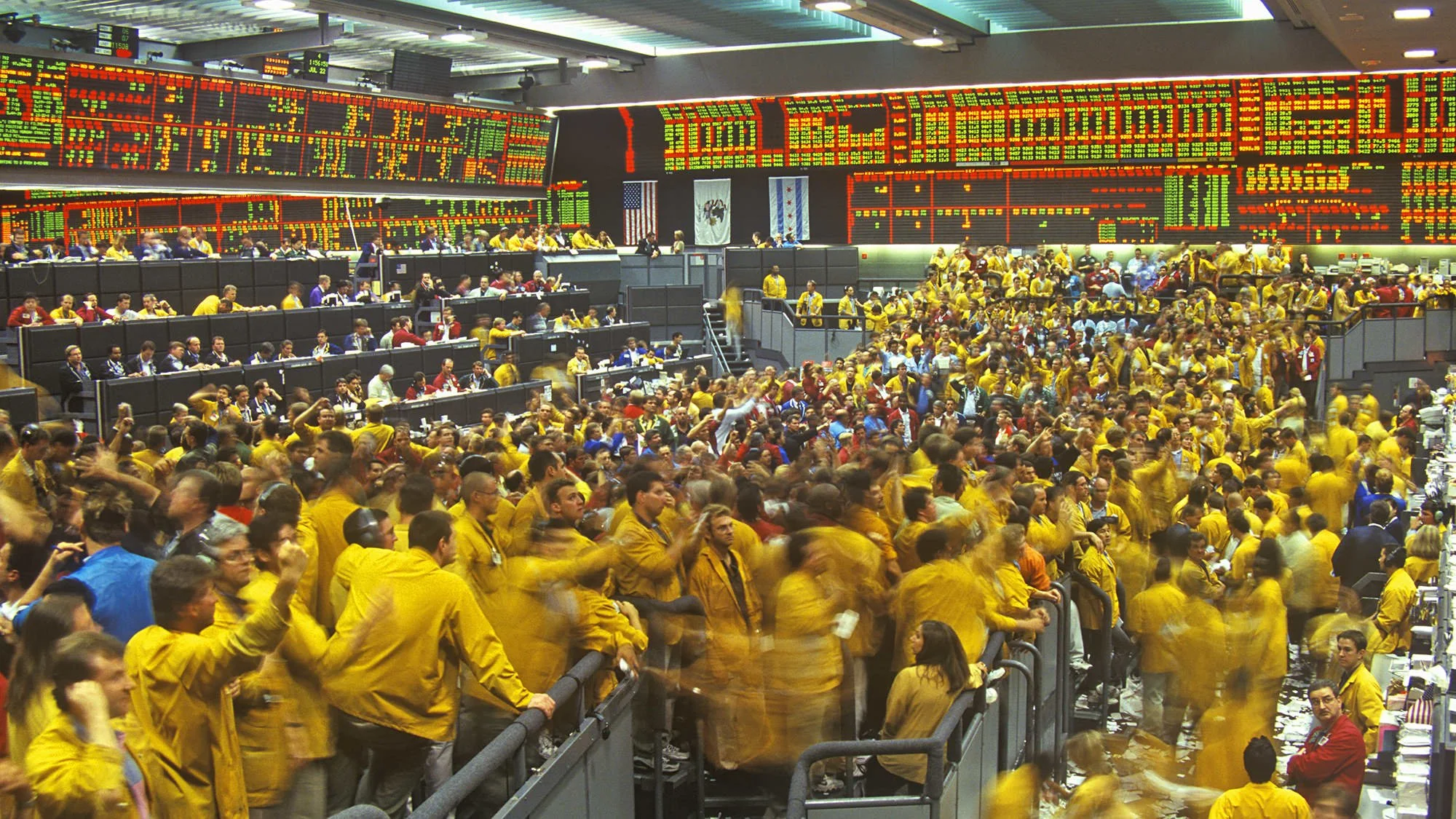
Once upon a time we transitioned from floor tradingECCOWARE (1998-2002): PIONEERING ALGORITHMIC TRADING INFRASTRUCTURE
Founding Team Member & Lead Architect
1998-2002 (approx. 4 years)
Building the first commercial algorithmic high-frequency trading platform
Overview
EccoWare represented a pivotal moment in electronic trading evolution - the transition from manual floor trading to fully automated algorithmic execution. As a founding team member, I helped architect and build what became the first commercial algorithmic HFT platform, fundamentally changing how derivatives were traded.
The company was acquired by eSpeed (BGC Partners/Cantor Fitzgerald) for £12M, with the technology forming the foundation for institutional algorithmic trading infrastructure that followed.
This early-career experience established deep technical expertise in trading system architecture, high-performance computing, and financial market microstructure - capabilities that underpin all subsequent work including current blockchain protocol development.
Genesis: From LIFFE Floor to Algorithmic Trading
Westminster Trading / REFCO (1998)
The journey began as a "yellow jacket" on the LIFFE trading floor during the final days of open outcry. Officially hired as a floor trader for Westminster Trading (the locals clearing operation for REFCO), the role quickly evolved:
Systems integration: Reconciling REFCO clearing system with ORC trading platforms
Screen scraping technology: Built automated scraping of VT220 terminals to enable algorithmic trading onto DTB (Deutsche Terminbörse) terminals
Early automation: Creating the technical infrastructure to bridge manual trading and electronic execution
The inflection point: REFCO shut down the Westminster Trading business, but the management team recognized the opportunity in electronic trading automation.
EccoWare Formation (1998-1999)
The Westminster Trading management team pivoted to form EccoWare, focused entirely on building algorithmic trading infrastructure for the emerging electronic derivatives markets.
Mission: Create commercial-grade algorithmic trading platform enabling sophisticated execution strategies across multiple exchanges and asset classes.
Market timing: Perfect convergence of:
European derivatives exchanges transitioning to electronic trading
Increased computational power making complex algorithms viable
Growing demand from proprietary trading firms and investment banks
Regulatory changes enabling greater automation
Technical Innovation & Architecture
First Commercial Algorithmic HFT Platform (1999)
Core achievement: Co-architected the first commercial platform enabling algorithmic high-frequency trading across multiple derivatives exchanges.
Technical characteristics:
C++ infrastructure for microsecond-level latency requirements
Multi-exchange connectivity - unified interface across DTB, LIFFE, EUREX, and other venues
Algorithmic execution strategies - not just order routing, but intelligent execution logic
Risk management integration - real-time position monitoring and exposure limits
Market data processing - high-speed tick processing and order book reconstruction
Innovation areas:
Low-latency architecture:
Custom C++ frameworks optimized for speed
Direct exchange connectivity protocols
Memory-efficient data structures for market data processing
Minimize network hops and processing overhead
Algorithmic strategy framework:
VWAP and TWAP execution algorithms
Iceberg order management
Smart order routing across venues
Spread trading and arbitrage strategies
Risk management systems:
Real-time position monitoring
Pre-trade risk checks
Exposure limit enforcement
Multi-asset portfolio risk calculation
Market microstructure optimization:
Order book dynamics modeling
Optimal execution timing
Liquidity detection and assessment
Transaction cost analysis
Patent Development
The technical innovation at EccoWare resulted in multiple patent applications that became foundational IP in electronic trading:
Systems and Patents Filed During EccoWare Period:
Trading System (Yield Spreader)
Patent: US 20090012893 (filed during EccoWare/eSpeed period)
Innovation: Automated trading for yield-based derivatives
Technical contribution: Enabled collaborative processing computing yields of non-fixed-income instruments, automated trading based on yield comparisons
System and Method for Determining Availability of a Tradable Instrument
Patent: US 20070016506 (filed 2007 but based on EccoWare-era innovation)
Innovation: Methodology for calculating instrument availability
Technical contribution: Determines available vs. unavailable offered quantities, enables accurate tracking across related instruments
Systems and Methods for Providing Dynamic Price Axes
Patent: US 20090043664 (filed 2006 but rooted in EccoWare UI innovation)
Innovation: Dynamic display of bid/ask prices where prices change locations as inside market moves
Technical contribution: Created intuitive visual representation of market movement for traders
These patents represented real innovation solving actual trading problems, not speculative IP. Each addressed specific challenges we encountered building commercial trading systems for demanding institutional clients.
Market Impact
Transforming Derivatives Trading
EccoWare's platform fundamentally changed how derivatives were traded:
Before: Manual floor trading, voice broking, limited automation
After: Algorithmic execution, multi-venue strategies, microsecond decision-making
Client adoption:
Proprietary trading firms using algorithms for market-making
Investment banks deploying automated execution strategies
Hedge funds leveraging HFT for arbitrage opportunities
Futures Commission Merchants offering algo execution to clients
Technology Diffusion
The architectural patterns and techniques developed at EccoWare became industry standards:
C++ as the language of choice for low-latency trading
Direct exchange connectivity over FIX protocol
Algorithmic execution frameworks
Real-time risk management integration
Acquisition by eSpeed (BGC/Cantor)
Exit: Acquired for £12M by eSpeed (part of BGC Partners/Cantor Fitzgerald)
Strategic rationale:
eSpeed wanted to expand beyond US Treasuries into European derivatives
EccoWare provided proven technology and team with deep market expertise
Platform could be integrated with eSpeed's existing infrastructure
Access to European client base and exchange relationships
Personal outcome: Continued with acquiring company in senior technical and product management roles, eventually becoming VP Global Head of Futures Product Management.
The acquisition validated both the technical innovation and commercial viability of the platform we'd built.
Skills & Expertise Developed
Technical Capabilities
Low-latency systems engineering:
C++ optimization techniques for microsecond-level performance
Network programming and exchange connectivity
Memory management for high-throughput systems
Multi-threading and concurrency patterns
Financial system architecture:
Trading system design patterns
Market data processing architectures
Order management systems
Risk management frameworks
Exchange integration methodologies
Algorithmic trading:
Execution algorithm design
Market microstructure analysis
Order book dynamics
Transaction cost modeling
Strategy backtesting frameworks
Business & Product Skills
Product development:
Translating trader requirements into technical specifications
Balancing performance, functionality, and reliability
Iterative development with demanding users
Feature prioritization under resource constraints
Market understanding:
Deep knowledge of derivatives markets
Exchange operations and rulebooks
Clearing and settlement mechanics
Regulatory requirements across jurisdictions
Startup operations:
Building products with limited resources
Rapid iteration based on market feedback
Client relationship management in early-stage company
Contributing to strategic direction
Foundational Lessons
This early experience established principles that guide all subsequent work:
1. Technical Excellence Matters
In trading systems, performance isn't a nice-to-have - it's existential. Microseconds determine profitability. This discipline carries through to current blockchain work where gas optimization and throughput are critical.
2. Innovation Must Solve Real Problems
The patents we filed weren't speculative - they solved actual pain points we encountered building for demanding clients. Same approach now: Pascal Protocol addresses real clearing challenges, not theoretical problems.
3. Architecture Determines Scale
Early architectural decisions constrained or enabled future growth. Getting core patterns right from the start mattered more than quick features. This thinking influences current protocol design.
4. Market Structure Drives Technology
You can't build trading technology without deep understanding of market microstructure, clearing mechanics, and regulatory constraints. Technical solutions must align with market reality.
5. Teams Matter More Than Individuals
Building complex systems requires collaboration. The EccoWare founding team's combined expertise exceeded what any individual could accomplish. Same principle applies to current ventures.
Legacy & Ongoing Relevance
Direct Technical Lineage
The technical foundations from EccoWare directly inform current work:
Then (1999): Building C++ HFT platform for derivatives
Now (2024): Building on-chain clearing infrastructure for derivatives
Common threads:
Obsession with performance and efficiency
Deep understanding of derivatives risk management
Focus on portfolio-level rather than individual instrument thinking
Rigorous testing and quality standards
Institutional-grade reliability requirements
Patent Foundation
The patents filed during and shortly after EccoWare created IP portfolio demonstrating consistent innovation capability over 25+ years:
1999-2007: Trading system patents (EccoWare era)
2012: Bin-based risk management patent
2013: Perpetual futures patent
2022-present: Pascal Protocol development
This track record matters for HMRC purposes - it's not recent invention, it's decades of continuous IP creation.
Market Understanding
The market structure expertise developed trading derivatives in the 1990s/2000s remains highly relevant:
Clearing mechanics haven't fundamentally changed
Portfolio margining principles are identical
Risk management approaches translate directly
Market microstructure understanding applies to DEXs
EccoWare provided the foundation for understanding how derivatives markets actually work - knowledge that proves invaluable when building blockchain-based clearing infrastructure.
Connection to Handleport Services
This experience enables Handleport to:
Technical Credibility: Not theoretical knowledge - hands-on experience building production trading systems at scale
IP Development: Proven track record creating valuable, commercially relevant patents
System Architecture: Deep expertise in high-performance, mission-critical systems design
Trading Expertise: Real understanding of derivatives, execution, and market microstructure
Startup Experience: Been through early-stage company building and successful exit
Innovation Capability: Demonstrated ability to identify problems and architect novel solutions
The Trading Technologies Ladder Patent Litigation
Background: The Price Ladder Innovation
During the EccoWare period, we developed what became known as the "price ladder" - a vertical graphical display showing bid and ask prices with quantities, enabling single-click trading. This UI innovation fundamentally changed how traders interacted with electronic markets.
The innovation:
Vertical price axis with best bid/ask prominently displayed
Visual representation of order book depth
Single-click order entry at specific price levels
Dynamic updating as market moved
Intuitive interface requiring minimal training
Critical point: We invented the term "ladder" to describe this interface. It wasn't borrowed from elsewhere - we needed a name for what we'd built, and "ladder" captured the vertical price structure.
This was parallel development solving an obvious problem: how to display an electronic order book intuitively for traders accustomed to seeing prices called out on trading floors. Multiple firms were working on similar solutions simultaneously because the problem was universal.
The Patent Wars Era
Industry context (late 1990s - early 2000s):
The electronic trading industry was in a destructive patent war period. Trading Technologies (TT) had filed patents on the price ladder and related trading interface elements, then began aggressive litigation against competing platforms.
The fundamental problem: First-to-file patent system was stifling innovation
In practice, this meant:
Whoever filed first could claim ownership of obvious solutions to common problems
Parallel development was ignored - if someone filed first, everyone else infringed
Innovation was being locked up by patent thickets rather than enabling progress
Small improvements or obvious solutions were being patented aggressively
Litigation became a competitive weapon rather than IP protection
The irony: TT's developers had been observed at Transmarket copying our spreader technology. Yet they were suing us for patent infringement on the ladder interface.
This created an absurd situation: we'd independently developed the ladder interface, even coined the term, but because TT filed patents first, we were allegedly infringing. I believe that eSpeed settled around the time I left that business, but am not aware of the final statements.
EccoWare/eSpeed Independent Development
Our development timeline:
The price ladder emerged organically from trader requirements:
Floor trading background: Many of us had floor experience and understood how traders processed price information visually
Electronic order books: Markets were transitioning to electronic, but interfaces were primitive
Trader feedback: Direct interaction with users telling us what they needed
Iterative development: Building, testing, refining based on actual trading use
Critical evidence of independent development:
Our developers had NOT seen Trading Technologies' implementation before building the ladder
We invented the terminology - "ladder" was our term for the interface we'd created
Different implementation details - while the concept was similar, the actual code and design choices differed
Solving an obvious problem - anyone building an electronic trading platform would arrive at similar solutions
The development environment: We were in London building for European markets while TT was in Chicago focused on US exchanges. Geographic and market separation meant limited interaction or knowledge sharing between firms.
30(b)(6) Witness Role
Legal designation: Corporate representative witness for eSpeed in the Trading Technologies litigation
30(b)(6) explanation: Under US federal rules, a 30(b)(6) designation means the witness represents the company's knowledge on specified topics. It's not just personal testimony - you're speaking for the entire organization.
Testimony scope:
Independent development of the price ladder interface
Timeline of UI innovation at EccoWare/eSpeed
Technical implementation details
Development process and design decisions
Knowledge (or lack thereof) of TT's patents and implementations
Industry practices around electronic trading interface design
Key testimony points:
Parallel development was common: Multiple firms solving identical problems with similar solutions because the problems were obvious
No knowledge of TT implementation: Our developers built the ladder based on trader requirements and floor trading intuition, not by copying TT
Independent invention of terminology: "Ladder" was our term for our interface, not borrowed language
Geographic and market separation: Limited interaction between European and US electronic trading development communities
Industry norms: Sharing ideas and concepts was common (as evidenced by TT developers being at Transmarket), but everyone implemented independently
The Transmarket Irony
A particularly galling aspect of the litigation:
We were aware that TT developers had been at Transmarket (a client) observing and copying our spreader technology.
The spreader innovation: Complex derivatives trading tool allowing traders to simultaneously quote multiple related contracts (calendar spreads, butterfly spreads, etc.) with automatic leg calculation and risk management.
The situation:
TT developers observed our spreader implementation at Transmarket
They incorporated similar concepts into their own platform
Yet TT was suing us for allegedly copying their ladder patent
The first-to-file system meant observation of our technology was irrelevant - their earlier patent filing gave them legal standing
This highlighted the fundamental problem with the patent system during this era: actual innovation and development timelines mattered less than who filed paperwork first.
Stifling Innovation: The First-to-File Problem
The industry impact:
The patent wars were actively harmful to innovation in electronic trading:
Defensive patent portfolios: Firms filed patents not to protect genuine innovation but to create bargaining chips for cross-licensing negotiations
Patent thickets: Every minor UI improvement or obvious solution got patented, creating minefields for new entrants
Litigation as competitive weapon: Patents used to slow competitors rather than protect genuine IP
Reduced collaboration: Fear of patent infringement reduced information sharing that previously helped the industry advance
Innovation tax: Development costs increased as firms had to navigate patent landscapes and pay licensing fees
Startup deterrent: New entrants faced immediate patent litigation regardless of independent development
The parallel development problem:
When a problem has an obvious solution, multiple smart people will arrive at similar answers independently. The first-to-file system punished this natural process, granting monopolies on obvious solutions simply because one firm filed paperwork first.
Examples from electronic trading:
Price ladder displays (obvious: show prices vertically with best bid/ask prominent)
One-click trading (obvious: click price to submit order at that level)
Spread trading tools (obvious: calculate leg quantities automatically for common spreads)
Market data visualization (obvious: use color coding for price movements)
None of these were revolutionary breakthroughs - they were natural solutions to common problems. Further a lot of these terms (one click, static) didn’t have clear legal definitions. Yet all became subjects of patent litigation.
Litigation Outcome & Industry Impact
The broader resolution:
The TT ladder patent litigation eventually resulted in settlements and cross-licensing agreements across the industry. No clear "winner" emerged - instead, the industry reached an uneasy détente where major platforms had mutual non-aggression agreements while extracting licensing fees from smaller entrants.
Personal lessons learned:
Patent strategy matters: Independent development isn't a defense under first-to-file systems
Documentation is critical: Detailed records of development timelines and design decisions become crucial in litigation
Industry collaboration vs. IP protection: Tension between sharing knowledge to advance the field and protecting competitive advantages
Expert testimony requirements: Ability to explain complex technical concepts clearly to non-technical judges and juries
Patent quality varies: Many patents granted shouldn't have been - they covered obvious solutions or overly broad claims
Impact on subsequent IP strategy:
This experience shaped approach to IP creation going forward:
File patents on genuine innovations: Don't just patent obvious solutions, focus on novel approaches to hard problems
Document independent development: Maintain clear records of design decisions and development timelines
Consider prior art carefully: Understand what others have done before filing
Balance IP protection with innovation: Patents should enable innovation, not stifle it
Relevance to Current Work
The lessons from the ladder patent wars apply directly to blockchain/crypto IP:
DeFi innovation environment: Currently similar to late-1990s electronic trading - rapid innovation with unclear IP boundaries
Obvious solutions risk: Many "innovations" in DeFi are obvious solutions to common problems (like the ladder was)
Parallel development common: Multiple projects solving identical problems (e.g., automated market makers, lending protocols)
Patent strategy considerations: Whether and when to patent blockchain innovations remains contentious
Current IP approach:
Learning from the ladder patent experience:
Focus on genuinely novel solutions to hard problems (portfolio margining on-chain)
Ensure implementation details differ from obvious approaches
Document development process showing independent innovation
Consider open-source vs. patent protection trade-offs
Avoid patenting obvious solutions just to create defensive portfolios
The perpetual futures patent (2013): Filed years before crypto perpetuals became standard, representing genuine foresight rather than obvious solution. This is the type of IP worth protecting.
Expert Witness Credentials
The 30(b)(6) testimony in the TT litigation established credentials as an expert witness in financial trading technology:
Demonstrated capabilities:
Explain complex technical systems to legal audiences
Provide corporate knowledge representation
Withstand cross-examination on technical details
Present development timelines and design decisions clearly
Understand patent law implications of software development
Subsequent expert witness work: Multiple engagements representing Cantor Fitzgerald in IP litigation, building on experience from the TT case
Current application: These credentials enable Handleport's expert witness services for commodities trading and FinTech disputes, backed by actual litigation experience in major cases.
Historical Perspective
Two decades later:
The electronic trading patent wars are largely resolved, but similar dynamics play out in new technology areas:
Mobile apps: Patent battles over obvious UI gestures and interaction patterns
E-commerce: Patents on common shopping cart and checkout processes
Blockchain/crypto: Beginning to see patent filings on DeFi mechanisms and protocol designs
The fundamental tension remains: Balancing IP protection incentivizing innovation against patent thickets that stifle progress.
Personal position: Patents should document genuine innovation solving hard problems, not lock up obvious solutions to universal challenges. The perpetual futures patent represents real foresight; the ladder display was an obvious solution that shouldn't have been patentable by anyone.
Personal Reflection
EccoWare was formative. It's where I learned that:
Great technology requires understanding the problem domain deeply
Performance optimization is both art and science
Patents should document real innovation, not speculative ideas
Building for institutional clients demands different rigor than retail products
The best solutions often come from small, focused teams
Twenty-five years later, these lessons remain relevant. The technology has changed (blockchain instead of C++), but the principles haven't.