
Yield-bearing collateral and the cost of mobilisation
Collateral and tokenised collateral are on my mind today. Does a DCO if it is QCCP need to own a CSD or not. However the key piece was a conversation about yield bearing stablecoin and separating components the other night with an investor doing DD. They echoed without realising the contents of a draft paper we have internally. The questions all boil down to what happens to yield on collateral.
Tokenised Collateral is often yield-bearing.
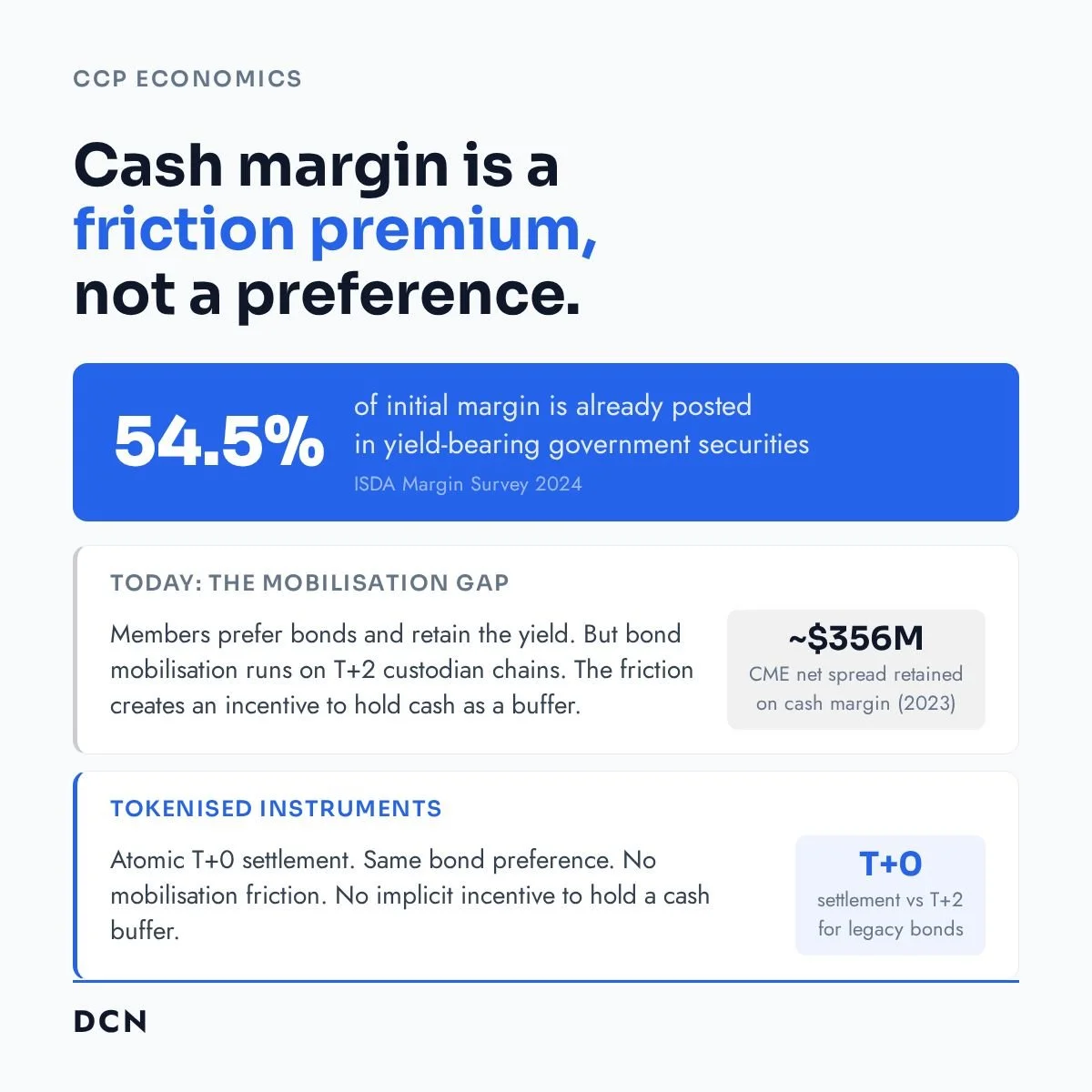
The clearing industry already runs on yield-bearing assets. ISDA's 2024 margin survey puts government securities at 54.5% of initial margin collateral globally. Cash is a minority of initial margin at most CCPs. Every clearing member who has a choice posts bonds and retains the yield.
So the financial architecture of central clearing is already, in large part, a yield-bearing architecture. LCH and CME operate detailed eligible collateral schedules. Under pledge structures, members retain the coupon on what they post. Though value accrual between coupon dates is a bit more murky.
What tokenised yield-bearing instruments change is not that principle. It is the operational cost of acting on it.
Mobilising a bond from custody into a CCP's eligible pool involves custodian chains built for a T+2 settlement cycle. For a clearing member managing margin across multiple venues, that friction has a real cost. It creates an incentive to hold cash as a buffer even when bonds are preferred. Cash can be moved much faster. That cash earns the CCP a spread, CME retained approximately $356 million net on cash margin in 2023.
If a tokenised T-bill settles atomically, the economics shift. The member posts the instrument at T+0, retains the yield, the CCP receives collateral of equivalent quality, and the operational cost that made cash the path of least resistance disappears.
The CFTC's December 2025 pilot (Letters 25-39 and 25-40) covers BTC, ETH, and USDC. Those are not yield-bearing instruments of the kind clearing members are already posting. The instruments institutional members would actually want in tokenised form, Treasury bills, money market instruments, are not yet properly understood.
From a certain perspective this is an unanswered question because of the massive fragmentation of the crypto market. The fragmentation leads to Cash as the choice of collateral, or at least stablecoin. Meaning yield is probably zero for traders (members) but it moves fast. Also given the awful default mechanics with ADL, it needs to be liquid and fungible which cash does. However as we walk the efficiency line, get some consolidation, and hopefully a horizontal clearing layer because of either understanding or because of regulated cash pressure to enter the market. Yield bearing collateral will come more into scope at most crypto exchanges.
For practitioners managing margin pools at scale: how much of your cash posting is a genuine preference, and how much is a function of mobilisation cost?
This first appeared on LinkedIn on 16 April 2026. If you want to comment or discuss, that's the place.