
Risk Calculation in an AI World, Part 4: The People Problem
Part three ended on a one word answer.
If the machinery exists, and the constraint that stopped it was never compute, what is this industry actually short of? People.
Ok, so not really People, but people with the right skill sets to take advantage of the new engineering tools.
Ask how the arrival of AI has changed quantitative finance and you can predict the article you will get. Large language models draft pricing code in minutes. Junior analysts are three times as productive. Banks are deploying co-pilot into their risk platforms (or something better), and the conference panels debate whether the machines threaten junior quants or senior ones. All of it is true, and all of it is the small answer. It lacks the understanding of the engineering shift, why there was a breakthrough, and what that might mean to an industry capable of spending more than practically any other on high end software engineers and mathmaticians.
We have spent this year building a clearing risk engine with these new tools, and the small answer is not what we found. What we found is that the mathematics and the engineering that produced modern AI, applied to risk, do not just accelerate the old workflow. They change what risk calculation is, the way it is seen, and therefore who is equipped to build it. The awkward consequence is that the skills it demands are not the ones the industry teaches, hires for, or that ambitious would-be quants choose to acquire. We have, as an industry, created a machine to produce specific skill sets in quants that are not these.
What actually transferred
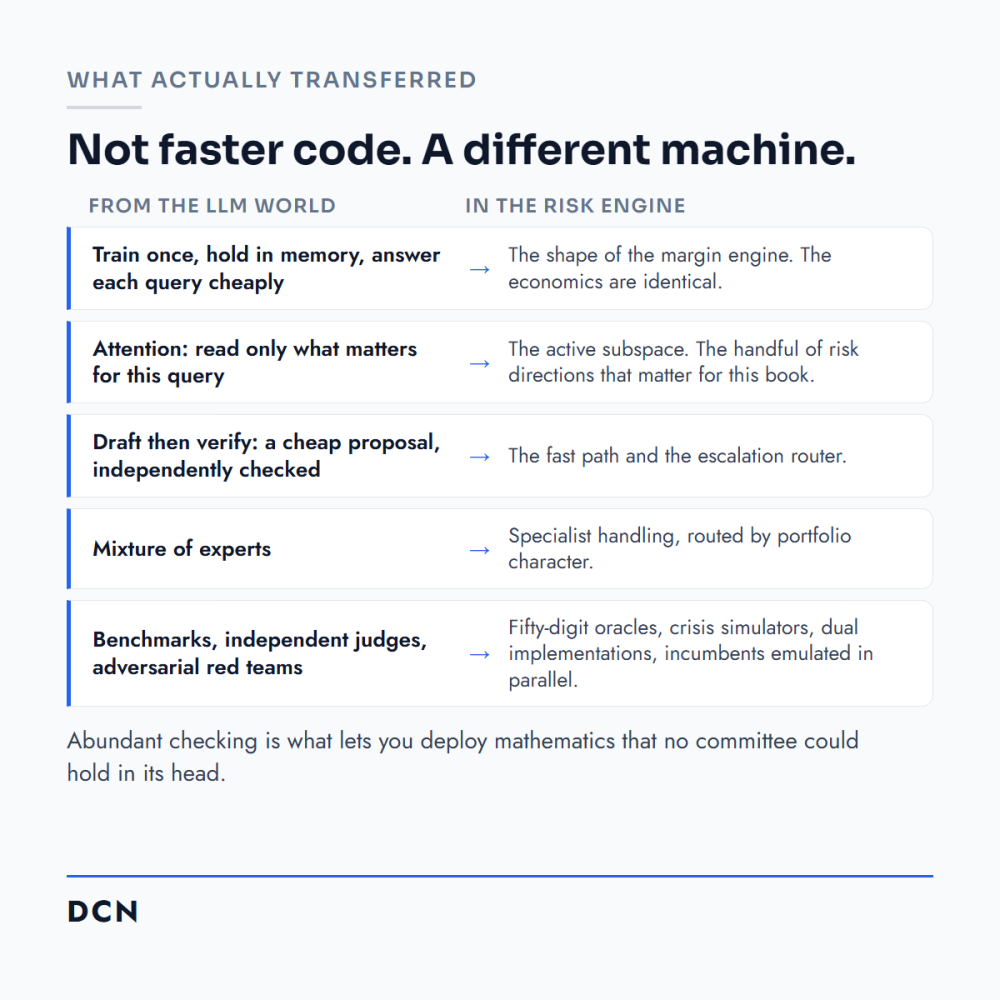
"AI techniques" is a phrase that hides more than it says, so here is what moved from the LLM world into the engine of part two, item by item.
The serving architecture moved.
Train expensively once, hold the result in memory, answer each query cheaply: the shape of every deployed language model became the shape of the margin engine, because the economics are identical.
Attention, the mechanism by which a model reads only what matters for this query, became the active subspace, the handful of risk directions that matter for this book.
The draft-then-verify pattern that makes model serving fast, a cheap proposal checked by an independent verifier before it is accepted, became the engine's fast path and its escalation router.
The mixture-of-experts idea became specialist handling routed by portfolio character. This one is hard to understand, essentially we don't need only one style of estimator.
The evaluation culture came with it, and that is the part we now think matters most when picking staff. The AI world learned early that its generators are fluent and untrustworthy, and its response was not to trust less ambitiously but to gate everything: benchmark suites, independent judges, adversarial red teams, machine-enforced acceptance criteria.
Carried into risk, that culture produced the harness of part two, hundreds of independent fifty-digit oracles, simulators that exercise the engine through synthetic crises, dual implementations reconciled continuously, incumbent models emulated in parallel as the standard of comparison, adversarial reviews of every design decision with the transcripts kept.
The old economics of model validation rationed human checking because it was scarce and slow. The new economics make checking abundant, and abundant checking is what lets you safely deploy mathematics that no committee could hold in its head.
The third thing to cross over was a way of "seeing", and it changes who can do the job.
Geometry against statistics
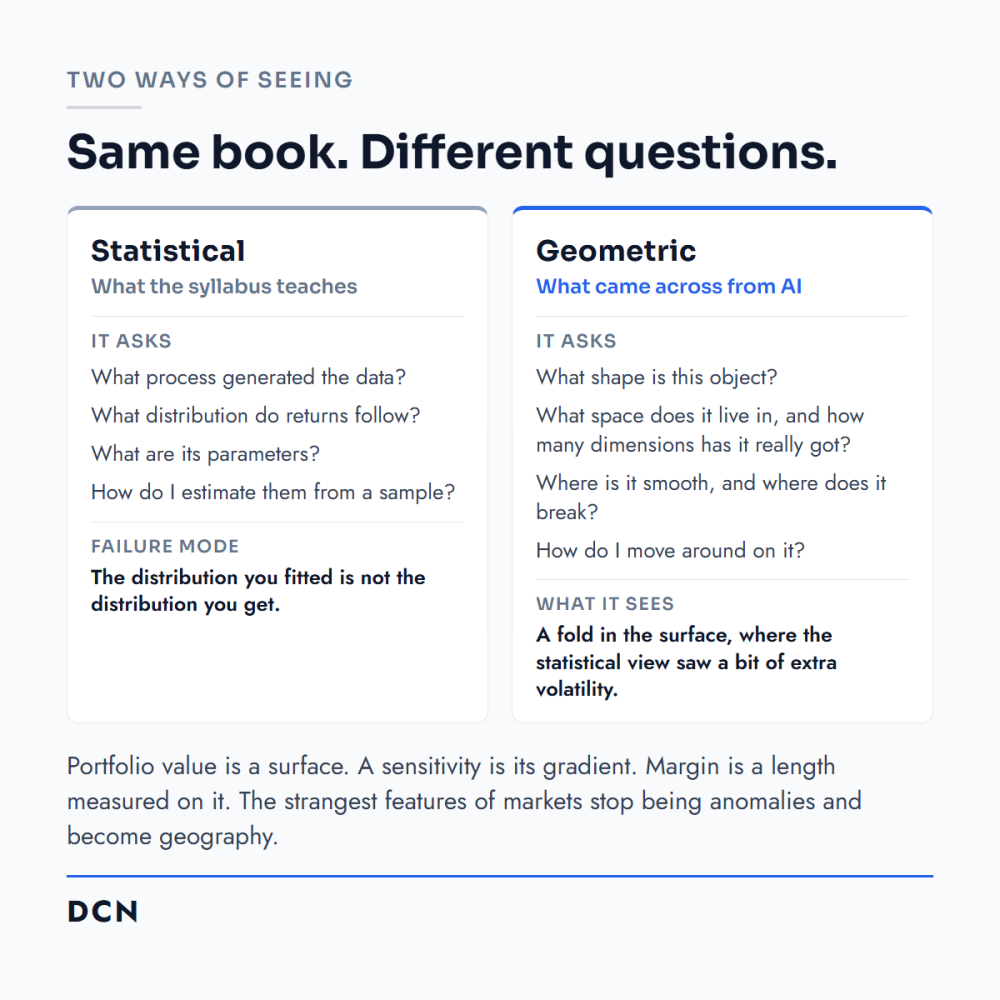
The quant education is, at its core, statistical. It teaches you to ask: what process generated the data, what distribution do returns follow, what are its parameters, how do I estimate them from a sample. Its instincts are calibration instincts; its failure mode, as 2008 taught expensively, is that the distribution you fitted is not the distribution you get.
This pattern is not specific to one institution.

-Carnegie Mellon's Master of Science in Computational Finance — sixteen months, twenty-five courses — gives its first year to eight courses in probability and statistics, three in Python, four on financial products and markets, and four in business communication. Machine learning arrives in the fourth mini-semester under the title Statistical Machine Learning; deep learning and natural language processing are optional modules in the final term.

-Oxford's MSc in Mathematical and Computational Finance runs ten months and makes Deep Learning one of four core courses in its second term.

-Princeton's Master in Finance teaches machine learning inside a core course called Statistical Analysis of Financial Data, in among density estimation and copulas.

Then look at what the machine learning consists of.
At Carnegie Mellon: convolutional networks, recurrent networks, generative adversarial networks, autoencoders.
At Princeton: support vector machines, convolutional and recurrent neural networks.

Both stop in the same place, the architecture canon as it stood before 2017. The word "transformer" appears in none of these curricula.

Princeton's engineering school does teach a course on transformers and large language models, but it is not among the machine learning electives the finance programme points its students toward.

This is no criticism of the teaching, which is excellent at all three. It is an observation about what the discipline takes itself to be. Machine learning enters quantitative finance filed under statistics, taught by statisticians, as one more family of estimators to fit to historical data.

Of AI engineering, building systems on top of these models rather than fitting them, there is nothing at all.
This is where the vision about how this will be in the future come in. The way of "seeing" that came across from the AI Engineering world is geometric.
It asks:
what shape is this object,
what space does it live in,
how many dimensions does it really have,
where is it smooth and where does it break,
and how do I move around on it.
A language model is, mechanically, an enormous learned surface navigated at inference time. Build risk systems in that image and the same questions take over. Portfolio value is a surface over the space of risk factors. A sensitivity is that surface's gradient in that dimension. Margin is a length measured between points. A book's risk lives in a low-dimensional slice of it.
And the strangest features of markets stop being statistical anomalies and become geography: the bond future of part two, whose deliverable can flip, is a surface with a fold in it, a dormant extra dimension that wakes up in one region of the map, and the correct margin near the fold follows from asking how likely the market is to reach it before you could close a defaulter's book. None of that is a distribution fit; it is geometry, and the fold was invisible to every treatment that tried to see it statistically, as a bit of extra volatility.
I do not want to overclaim novelty for the mathematics itself; catastrophe theorists were drawing folds in the 1970s and one of them, Zeeman, even wrote about stock exchanges. What is new is that the geometric way of seeing now comes with an engineering practice that makes it operational at production scale, and with a verification culture that makes it certifiable. That combination did not exist when the folds were first drawn. It exists now because a neighbouring industry spent a decade building it for its own reasons.
It is interesting to us that large-scale structure of space-time publications are looking at this at the same time.
The inventory of missing skills
Now walk through what the build actually required, against what a quantitative finance masters actually teaches. Take it as a practical inventory rather than a lament; anyone planning a career or a hiring round can use it as a list.
The engine's compression layer rests on tensor decompositions, the numerical multilinear algebra that lets a high-dimensional surface be stored and queried at a fraction of its naive size. That mathematics matured inside computational quantum physics; the canonical modern reference is only fifteen years old (Oseledets, "Tensor-Train Decomposition," 2011). It appears in no finance curriculum I am aware of. The people fluent in it are in physics departments. We even see this in AI Engineering publications where surface is used for what are manifolds, vector fields is the chosen term for what are Tensors. This is new for everyone.
The accuracy layer rests on approximation theory: Chebyshev representations, sparse grids, certified error bounds, the discipline of knowing exactly how wrong a cheap representation can be. This is classical numerical analysis, some of it a century old, and it is likewise mostly absent from the quant syllabus, which teaches you to simulate where an approximation theorist would interpolate and bound.
The tail layer rests on extreme value theory, which the syllabus does mention, usually as a formula: fit a generalised Pareto distribution above a threshold. What the build needed was the real-analysis underneath, regular variation, domains of attraction, the conditions under which the limit theorems apply and the threshold trade-offs at the edge of the data, because a tail calibration you cannot defend at the level of its conditions is a tail calibration a validator should reject. The formula is taught; the conditions are not.
The conceptual layer, as above, is differential geometry, at least at the level of fluency needed to understand it: surfaces (manifolds), gradients as covectors, tensors, metrics, curvature, coordinates and what should not depend on them. Quants meet Ito calculus; they rarely meet the geometry that makes "the margin should be invariant when you re-describe the book" a statement you can test.
And wrapped around all of it, the engineering: decomposition of work into verifiable pieces, design of gates and oracles, the economics of memory against computation, the discipline of registers that record what is proven, what is assumed and what is open. This is the software engineering that AI development forged, and it is not taught in finance at all. It is barely taught in computer science; it is a practice culture, learned by building.
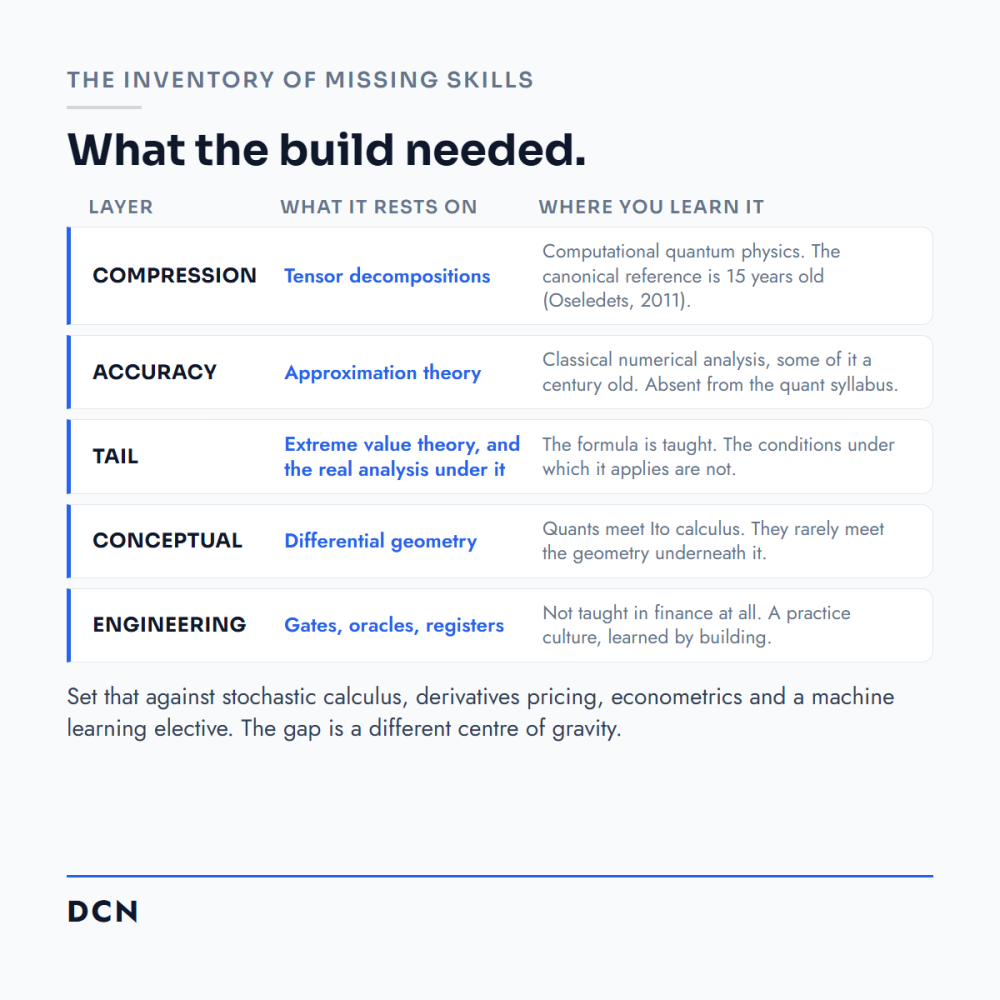
Set that inventory against the standard curriculum, stochastic calculus, derivatives pricing, econometrics, a machine learning elective, and the gap is not a course or two but a different centre of gravity. The industry's own house journal ran a piece last November titled "For tomorrow's quants, Python is essential; AI isn't," reporting that employers want general software skills and do not yet list AI as a hiring criterion. I read that as a snapshot of hiring criteria trailing practice by exactly one generation, the way "knows C++" trailed the AAD revolution. The quants who will build the next decade's risk systems are not the ones the current postings describe. Still, we must concede there is a difference between an operator and an innovator, the assumption we are making is that most want to be innovators, at least at the time of selecting a course.
The race to optimise the wrong thing
There is a historical warning here that the quant world should take personally, because it is written in its own best journals.
For twenty years, some of the field's finest minds worked on variance reduction: importance sampling, quasi-random sequences, control variates, ever-cleverer ways to make Monte Carlo converge faster inside the nightly batch. The work was genuinely brilliant. And it all optimised within a frame, the batch, the scenario set, the recompute-per-point architecture, that was never itself the question. When the frame finally shifted, the shift came from outside: from adjoint techniques out of numerical engineering, from proxy models the insurers were forced into, from an AI industry that made train-once-query-cheap the default shape of computation. The lesson is not that the variance-reducers were wrong; it is that a discipline trained to optimise inside its inherited frame produces virtuoso answers to the wrong question, indefinitely, until a skills base from outside the frame asks the right one.
That, in the end, is my answer to whether the quant skill set is obsolete. The mathematics is not; the engine of part two contains more classical mathematics than a production VaR farm, not less. What is ending is the monopoly of the statistical way of seeing, and the career path built on performing calculations that a verified pipeline now performs better. What is scarce, and will stay scarce for years, is the combination: enough mathematics to own the geometry, enough engineering to build the gates, enough scepticism to keep the registers honest. People with all three are today mostly found in physics corridors and AI labs, not on graduate trading floors, and the industry that needs them has not yet written the job description. Knowing some of the Lead Engineers at top AI companies directly, even they struggle to put these in one place, and the also lack the language to identify the skill needed to slot into their top research engineering roles.
Who moves first
One prediction falls out of all this, and part one already supplied its evidence. If the skills were the only barrier, the incumbents would simply hire and retool; they have the balance sheets for it. But recall the natural experiment: the compute constraint fell twenty years ago, adjoints and GPU farms made the modern architectures affordable by the early 2010s, and the incumbent architecture did not move, because the model is not just a calculation at an incumbent, it is the franchise, the validation estate, the regulatory filing, the thing three committees have signed. Institutions do not re-derive their load-bearing walls while standing on them, and the more successfully a model is embedded in governance, the more expensive it is to see past. So the geometric generation of risk systems will mostly not arrive as upgrades to the systems it improves on. It will arrive the way the proxy-model wave arrived in insurance and the way the adjoint wave arrived in XVA: from the edges, built by people who carry the new inventory because they never trained on the old one, adopted first where the franchise cost of change is lowest, and studied by the incumbents' validation teams before it is imitated by their engineers. That is not a criticism of anyone; it is how regulated infrastructure has always absorbed a new way of seeing, and it is why the training question lands hardest not on the incumbents but on the people deciding, this year, what to learn.
The training ahead
So the closing note of this series is not a victory lap for the machines; it is a training requirement, and it runs in both directions.
The quants need the new skills inventory: the geometry, the approximation theory, the tensor methods, the verification engineering. Whether we are right or wrong almost no one thinks that the AI Engineering skill set will not come to finance, we just think its the skills not the LLM that will be most critical. None of it is beyond anyone who survived a stochastic calculus course; it is simply not on the syllabus, and it needs to be, in the masters programmes, in the CPD budgets, in what desk heads reward. The AI-native engineers coming the other way need what the quants have and undervalue in themselves: the institutional knowledge of margin, default, collateral and disputes, the scar tissue of 2008 and 2020, the understanding that in this domain a wrong number is not a bad benchmark score, it moves someone's collateral the same afternoon. And the validators and regulators, who will see these systems land on their desks within a few years, need the version of the skills that lets them audit registers and equivalence evidence rather than re-derive formulas, because re-derivation does not scale to what is coming and auditing does.
If you run a risk function, lead a quant desk, the question to sit with is the one this series set out to answer: how much of your team's effort goes into performing calculations a verified pipeline could now perform, and how much into the geometry, the gates and the registers that would let you trust one?
If you are a student choosing between the well-worn syllabus and the strange one, the strange one is where the shortage is.
And if you are building in this space from either side, the mathematics corridor or the AI one, we would genuinely like to compare notes, because the interesting work is exactly where the two skill sets meet, and there are still very few of us standing there.
All of this is great, it doesn't build a business on its own. This may appear to cross with our posts on SIMM, on netting. It will look incongruent as we talk about non-recourse, about the difficult issue of legal reliance about default securitisation. Sales skills, marketing. It is all critical to make a business work. This aspect is just interesting to the market as a whole.
DCN.
This first appeared on LinkedIn on 3 August 2026. If you want to comment or discuss, that's the place.