
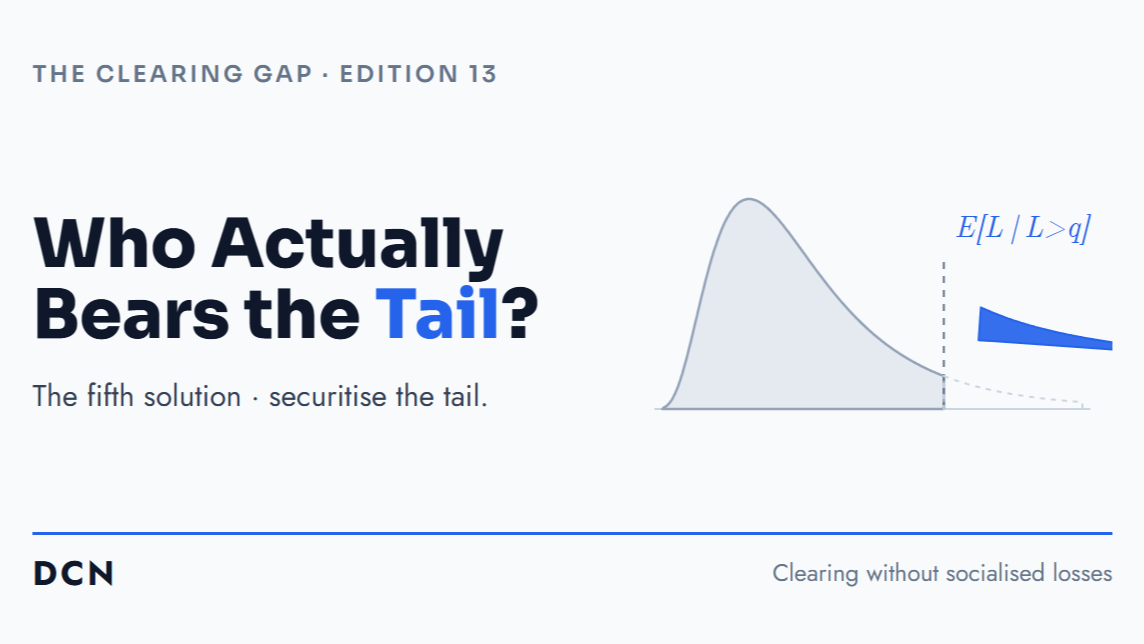
Who Actually Bears the Tail?
The last four editions of this newsletter were about how risk gets calculated in a world that has learnt about scaled processing from AI Engineering, and the skills needed to work in that space. This one is about where the residual risk lands. It is also a position piece rather than a survey, so read it as an argument you are invited to disagree with.
Every clearing entity eventually answers one question: when a position blows past its margin, who absorbs the loss after it is liquidated. The margin was supposed to be enough. Sometimes it is not. What happens next is the part of market design almost nobody reads until after an event, and it decides who writes the cheque on the worst day the market has seen in a decade.
Central clearing has spent forty years answering that question the same way: the survivors pay. The default waterfall dresses the answer in sequence, initial margin, then the defaulter's fund contribution, then a slice of the clearing house's own capital, then the mutualised default fund of every member still standing, then assessments on those same members. But strip the sequencing away and the design commitment is one sentence. Whatever the defaulter cannot cover, the membership covers together.
We think that commitment is the wrong one, and for the first time it is worth asking seriously whether it has to stand. That is the argument of this edition. Socialised losses are not an efficient model for a market.
Where the loss has actually landed
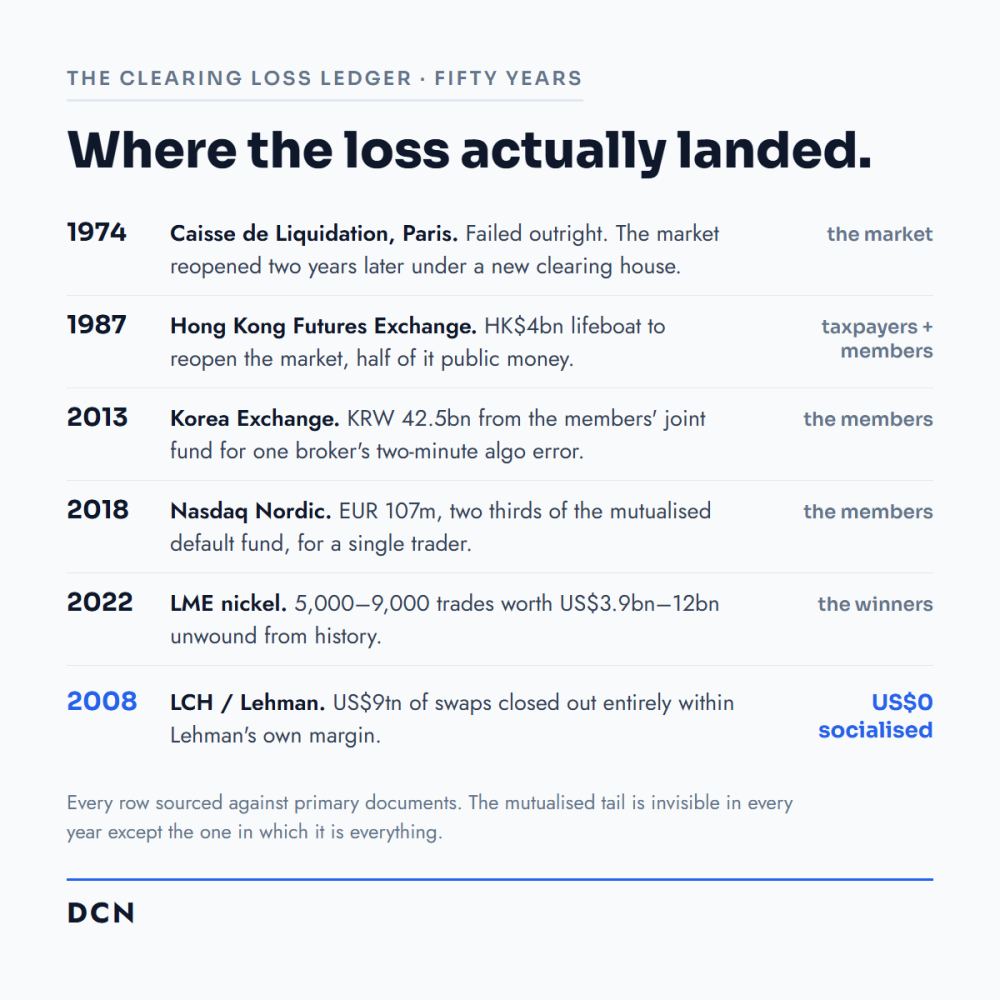
We spent the last two weeks building a public record of what happens when the defaulter's own resources run out. We called it the Clearing Loss Ledger, and every row is sourced against primary documents because numbers in this territory have a habit of improving with each retelling. The pattern across fifty years is remarkably consistent.
In March 2022 the London Metal Exchange cancelled somewhere between five and nine thousand nickel trades, worth between US$3.9bn and US$12bn depending on whether you take the press reports or the LME's own court filings. The alternative was US$19.75bn of intraday margin calls that several members could not have met. The loss did not get absorbed by the system; the trades that produced it were unwound from history.
In September 2018 a single Norwegian power trader failed at Nasdaq's Nordic clearing house. His margin and Nasdaq's first EUR 7m of capital went first, and then EUR 107m came out of the mutualised default fund, roughly two thirds of it, contributed by members. They refilled the fund within the week because the rules required it.
In December 2013 a Korean broker's trading algorithm malfunctioned for two minutes. The exchange drew KRW 42.5bn from the members' joint compensation fund. The exchange's own capital sat junior to the member fund in the waterfall and appears that it was never touched. The members paid for a coding error in software none of them ran.
Go back further and the pattern holds at larger scale. Hong Kong's futures guarantee corporation failed outright in October 1987 and took a HK$4bn lifeboat, half from the Exchange Fund, half from the banks and brokers, to reopen the market. Paris's commodity clearing house failed in 1974 and did not reopen at all; the market came back two years later under a new clearing house.
The counterpoint matters just as much. When Lehman defaulted in 2008, LCH's SwapClear closed out a US$9tn notional book, over 66,000 interest rate swaps, entirely within the margin Lehman itself had posted. Not one dollar was socialised. Default management can work, and when it works the membership never notices. That is precisely the problem: the mutualised tail is invisible in every year except the one in which it is everything.
And the invisible years are not free. A clearing member pays for the mutualised tail twice. Once in the capital tied up against its default fund contribution, and again in the contingent exposure it carries to everyone else's failures: the funded contribution that can be burned, the assessments that can follow it, capped in most rulebooks at a multiple of the contribution. In Europe the fund must be sized to survive the largest member or the second and third largest combined, and total resources must cover the two largest. That is a real, quantifiable cost of membership, and almost nobody prices it, because the instrument it prices does not exist.
The four known answers
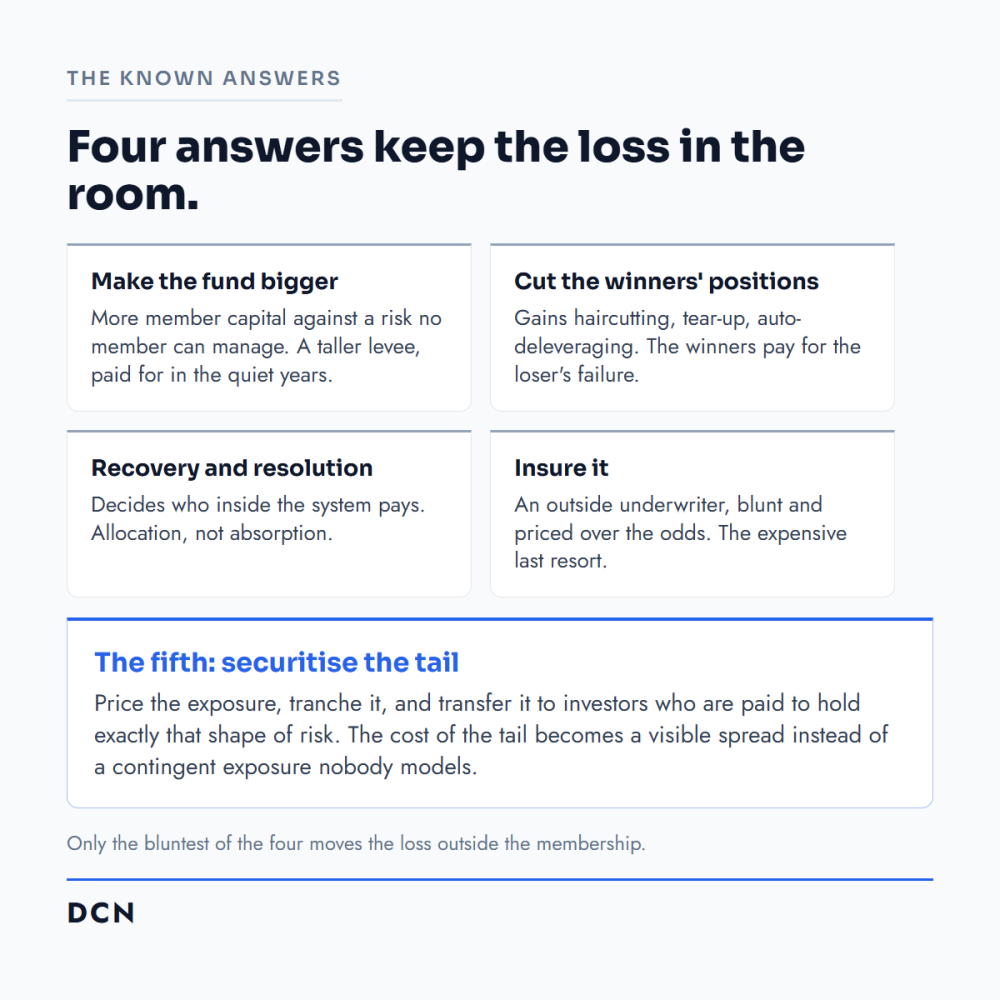
Ask anyone in this industry how the system should handle a loss that outruns the waterfall, and you will get one of four answers.
The first is to make the fund bigger. More prefunded resources, more skin in the game, higher assessments. This works in the sense that a taller levee works. It also concentrates more member capital against a risk the members cannot individually manage, and it makes membership more expensive in exactly the years when nothing goes wrong.
The second is to cut positions rather than chase money. The recovery toolkit calls this gains haircutting and partial tear-up: the clearing house takes back some of what the winners won, or tears up contracts to flatten the book. Crypto venues run the same move continuously under the name auto-deleveraging. Whatever the label, the winners pay for the loser's failure, which is a strange incentive to embed in a market whose whole purpose is that winners get paid.
The third is recovery and resolution: the formal regime that decides, when the first two answers are exhausted, how the remaining losses get allocated so the clearing house itself survives. It is necessary and it is well designed, and it is an allocation mechanism, not a source of loss absorption. It decides who inside the system pays. It does not change the fact that someone inside the system pays.
The final is insurance. Really this exists amongst entities that rarely get invitations to Boca, the FIA conference, it's smaller regional exchanges for commodities where the incumbents approach insurers to underwrite the default fund because clearing members don't have the confidence to do it. These are expensive last available option mechanics. The insurance contracts are typically oversized, not specialist and therefore expensive. They look at typical risk in the space and underwriting cost to mix with other assets not the risk in the system itself. A very blunt tool.
Four answers, different mechanics. Only in the worst of these does the loss leave the membership. For the first three it moves between corners of the same room, from the defaulter to the fund, from the fund to the survivors, from the survivors' cash to the survivors' contracts. The room stays sealed.
Our answer
There is a fifth answer, and the industry has never had to take it seriously before: price the tail risk and sell it.
The tail exposure of a clearing system is a definable risk. It has a size, a probability structure, and a fifty-year public loss history, some of which you have just read. Risks with those properties in other markets get securitised: priced, tranched into instruments, and transferred to capital market investors who are paid to hold exactly that shape of risk and who want it precisely because it is uncorrelated with most of what else they hold. Catastrophe bonds did this for hurricanes. Significant risk transfer did it for bank credit portfolios. The mechanism is not exotic. What would be new is pointing it at the one risk clearing has always kept in the family without a blunt insurance approach.
The change in incentives is the point, more than the change in accounting. When the tail sits with investors who priced it, every member stops being the silent underwriter of every other member. The cost of the tail becomes explicit, visible in a spread rather than buried in a contingent exposure nobody models. And the people holding the risk are holding it on purpose, at a price they set, rather than by virtue of having joined the same clearing house.
I am not going to pretend this is a free lunch, because it is not. Pricing a tail event well is genuinely hard, and a mispriced tranche is a different failure mode, not the absence of one. It is not harder to price than a lot of securities in the market. Moral hazard does not vanish because the risk moved; a clearing house that has sold its tail needs stronger member discipline, not weaker, and the structure has to be built so that selling the risk cannot mean relaxing about it. Building a market in securitised default risk needs to build over a protracted period, as the market builds knowledge, pricing becomes more competitive. They are also the same class of problem the catastrophe bond market spent thirty years solving, which is different from being unsolvable.
Why now
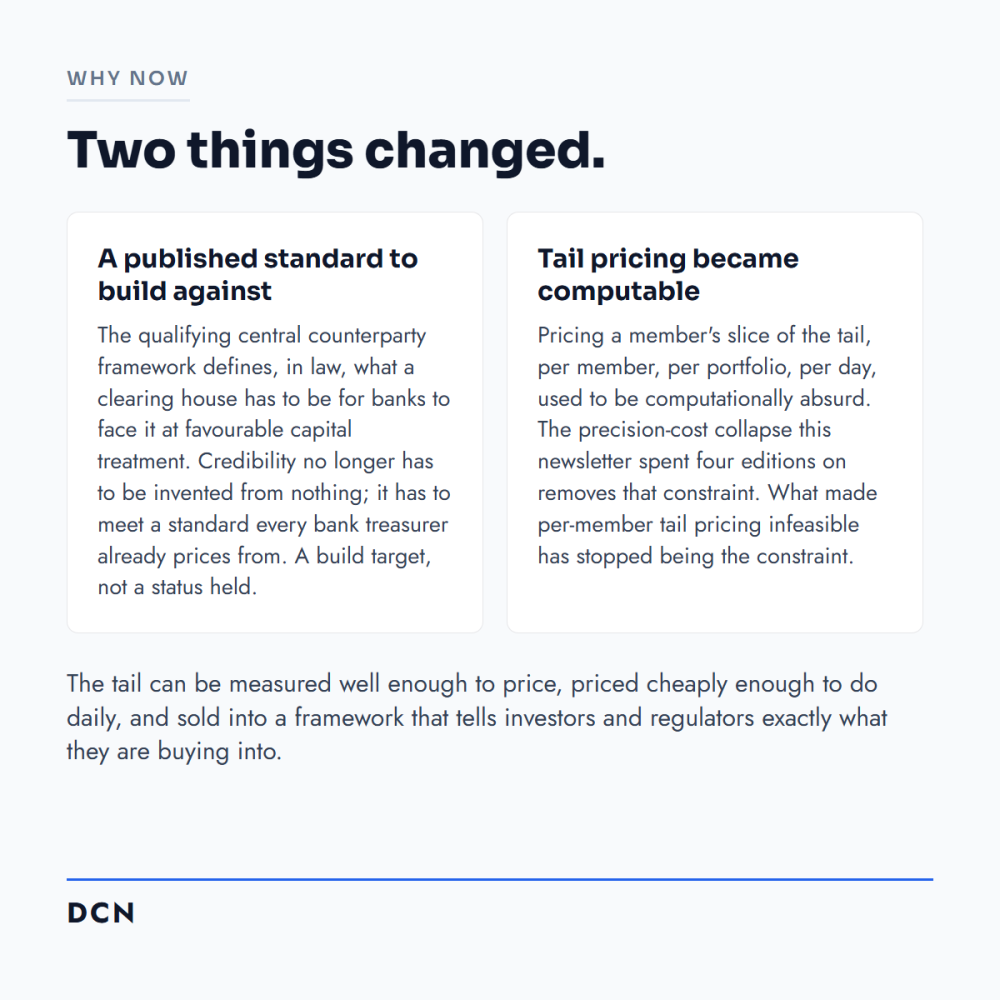
If securitising the tail were straightforwardly possible, someone would have done it. At least that's one of the objections we hear. Two things have changed.
The first is the credibility path. The qualifying central counterparty framework defines, in law, what a clearing house has to be for banks to face it at favourable capital treatment. That framework is the target we are building against, and I am careful with the tense: it is a build target, not a status we hold. But its existence changes the problem. A new clearing venture does not have to invent credibility from nothing; it has to meet a published standard that every bank treasurer already prices from.
The second is the one this newsletter spent four editions on. Pricing a member's slice of the tail, properly, per member, per portfolio, per day, used to be computationally absurd. The precision-cost collapse we wrote about in the Risk Calculation series changes that arithmetic. When a verified pipeline can price complex risk at a fraction of the historic cost, the thing that made per-member tail pricing infeasible stops being the constraint. The last edition closed by saying the interesting work sits where the mathematics corridor and the AI corridor meet. This is what is standing there.
Put those together and the securitisation answer stops being a thought experiment. The tail can be measured well enough to price, priced cheaply enough to do daily, and sold into a framework that tells investors and regulators exactly what they are buying into. The securities market can easily absorb this and it sits at a risk level between corporate debt and sovereign debt where there is a lot of appetite. It also creates strong early signals on market views of risk.
Barriers for existing players
This brings us to an interesting aspect, why can't the major exchanges adopt this if it is better and frees member cash for trading. Here the incumbency of the model works against them. This model isn't FCM narrow, it has a lot more direct participation by a wider group of members, as long as the risk has enough transparency for it to be priced. Securitised risk can be broken into Junior and Senior components, broken up by client type, asset type, whatever is needed to enable it to be priced better and grown. A major part of the FCM model is controlling this aspect and risk vs default fund. Now the market sets that cost. FCMs have a reduced role, asset improvement for collateral, consolidating access for periphery market players. What we don't need them for is Default Fund coverage. They can choose to do this or choose to participate in other ways. For existing exchanges the FCMs are symbiotic. They are the core of their route to market, and the positions they have with the default fund contribution gives them control over the exchanges. This control enables them to control access and keep the market amongst them. Direct market access enables the largest volume traders to bypass the FCMs and changes the profitability model. For the exchange this would be a burn the boats on the beach moment. They have done it before when the markets went electronic, notably CBOT. However Eurex led this, it was a challenger coming in that forced this as they were defending a rapidly diminishing market. This needs the same, it needs a clearing house to base their model on real-time risk and securitised risk. This drives the adoption, and then before it is complete everyone migrates. Everything changes with this. Real-time risk unlocks securitisation of default risk and tokenised assets as collateral. Market access gains more equality, risk is paid for. Uniquely the securities market placement happens before the need, and as it is not aligned to the same players it is not cyclical or countercyclical, it is de-coupled. Even if the same players take part the initial funding is countercyclical.
The question this leaves you with
This is the problem we are working on at DCN: clearing built so that the tail is transferred rather than mutualised, at the standard the QCCP framework defines. The concept is public and I have just argued it as plainly as I can. The implementation is ours.
The question I would leave with anyone who runs risk, sits on a clearing membership, or allocates to alternatives is the one this campaign opened with. When a cleared position blows past its margin, who actually bears the loss, on whose balance sheet, at what price, and did anyone ask them first? For fifty years the honest answer has been: the other members, at par, and no.
I do not think that answer survives the next decade.
If you have a clearing loss event we should add to the Ledger, reply and tell me, with a source. The record is the argument, and it is not finished.
DCN.
This first appeared on LinkedIn on 28 August 2026. If you want to comment or discuss, that's the place.