
Risk Calculation in an AI World, Part 3: The Liquidity Spiral
Part 3: The Liquidity Spiral
Parts one and two argued that risk calculation can be sharper, faster, cross-product and continuously verified.
This part takes on the strongest objection to everything I have written so far to show where the edges of the ideas are.
The objection: risk-sensitive margin models are procyclical.
It demands the most collateral at exactly the moment liquidity is scarcest, and every improvement in speed and sensitivity tightens that feedback loop. The history is not on the side of clever models here. Portfolio insurance, a model-driven hedging rule, amplified the 1987 crash. The quant funds of August 2007 discovered that crowded, similar models liquidate together (Khandani and Lo, Journal of Financial Markets, 2011). Value-at-risk itself generates leverage cycles: risk falls, so you lever up, so risk compounds, so you deleverage into the fall (Danielsson and Shin, "Endogenous Risk," 2002). The margin calls of March 2020 and the 2022 commodity and gilt stresses pulled liquidity out of the system fast enough that the international committees spent the following three years writing reports about it. And the financial stability community now says the same about AI specifically: correlated models, shared data, herding, a stressed market behaving, in the Financial Stability Board's phrase, as if it were a single institution. The Bank of England has floated kill switches for AI-driven trading. On this reading, a continuously computed, sharply accurate margin engine is not welcome progress.
The issue I see here though is better risk just highlights the issue. Holding more collateral by accident or design using inefficient methods and timing serves no one. It cannot be an accident that we make the make safe. We need better risk models and an additional approach to how we manage the procyclical risk.
The answer here have to be clear. Ours view is that the objection is right about the disease and wrong about where it lives. Procyclicality is not one thing. Take it apart and it is three things, and they live in three different layers of a clearing system, and the current architecture's deepest problem is that it conflates them inside a single model.
What the margin reviews actually found
Start with the evidence from the stress everyone studied. After March 2020, the Basel Committee, CPMI and IOSCO reviewed margining practice across the cleared and uncleared world (BCBS-CPMI-IOSCO, "Review of Margining Practices," September 2022). Read that report and its 2025 successors carefully and the complaint is more specific than "margin went up." Margin had to go up; risk had genuinely risen. The damage came from margin going up by surprise: large, unpredictable calls, including ad hoc intraday calls, landing on treasurers who had no way to anticipate them, in size, simultaneously, across every venue. The policy response that followed was not "make margin less risk-sensitive." It was predictability: scheduled rather than ad hoc intraday calls, transparency of model behaviour, and margin simulators so members can estimate tomorrow's call before it arrives (BCBS-CPMI-IOSCO, "Transparency and Responsiveness of Initial Margin in Centrally Cleared Markets," January 2025).
So decompose the disease. The first component is reactive repricing. The production models of part one learn risk from realised history: a volatility filter scales the lookback window by what volatility has just done. By construction, such a model raises margin after the move, which is precisely when the liquidity to meet the call has evaporated. The model is not wrong, it is late, and its lateness is what turns a repricing into a spiral.
The second component is surprise. A call you saw coming three weeks out is a funding plan; the same call landing overnight is a fire sale. Surprise is a function of how the model communicates, whether members can simulate it, and how calls are scheduled. It is an operational property, not a mathematical one.
The third component is aggregate co-movement: in a genuine stress, measured risk rises everywhere at once, so collateral demand rises everywhere at once, whatever the model. This one is intrinsic. Murphy, Vasios and Vause established it formally a decade ago: risk-sensitive margin models are procyclical in aggregate, and every available mitigant trades stability against risk sensitivity or capital efficiency (Bank of England Financial Stability Paper No. 29, 2014). The European regulation that followed requires clearing houses to run at least one of three anti-procyclicality tools, a releasable 25% buffer, a 25% weighting on stressed observations, or a ten-year volatility floor (EMIR RTS 153/2013, Article 28). ESMA's own review after 2020 and the nickel suspension concluded that none of the three eliminates the effect (ESMA, Final Report on the review of RTS 153/2013 with respect to procyclicality of CCP margin, July 2023). There is no parameter setting that repeals this. Anyone who tells you their margin model has solved procyclicality is describing a model that has stopped measuring risk.
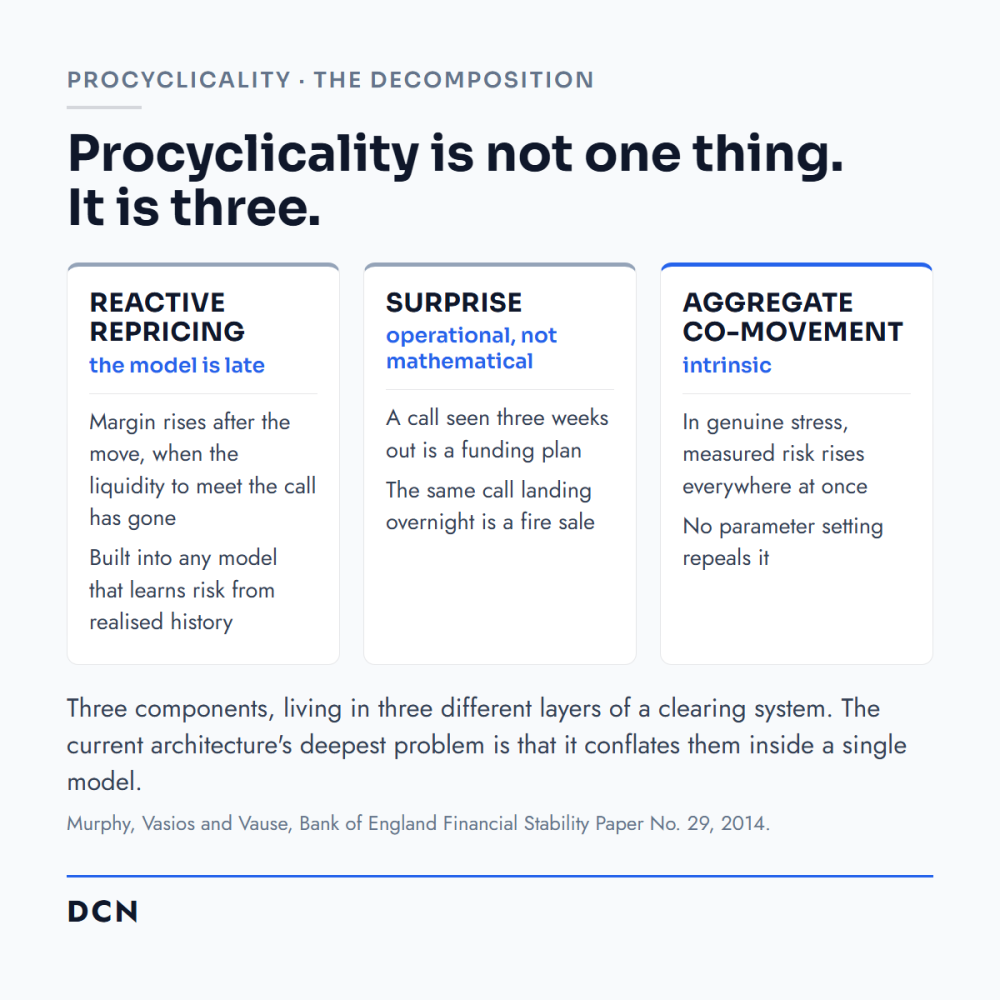
Three components. Now put them against the three layers.
Measurement: the ramp, not the cliff, and not the smear
Take the cheapest-to-deliver switch from part two, because it is the cleanest case of a risk that concentrates at a place in the market rather than a time, and ask what each approach to it does to a liquidity spiral.
The smear, our derogatory term for smoothing an unmeasured risk across the whole surface and today's standard treatment, prices the switch option as a little extra volatility everywhere. Notice what that does cyclically: nothing. This does not respond to the cycle at all. It is not procyclical, it is not anticyclical, it is simply wrong twice over, a permanent deadweight collateral cost in the years when the option is unreachable, and no meaningful gradient at all in the weeks when the switch comes within range. The desk pays for risk it does not have, then fails to pay for risk it suddenly does. Ok, to be fair some entities do better with this than others, but the point stands, uncaptured risk is just extra vol on the whole surface. If you wanted to design a treatment that maximises capital waste in calm and maximises the shock of correction in stress, a globally premium is close to optimal.
A naïve sharp model, margining the instantaneous risk at today's point, produces the opposite failure: a margin cliff, a market level at which collateral demand jumps discontinuously. Cliff effects are procyclicality in its purest form and regulators are right to hate them.
The region-based measurement of part two produces neither. Because margin covers the close-out period, the correct number at any point weighs the loss surface over the whole region the market can reach before liquidation completes, and the discontinuity at the switch, integrated over that region, becomes a steep but smooth ramp that begins rising while the switch is still tens of basis points away. The probability of touching the boundary within the holding period is a continuous function of distance, and it is computable by the member as easily as by the clearing house. Margin rises before the risk arrives, on a published, simulatable path. That is anticipation, and anticipation is the exact opposite of the reactive lateness that drives component one, and the exact opposite of the surprise that drives component two. It is also precisely the property the post-2020 international reviews asked for: members who can see their margin coming.
One caution. The width of that anticipatory ramp scales with volatility. When markets get stressed, the ramp starts further out and sits higher, which means that even perfectly anticipatory, perfectly honest measurement produces collateral demands that co-move with stress in aggregate. Component three does not vanish because components one and two were engineered away. Accurate anticipatory measurement removes the lateness and the surprise, and it removes the smear's double mispricing. It does not repeal Murphy, Vasios and Vause. Whoever claims otherwise is hiding the residual somewhere in a label, and the one thing the 2008 generation should have taught us is never to hide the residual in the label. (Or a badly named bundle of debt products).
So the measurement layer, done properly, is acquitted of components one and two and leaves component three standing. Where does that go?
Cadence: computing continuously is not calling continuously
A short layer, often skipped. The speed of calculation and the speed of collection are different dials. A clearing house can compute margin continuously, watch every ramp in real time, publish simulators that let members do the same, and still collect on a scheduled, predictable cadence with defined windows and notice periods. Continuous calculation makes calls more predictable, not more frequent: the treasurer who can query the engine at any moment about any hypothetical is the treasurer who is never surprised. The dash-for-cash dynamics documented in 2020 were made worse by ad hoc timing and information asymmetry, and both of those are cadence-layer choices. Conflating measurement speed with call frequency is how the objection at the top of this piece gets mis-aimed at the engine when it should be aimed at the calling policy. The lag in today's nightly batch is not a stabiliser; it is lateness wearing a costume.
Absorption: who bears the tail decides whether stress compounds
Component three, the intrinsic one, is a question about architecture, not measurement: when measured risk rises everywhere at once, who funds the increase, and does the funding mechanism itself amplify the stress?
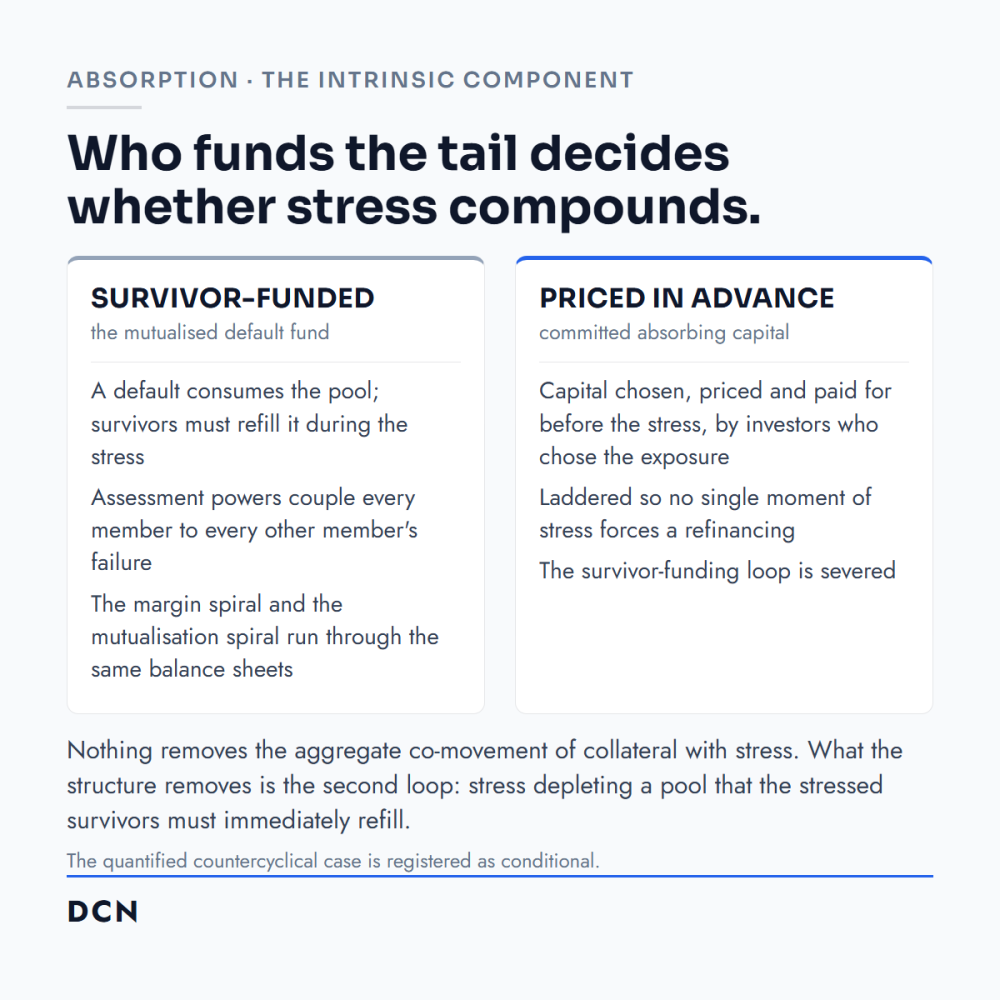
Look at how the conventional structure answers. A clearing house in stress raises margin on everyone, and behind margin sits the mutualised default fund: surviving members' pooled contributions, which get consumed by a default and must then be replenished, by the survivors, during the stress. Add the assessment powers that let a clearing house call further contributions from those same survivors, and you have coupled every member's liquidity position to every other member's failure at the worst possible moment. The margin spiral and the mutualisation spiral run through the same balance sheets simultaneously. This coupling is a design choice, not a law of nature, and readers of this newsletter will recognise it as the choice I have spent two years arguing against; the masthead says clearing without socialised losses for a reason.
If you want to see the coupling at its purest, look at crypto derivatives, where the mechanism runs without the moderating institutions. When a crypto venue's insurance fund proves too small for a cascade, the losses are socialised by auto-deleveraging: profitable positions on the other side are forcibly closed to pay for the failures. October 2025 is the worked example: $19 billion of positions liquidated inside twenty-four hours across 1.6 million accounts, a figure the data provider itself calls an undercount, with $6.9 billion of it in the worst forty minutes and $3.2 billion in a single minute; on Hyperliquid alone the cascade executed nearly thirty-five thousand auto-deleveraging events across more than nineteen thousand wallets (CoinGlass; Amberdata; Chitra, arXiv:2512.01112). That is the mutualisation spiral with the paperwork removed: winners taxed mid-crisis to fund losers, positions destroyed at the moment holders most wanted them, stress compounding through the loss-allocation mechanism itself. The traditional default fund is a slower, better-governed cousin of the same design choice, and the same coupling sits inside it.
The alternative direction is to move the tail outside the membership: default absorption funded by capital that was priced, committed and paid for in advance, by investors who chose the exposure, rather than extracted from survivors mid-crisis. Done that way, a rise in measured risk flows to margin, which members saw coming on the published ramps, and the tail beyond margin flows to absorbers whose capital is already in the structure, laddered so that no single moment of stress forces a refinancing. What it removes is not the aggregate co-movement of collateral with stress, nothing removes that, but the second, nastier loop: the one where the stress itself depletes a pool that the stressed survivors must immediately refill. I am deliberately careful here. The full countercyclical case for this structure is conditional, dependent on how the absorbing capital is laddered and who holds it, and quantifying that is open work, registered but unfinished. The architectural claim stands on its own: severing the survivor-funding loop removes an amplification channel that mutualisation hard-wires in. The quantified claim waits for the evidence, where it belongs.
Three layers, one discipline
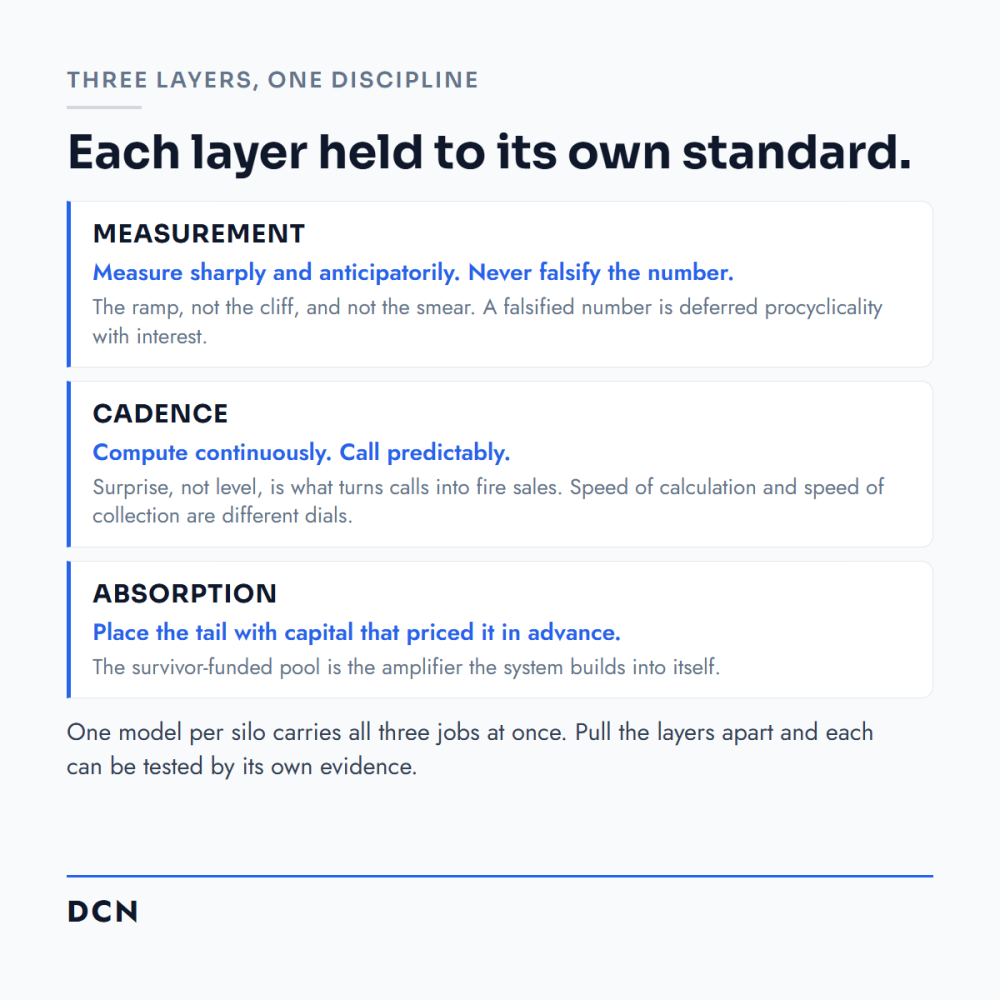
Put the decomposition back together and the answer to the objection reads simply. Measure sharply and anticipatorily, and never falsify the number, because a falsified number is deferred procyclicality with interest. Collect on a predictable cadence, because surprise, not level, is what turns calls into fire sales. And place the tail with capital that priced it in advance, because the survivor-funded pool is the amplifier the system builds into itself. The regulatory floors and buffers keep their place in this picture, not as apologies for bad measurement but as insurance against the failure mode any navigating model retains, reading the wrong region confidently; a floor that binds regardless of what the model believes is cheap humility.
The current stack cannot separate these layers because a single model per silo is carrying all three jobs at once: its lookback window is the measurement, its recalibration schedule is the cadence, and its add-ons and default fund are the absorption. The reports since 2020 keep prescribing predictability, transparency and simulators, and the prescription keeps straining against architectures where the measuring instrument and the liquidity policy are the same object. Pull them apart and each layer can be held to its own standard, tested by its own evidence.
Which leaves the question this series has been circling from the start. If the machinery of parts two and three exists, and the constraint that stopped it was never compute, then.....
what exactly is the industry short of?
People.
The mathematics in these pieces is geometry and approximation theory and asymptotic statistics, and the engineering is the discipline that built AI systems, and almost none of either appears in the curriculum that produces quants. We have intensively developed deep knowledge in a place where we cannot jump to new engineering approaches. This is a harder problem than can you make the maths work. Being a quant since the shortest of stints in and around the the Liffe floor, the first electronic trading, where HFT started with VT220 terminal emulation right though EVT gives you a different outlook. No where in it does the geometry of AI Engineering intersect with Risk. It makes for interesting times.
Part four is about that gap: what the new skill set actually is, how the arrival of AI genuinely changes what a quantitative career means, and how much retraining stands between this industry and the systems it is now possible to build.
We'll come back to replacing the mutualised default pools in another series.
DCN.
This first appeared on LinkedIn on 30 July 2026. If you want to comment or discuss, that's the place.