
Review of 2026 predictions: Part 1 AI x Crypto — The Emergence of Autonomous On-Chain Economies
Introduction
Every year brings a flood of "2026 predictions" from venture capital firms, asset managers, and industry commentators with a lot of help from AI. Individually, they're not particularly revealing. Collectively, they tell us something useful: where institutional consensus is forming, where they disagree, and which narratives are gaining traction, rightly or wrongly.
This report synthesizes predictions from 15+ major sources—BlackRock, Fidelity, a16z Crypto, Pantera Capital, Galaxy Research, and others—across 12 topic areas where blockchain intersects with markets, regulation, and geopolitics. I’ve also searched all the industry leader X messages for any 2026 predictions. The goal is simple: save everyone reading these reports individually.
We've used AI to systematically analyze these documents, identifying convergent predictions (where multiple sources align), divergent views (where respected analysts disagree), and occasionally, claims that lack supporting evidence. Each section presents quantitative data points, proper attribution, and then I have added our perspective distinguishing signal from noise.
Authors: Thanks to Wolfgang Rückerl , Nghia Nguyen, Matthew Durkin and Adam Davies BSc(Hons), MSc, PG Dip. for feedback and contributions across the different sections.
I’ll publish these over the next week, 1-2 per day.
1. AI x Crypto — The Emergence of Autonomous On-Chain Economies
Overview
The convergence of artificial intelligence and blockchain technology emerged as one of the most compelling themes in 2026 predictions across the crypto ecosystem. While the hype cycle around "AI coins" dominated late 2024 and early 2025, forecasters are now coalescing around more substantive predictions: autonomous agents managing real capital, new payment standards enabling machine-to-machine transactions, and decentralized infrastructure challenging Big Tech's AI dominance.
Notably, this theme has now captured institutional attention. Grayscale Investments 2026 Digital Asset Outlook (December 16, 2025) dedicates an entire section—Theme #6—to "AI Centralization Calls for Blockchain Solutions," arguing that "the fundamental alignment between crypto and AI is stronger and clearer than ever." They identify relevant tokens (TAO, NEAR, WORLD, IP) and describe x402 as enabling "the low-cost, instant micropayments required for agent-to-agent or machine-to-human economic interactions."
Coinbase Institutional frames this evolution carefully in their December 2025 market outlook, acknowledging skepticism while defending the convergence thesis: "Reports regarding the demise of the 'artificial intelligence x crypto' theme have been greatly exaggerated." The firm notes the narrative has shifted meaningfully since they first wrote about AI x Crypto in June 2023, when concerns centered on data marketplaces and AI-generated misinformation. By late 2024 and early 2025, the focus pivoted decisively toward autonomous agents capable of managing assets, executing trades, and performing complex governance functions by analyzing market news and external feeds.
The market has responded to this evolution with substantial capital deployment. Grayscale's Exhibit 13 documents that the AI Crypto Sector grew from approximately $5 billion in January 2023 to roughly $45 billion by July 2025—a ninefold increase driven primarily by assets like TAO, NEAR, RENDER, FET, WLD, and IP. Grayscale contextualizes this growth against concerns that "AI systems are centralizing around a few dominant firms, creating concerns about trust, bias, and ownership"—positioning blockchain as the natural solution to AI centralization risks. Traditional finance is taking notice: J.P. Morgan's 2026 outlook identifies AI as one of three major structural forces reshaping markets (alongside fragmentation and inflation), noting that "AI could drive the cost of expertise toward zero" as agentic AI potentially reaches human-level performance by May 2026 according to Bernstein analyst projections cited in their report.
Yet not all observers share this optimism. BlackRock's 2026 Investment Outlook injects a note of caution, asking "whether an AI bubble is forming" and noting that "market bubbles have arisen in all major historical transformations." The firm emphasizes that AI builders are "leveraging up: investment is front-loaded while revenues are back-loaded," creating vulnerability in the financial system. This counterpoint from traditional finance institutions serves as important balance to the crypto-native enthusiasm.
Rain, a stablecoin payments infrastructure company, predicts in their December 22, 2025 outlook that "stablecoins will become the preferred medium of exchange for agentic payments" as AI agents take on more responsibility managing supply chains and treasuries.
What's notable is the growing divergence between optimists who see AI agents becoming significant DeFi participants within the year, and skeptics who believe meaningful autonomous commerce remains further away than enthusiasts project. Both perspectives draw from credible sources, and the truth likely lies somewhere in between.
AI Agents Managing DeFi: The 5% Prediction
Perhaps the most specific prediction comes from 0xJeff, a crypto-AI analyst whose December 9, 2025 thread garnered significant engagement. He forecasts that "at least 5% of DeFi will be managed by AI agents" by end of 2026—a bold claim that would represent billions in autonomous capital deployment.
This prediction encompasses several sub-themes that 0xJeff elaborates on: yield farming agents that "optimize more complex strategies, beyond optimizing lending markets," reliable trading agents serving as "co-pilots that help newbies trade better," and DeFAI abstraction layers embedded into "popular dApps and mobile apps, optimizing experience for newcomers."
The Pantera Capital summary (December 29, 2025) supports this trajectory, predicting that "AI will become the standard in crypto apps—assistants for project analysis, on-chain data tracking, and trading ideas will appear almost everywhere." They also forecast that crypto lending will evolve as "AI will analyze your transaction history and behavior to issue loans faster and on better terms than banks."
However, Haseeb Qureshi of Dragonfly offers a notably more skeptical view. In his December 29, 2025 predictions thread, he states bluntly: "AI agents will still not be 'paying each other' or spending any meaningful money in 2026." While he acknowledges that "primary AI use cases in crypto remain within software engineering and security," he predicts "everything else remains a prototype" and that "wallet automation remains minimal."
Our Commentary: The Derivatives Clearing Gap
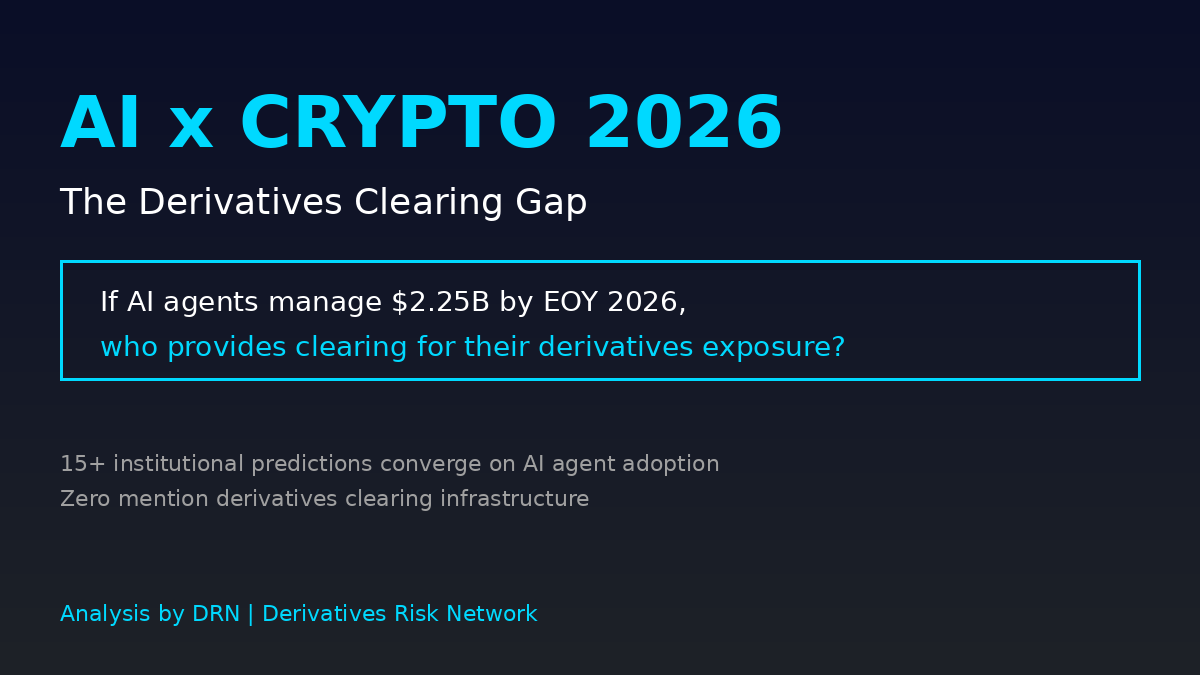
What's missing from this debate? If AI agents manage ~$2.25B in capital by EOY 2026 (5% of the $45B AI crypto sector), they'll need volatility hedging, basis trading, and delta-neutral strategies. Traditional DCOs with daily margining cycles can't handle autonomous agents rebalancing 20-30 times daily. Pure DeFi protocols lack institutional-grade risk management. This creates a structural gap that bilateral clearing infrastructure with real-time risk calculation is uniquely positioned to fill. It is why we are building and need help to build a proper global clearing infrastructure that supports tokenised collateral.
Consensus Assessment: Most sources agree AI will increasingly integrate with crypto applications, but the magnitude and timing remain disputed.
The x402 Payment Standard: Infrastructure for Agentic Commerce
If AI agents are to participate meaningfully in the economy, they need payment rails designed for autonomous transactions. Several major sources converge on x402 as the emerging standard.
Galaxy Research (December 18, 2025) makes a specific quantitative prediction in their Prediction #26: "Payments following the x402 standard will reach 30% of Base daily transactions." They attribute this to "improvements in agent intelligence, continued stablecoin adoption, and better developer tooling."
The a16z crypto team (December 11, 2025) predicts that "in a world where systems act on intent rather than step-by-step instructions—moving money because an AI agent recognizes an opportunity or fulfills a contract—the current payment infrastructure will become a bottleneck." They specifically note that "emerging privacy protocols like x402 will make it possible for agents to transact privately, at scale."
The Pantera summary goes even further, predicting that "AI agents will start paying for services en masse via x402—like Apple Pay, but automatic. Some services will generate over 50% of their revenue from such payments."
Our perspective: x402 integration becomes critical for clearing operations - enabling variation margin settlement, collateral mobility, and real-time mark-to-market adjustments in a 24/7 tokenized environment. This strengthens the thesis for Canton Network integration, combining agentic payment rails with institutional privacy features. Notably absent from these predictions is Canton Network, despite its natural fit for privacy-preserving agentic transactions at institutional scale.
Consensus Assessment: Strong agreement that x402 represents the leading standard for agentic payments.
Beyond payment infrastructure, Coinbase's December 2025 outlook emphasizes that the adoption of internet-native payment protocols like x402 represents "a critical step" for enabling AI systems "to continuously settle a high volume of microtransactions without human intervention, potentially resulting in new forms of online commerce." They note that as AI systems become "more autonomous" and "transact with each other, we think traditional financial systems may prove too costly, or geographically restricted."
Moreover, Coinbase identifies proof-of-personhood systems like Worldcoin as essential infrastructure for distinguishing humans from agents "in a world of synthetic activity." This addresses what they characterize as risks of "disinformation and economic harm caused by increasingly realistic online bots." The firm also highlights agentic tooling's potential to revolutionize blockchain development itself, noting that AI agents "may be poised to revolutionize onchain development, potentially allowing non-technical founders to launch businesses in hours or days, rather than months or years" through agents that write smart contract code, perform security reviews, and monitor for ongoing risks.
Know Your Agent (KYA): Identity Frameworks for Non-Human Participants
A particularly novel prediction comes from Sean Neville, cofounder of Circle and architect of USDC. Writing for a16z crypto's 2026 outlook, he argues that "the bottleneck for the agent economy is shifting from intelligence to identity."
Neville offers a striking statistic: "In financial services, 'non-human identities' now outnumber human employees 96-to-1—yet these identities currently have no way to prove who they are or what their capabilities are." His prediction centers on a fundamental shift "from 'know your customer' to 'know your agent'—establishing identity frameworks for non-human market participants."
Our view: Neville focuses on identity, but credit risk assessment becomes equally critical. Traditional clearing relies on financial statements and credit history; AI agents have smart contract code, on-chain transaction history, and algorithm transparency. This represents a new credit risk paradigm that bilateral clearing models can handle more flexibly than mutualized default funds.
0xJeff's prediction that "ERC-8004 will become the registry for AI agents reputation" aligns with this thesis.
Inference Networks and Decentralized AI
0xJeff predicts that "inference networks will serve more demand than ever, especially domain-specific inferences (weather prediction, sports prediction, outcome prediction, and more)." He also forecasts that "Decentralized AI hit more adoption, driven by the trend of developers and startups opting for open-source models, cheap & efficient, distributed setups."
Hashdex (December 14, 2025) predicts the "'AI Crypto' market will grow to $10bil"—one of the few specific market size predictions for the category.
The Bittensor ecosystem receives extensive coverage, with Louise Beattie (December 26, 2025) predicting "utility-first subnets pull ahead as real-world use cases emerge" and citing Grayscale identifying "2026 as the 'Dawn of the Institutional Era,' positioning Bittensor as foundational infrastructure for the agent economy."
Robotics Integration with Blockchain
Tiger Research (December 26, 2025) dedicates their Prediction #5 to this thesis: "Robotics and Crypto Will Open a New Gig Economy Era." They argue that "real-world data for robot training has become critical" and that "blockchain-based decentralized crowdsourcing solves this problem."
0xJeff makes a complementary prediction that "Crypto x AI will help propel the development of robotics through data collection, coordination, payments, identity, and funding at scale."
Clearing Infrastructure: The Missing Prediction
Notably absent from all institutional predictions: derivatives clearing infrastructure for autonomous agents. The convergence around AI agent payments (x402), identity (KYA), and DeFi participation creates derivative demand that existing infrastructure—traditional DCOs designed for human trading patterns, or pure DeFi protocols lacking institutional risk management—cannot adequately serve.
The 18-month first-mover window for tokenized derivatives clearing isn't just about beating traditional players to crypto markets—it's about establishing infrastructure before AI agent derivatives trading becomes the dominant paradigm. Firms building AI agent trading systems represent a new founding participant category beyond traditional crypto market makers. We are building this, and believe it is the necessary gap.
Synthesis: Where the Weight of Opinion Lies
Across these sources, several themes command strong consensus:
AI integration with crypto is accelerating, though the magnitude of autonomous agent activity in 2026 remains disputed
x402 is emerging as the leading agentic payment standard, with Galaxy's 30% of Base transactions serving as a specific benchmark
Agent identity frameworks (KYA) will become critical infrastructure as non-human participants proliferate
Decentralized AI will gain traction against centralized alternatives, with specific market size predictions around $10B
Privacy becomes table stakes for institutional and enterprise AI agent adoption
The key divide is between optimists like 0xJeff and the Bittensor community, who see transformative adoption, and skeptics like Haseeb Qureshi, who predict that "everything else remains a prototype." For investors and builders, this suggests focusing on infrastructure plays (x402, identity, inference networks) that will succeed regardless of which adoption timeline proves correct.
Sources: Grayscale (Dec 16, 2025), Rain (Dec 22, 2025), 0xJeff (Dec 9, 2025), a16z Crypto (Dec 11, 2025), Galaxy Research (Dec 18, 2025), Pantera Capital (Dec 16, 2025), Tiger Research (Dec 26, 2025), Bankless (Dec 24, 2025), Haseeb Qureshi/Dragonfly (Dec 29, 2025), Hashdex (Dec 14, 2025), Louise Beattie/Bittensor (Dec 26, 2025)
I’ll publish the longer version on my personal website at www.handleport.com shortly with all the sections. I’ll also make a markdown file available for download for those that want to add this to their AI files. DM if you need it earl
This first appeared on LinkedIn on January 6, 2026. If you want to comment or discuss, that's the place.