
Section 4: Stablecoins - The Settlement Layer for the Internet of Value
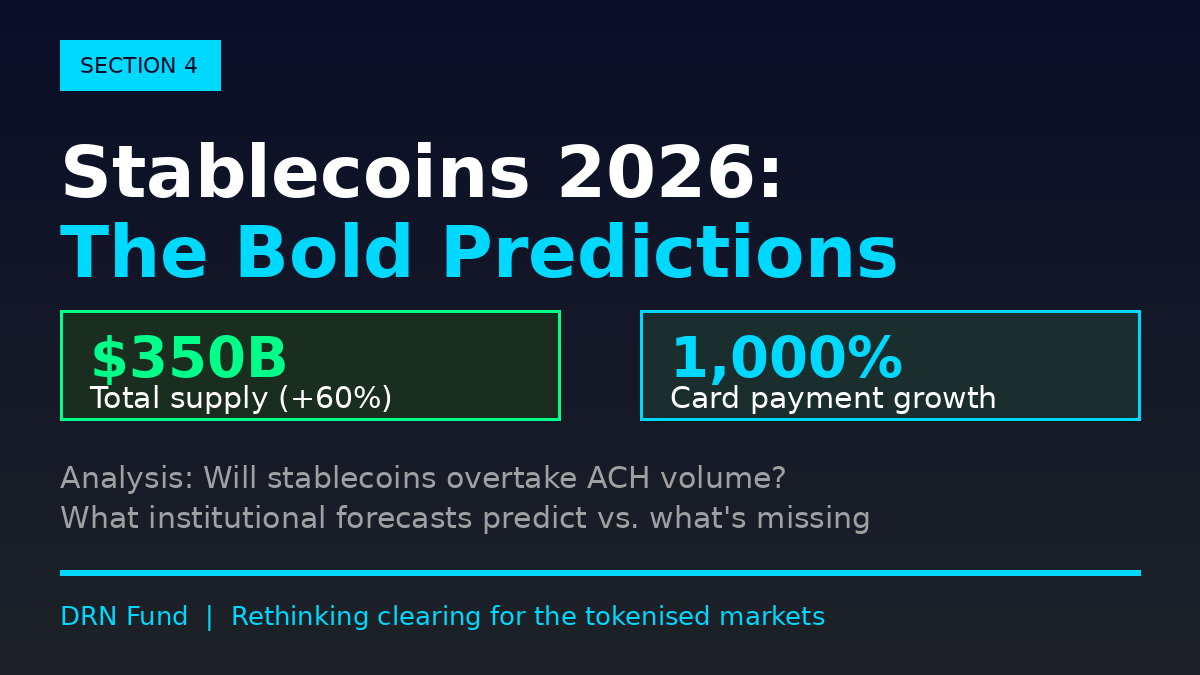
Stablecoins enter 2026 positioned to become the dominant settlement layer for digital commerce, with institutional forecasts converging on dramatic growth across transaction volume, supply expansion, and infrastructure integration. After years establishing product-market fit primarily within crypto-native use cases, stablecoins are now breaking into mainstream payments infrastructure, with predictions ranging from overtaking traditional ACH networks to enabling blockchain-based card payments at thousand-percent growth rates. This maturation reflects stablecoins evolving from speculative trading instruments into institutional-grade payment rails that major financial institutions, fintech companies, and card networks are actively integrating into core infrastructure.
Our perspective: What is starkly missing is the suggestion of them coming into bank-bank trading on scale. Whether this is lack of understanding of the difference, over focus on payment (a smaller market segment) or misunderstanding of how fixed the regulation over this is. No bank can use a stablecoin for collateral unless it is liquid, enforceable and Basel 3 compliant, these are necessary conditions for a stablecoin. However, no bank is incentivised to support building this until there is a clear and significant commercial business case for doing, realistically based on reduced costs, increased liquidity and regulatory capital benefits. We think any implementation of a clearinghouse or alternative structure to materially reduce margin posted for not just crypto but traditional instruments where the benefits of digital ledger technology (a term that feels out of date even to write) can make a benefit.
The following sections summarise the major predictions published for 2026:
Market Structure Evolution
The USDT/USDC duopoly that has defined stablecoin markets for years faces meaningful erosion in 2026, according to multiple institutional forecasts. Rain's dedicated stablecoin analysis, published December 2025, predicts the combined market share of Tether (USDT) and Circle (USDC) will fall below 75% by year-end as new entrants fragment the landscape. This represents a structural shift from two-player dominance toward a more diversified market with distinct product categories serving different use cases.
Galaxy Research's December 2025 outlook identifies bank-issued and fintech-backed stablecoins as the primary disruptors, projecting this category will exceed $10 billion in aggregate supply by year-end 2026. This reflects major financial institutions launching compliant, fully-reserved stablecoins that appeal to enterprises requiring bank-grade regulatory assurance and integration with existing treasury management systems. Coinbase Institutional's December 2025 market outlook notes that "stablecoin composability enables atomic delivery-versus-payment, reduces settlement windows, and tightens margin cycles," advantages that banks increasingly recognize as foundational for next-generation payment infrastructure. Personal note - how does this tighten margin cycles, I get how it could tighten margin cycles, but that really needs way more. Settlement is running ahead of clearing here.
The emergence of yield-bearing stablecoins represents another category challenging incumbent dominance. Ethena's USDe and Usual's USDH, highlighted in social media predictions aggregated by Grok in late December 2025, offer embedded yields through delta-neutral funding rate strategies or real-world asset backing. Pantera Capital's December 2025 outlook warns this could "challenge USDC's DEX dominance" by fragmenting liquidity across competing collateral types—though Pantera acknowledges these products may reduce capital efficiency if liquidity becomes too dispersed across non-fungible stablecoin variants. Our perspective: The fragmentation risk is more severe for derivatives clearing than DeFi liquidity pools. Multiple non-fungible stablecoin variants as collateral creates operational nightmares for risk calculation, margining systems, and liquidation waterfalls. Payments can route across fragmented stablecoins; derivatives clearing requires standardized collateral hierarchies.
Yield-bearing stablecoins introduce additional complexity: How do you value USDe with embedded funding rate exposure as derivatives collateral? What's the haircut for USDH with RWA backing versus USDC with treasury backing? Traditional clearing has decades of established collateral haircut frameworks. The stablecoin ecosystem lacks these standards, making institutional derivatives clearing infrastructure harder to build, not easier.
This is why bilateral OTC derivatives markets haven't migrated on-chain despite "atomic settlement" and "composability." The collateral standardization problem must be solved before derivatives clearing can scale, yet every prediction focuses on settlement infrastructure while ignoring collateral quality frameworks. Crazy level of oversight.
Bitcoin Suisse's December 2025 analysis documents the scale of stablecoin market concentration, noting that Tether commands approximately 70% market share with USDT supply exceeding $140 billion, while USDC holds roughly 20% with supply around $40 billion. The firm projects total stablecoin supply will expand approximately 60% through 2026, reaching nearly $350 billion, driven by institutional adoption and expanding use cases beyond crypto trading.
Infrastructure Integration
Perhaps the most dramatic prediction comes from Rain's December 2025 dedicated stablecoin report: stablecoin-backed card payments will grow by more than 1,000% in 2026. This forecast reflects card networks and fintech platforms embedding stablecoin settlement directly into payment flows, enabling instant settlement and cross-border transactions without traditional correspondent banking delays.
a16z crypto's December 2025 outlook, authored by Guy Wuollet, emphasizes that "stablecoins are getting embedded everywhere"—from gaming platforms to remittance corridors to point-of-sale systems. Wuollet argues that 2026 will see "major payment card networks operating on public blockchain rails," representing fundamental infrastructure transformation where Visa and Mastercard process transactions via public blockchains rather than proprietary settlement networks.
Coinbase Institutional's December 2025 analysis provides crucial context for this integration, noting that "in DeFi, stablecoins are the base asset for liquidity, risk transfer, and programmatic cash management—increasingly on regulated venues that preserve composability while meeting institutional controls." The firm emphasizes atomic settlement advantages: capital turns faster without sitting idle for T+2 settlement windows, margin cycles tighten, and counterparty risk diminishes through programmable escrow and instant delivery-versus-payment.
Tiger Research Inc.'s January 2026 market outlook predicts stablecoins will overtake ACH transaction volume in 2026, marking a watershed moment when blockchain-based payments eclipse a core traditional banking network. ACH processed over 31 billion transactions worth $76 trillion in 2023 according to Nacha data, making this prediction particularly bold—though it likely refers to specific corridors or use cases rather than comprehensive volume replacement.
Rain's analysis identifies five specific infrastructure transformations: real-time global settlements replacing T+2 delays, programmable payment rails enabling automated business logic, transparency and auditability improving treasury operations, disintermediation reducing transaction costs, and composability with DeFi protocols unlocking novel financial products. These structural advantages explain why institutions are actively building on stablecoin infrastructure despite regulatory uncertainty.
Supply and Adoption Metrics
Bitcoin Suisse projects total stablecoin supply will grow from approximately $220 billion at end-2025 to nearly $350 billion by end-2026, representing 60% expansion. This growth trajectory reflects institutional adoption accelerating beyond crypto-native use cases into mainstream payment corridors, cross-border remittances, and corporate treasury management.
Galaxy Research documents that stablecoin transaction volume has already achieved scale comparable to major payment networks, processing hundreds of billions monthly. The firm notes institutional participation in on-chain borrowing and lending grew dramatically through 2025, with stablecoins serving as the primary collateral and settlement asset. Galaxy predicts stablecoin interest rate volatility will "remain tame" through 2026, with borrow costs not exceeding 10% through DeFi applications as deepening liquidity pools stabilize funding markets.
Coinbase Institutional's December 2025 outlook emphasizes that stablecoin adoption extends far beyond speculative trading: "Stablecoins are increasingly used for remittances, payroll, B2B payments, and as a store of value in emerging markets experiencing currency instability." The firm notes that institutional treasurers are beginning to hold stablecoin allocations for operational liquidity, reflecting growing confidence in regulatory frameworks and custodial infrastructure.
Grayscale Investments's December 2025 digital asset outlook highlights that stablecoin growth is particularly concentrated in emerging markets where dollar-denominated digital assets provide protection against local currency volatility. The firm notes that countries experiencing high inflation or capital controls see disproportionate stablecoin adoption as citizens seek dollar exposure without traditional banking access barriers.
a16z Crypto's Sam Broner characterizes this adoption pattern as the "bank ledger upgrade cycle," arguing that "as institutions increasingly adopt stablecoins and embed them into new products, we'll see a reckoning with legacy banking infrastructure." Broner's prediction suggests stablecoin rails could become the settlement layer for next-generation financial services, with traditional institutions building consumer-facing experiences atop blockchain back-end infrastructure.
Our view: As we noted in Section 3, the "bank ledger upgrade cycle" thesis assumes settlement is the binding constraint. For derivatives markets, the binding constraint is clearing infrastructure, custody frameworks, legal recourse, credit intermediation, risk management systems. These take years to rebuild and can't be solved by settlement tokenization alone.
Regulatory Framework and Institutional Clarity
Multiple institutional sources cite the proposed GENIUS Act as a potential catalyst for stablecoin market expansion in 2026. This bipartisan U.S. legislation, if enacted, would establish clear regulatory frameworks for stablecoin issuers including reserve requirements, redemption rights, and supervisory oversight. CoinShares LLC' December 2025 outlook notes that regulatory clarity in the United States would likely accelerate institutional adoption by removing legal uncertainty that currently constrains bank participation.
Grayscale emphasizes that U.S. regulatory progress may diverge significantly from international approaches, with the European Union's MiCA framework already operational and Asian jurisdictions pursuing distinct regulatory architectures. This fragmentation could benefit stablecoin issuers with multi-jurisdictional compliance capabilities while creating barriers for smaller entrants unable to navigate complex international requirements.
Rain's December 2025 analysis argues that regulatory clarity will unlock "bank-issued stablecoins designed for enterprise use cases," with major financial institutions launching compliant products that appeal to corporate treasurers requiring regulatory assurance. The prediction that bank/fintech stablecoins will exceed $10 billion supply (Galaxy) reflects expectations that regulatory frameworks will enable traditional financial institutions to compete directly with crypto-native issuers like Tether and Circle.
Pantera Capital's December 2025 outlook predicts "ready-made compliance infrastructure will emerge, especially for corporate stablecoin adoption," suggesting that regulatory technology vendors will build standardized tools enabling enterprises to deploy stablecoins while meeting evolving regulatory requirements across jurisdictions. Our observation: Regulatory clarity for stablecoin issuance doesn't solve regulatory requirements for stablecoin use as derivatives collateral. The GENIUS Act addresses reserve requirements and redemption rights, critical for payments infrastructure. But Basel III capital adequacy frameworks, ISDA collateral schedules, and derivatives clearing regulations operate under entirely separate regimes.
This jurisdictional gap explains why stablecoins can process hundreds of billions in payment volume while institutional derivatives clearing remains constrained to traditional collateral. Legislative progress on stablecoin issuance won't automatically unlock their use as clearing collateral without parallel regulatory work on capital treatment and risk weighting.
Geographic Expansion and Emerging Market Dynamics
Grayscale's December 2025 outlook identifies emerging markets as the primary driver of stablecoin adoption in 2026, noting that "countries experiencing currency instability increasingly adopt dollar-denominated stablecoins for savings, remittances, and daily commerce." This use case extends far beyond cryptocurrency trading into fundamental economic activity—citizens in Argentina, Turkey, Nigeria, and other high-inflation economies using stablecoins as de facto dollarization tools.
Rain's analysis documents that cross-border remittances, a $800+ billion annual market globally, represent one of stablecoins' most compelling value propositions. Traditional remittance services charge 6-7% in fees with multi-day settlement times, while stablecoin-based transfers cost a fraction of traditional fees and settle near-instantly. Rain predicts remittance corridors will increasingly migrate to stablecoin rails throughout 2026 as fintech platforms integrate blockchain-based settlement.
However, this dollarization dynamic raises geopolitical concerns. TigerResearch's January 2026 outlook notes that widespread stablecoin adoption in emerging markets could undermine local currency monetary sovereignty, potentially triggering regulatory backlash from governments seeking to preserve central bank policy effectiveness. The risk is that nations experiencing rapid stablecoin adoption may impose capital controls or outright bans to prevent currency substitution.
CoinShares' December 2025 analysis adds that central bank digital currencies (CBDCs) may compete directly with stablecoins in emerging markets, offering government-backed digital dollars with official monetary policy integration. While CBDCs face technical and adoption hurdles, they represent potential substitutes that could fragment the digital dollar landscape.
Contrarian Views and Downside Risks
Not all forecasts share the consensus optimism on stablecoin expansion. Social media predictions aggregated through Grok identify concerns about market fragmentation undermining network effects—if dozens of bank-issued stablecoins proliferate without interoperability standards, liquidity could fragment across incompatible systems, reducing capital efficiency rather than enhancing it.
The yield-bearing stablecoin trend, while innovative, carries distinct risks that Pantera Capital highlights: if multiple non-fungible stablecoin variants compete for DeFi liquidity, the resulting fragmentation could reduce capital efficiency in lending markets and increase complexity for protocol integrators. The question is whether yield advantages offset liquidity fragmentation costs.
Regulatory uncertainty remains acute despite progress toward frameworks like the GENIUS Act. Grayscale notes that "stablecoin regulation remains politically contentious, and comprehensive frameworks may not materialize in 2026 despite bipartisan proposals." Failure to achieve regulatory clarity could constrain institutional adoption and leave stablecoin markets vulnerable to enforcement actions that destabilize leading issuers.
Geopolitical risks around emerging market dollarization represent another downside scenario. If major economies impose capital controls or ban stablecoin usage to preserve monetary sovereignty, adoption trajectories could reverse sharply in key growth markets. TigerResearch warns this represents a "tail risk that could derail consensus adoption forecasts if multiple large economies coordinate restrictions."
CoinShares' December 2025 outlook raises concentration concerns about Tether's dominance, noting that despite diversification trends, USDT still commands approximately 70% market share with limited transparency about reserve composition and management. The firm warns that "loss of confidence in the largest stablecoin issuer could trigger industry-wide contagion," particularly if Tether faces regulatory enforcement or banking access restrictions that impair redemption capabilities.
Synthesis: Where Institutional Consensus Lies
The weight of institutional opinion points toward stablecoins achieving mainstream adoption as payment infrastructure in 2026, though consensus diverges on specific mechanisms and timelines. Virtually all major forecasts agree on substantial supply expansion (Bitcoin Suisse's 60% growth, Galaxy's projections), infrastructure integration (Rain's card payment growth, a16z's blockchain-based card networks), and emerging market adoption acceleration (Grayscale, Rain, TigerResearch).
The convergence is particularly striking on regulatory clarity as a catalyst: CoinShares, Grayscale, Pantera, and Galaxy all emphasize that U.S. legislative progress through frameworks like the GENIUS Act would unlock institutional adoption by removing legal uncertainty constraining bank participation. Similarly, consensus exists around bank-issued stablecoins breaking $10 billion (Galaxy) and yield-bearing variants challenging USDT/USDC duopoly (Pantera, social media predictions).
However, meaningful divergence exists on whether fragmentation represents opportunity or risk. Optimistic forecasts emphasize product differentiation enabling specialized use cases (enterprise stablecoins for corporate treasuries, yield-bearing for DeFi, bank-issued for regulated institutions), while cautious views warn that liquidity fragmentation could undermine network effects and reduce capital efficiency (Pantera, CoinShares).
The predictions around stablecoins overtaking ACH volume (TigerResearch) and 1,000% card payment growth (Rain) represent the most aggressive forecasts, suggesting transformational adoption beyond crypto-native corridors. More conservative institutional views from Grayscale and CoinShares emphasize gradual integration with traditional finance rather than wholesale displacement of incumbent systems.
Geopolitical dimensions reveal consensus that emerging market adoption will accelerate (Grayscale, Rain) alongside concerns about dollarization triggering regulatory backlash (TigerResearch, CoinShares). The institutional community recognizes stablecoins' value proposition in high-inflation economies while acknowledging governments may resist currency substitution threatening monetary sovereignty.
What 2026 will ultimately reveal is whether stablecoins can navigate the transition from crypto-native infrastructure to mainstream payment rails while managing regulatory uncertainty, competitive fragmentation, and geopolitical resistance. The institutional consensus suggests 2026 represents an inflection point where stablecoins either achieve escape velocity into mass adoption or encounter resistance that constrains growth to specialized corridors. Our view: Everyone's excited about stablecoins enabling instant settlement, atomic DvP, and T+0 payment finality. This solves payments infrastructure. But derivatives markets need clearing infrastructure, credit intermediation, standardized collateral frameworks, Basel III compliance, which instant settlement doesn't address. There are no rails yet for Basel III stablecoins to make this work, but once there are surely the Basel III stablecoins will quickly displace the existing infrastructure. This isn’t VHS vs Betamax, it is DVDs vs streaming, totally different scale.
Sources Cited: Rain (Dec 2025), Galaxy Research (Dec 18, 2025), Coinbase Institutional (Dec 2025), Bitcoin Suisse (Dec 2025), a16z Crypto (Dec 11, 2025), Pantera Capital (Dec 16, 2025), TigerResearch (Jan 2026), Grayscale (Dec 16, 2025), CoinShares (Dec 2025), Grok-Sourced Predictions published on X (Dec 2025)
Quantitative Metrics:
USDT/USDC market share falling below 75% (Rain)
Bank/fintech stablecoins exceeding $10B (Galaxy)
Stablecoin supply reaching ~$350B, 60% growth (Bitcoin Suisse)
Card payments growing 1,000%+ (Rain)
USDT commanding ~70% market share at $140B+ (Bitcoin Suisse)
USDC at ~20% market share, $40B supply (Bitcoin Suisse)
Stablecoin borrow costs remaining below 10% (Galaxy)
$800B+ annual remittance market (Rain)
6-7% traditional remittance fees (Rain)
31B+ ACH transactions, $76T volume in 2023 (TigerResearch context)
This first appeared on LinkedIn on January 10, 2026. If you want to comment or discuss, that's the place.